Hard to start 3CL Project with Mikuni carbs

I really like the swingarm/gsxr wheels, etc- did you have to alter the frame to accept any of it? It should handle and brake better. And are the GSXR wheels any lighter than stock?
Thanks again for all the input. Lots of good information here.
I’m away for a few days but looking forward to getting back into the garage
Swing arm fit with no alterations
I’m confident the braking will be improved as should the handling with the larger modern rubber
Very little difference in weight between stock front the stock front rim-rotors and the Metal Gear rotors and Gsxr rim.
On the rear I weighted the new swing arm complete with Gsxr rim new rotor calliper and mount, sprocket,axel and spacers. It was only a few hundred grams less than stock. The Gsxr rear rim is a lot heavier than stock.
 
Very little difference in weight between stock front the stock front rim-rotors and the Metal Gear rotors and Gsxr rim.
On the rear I weighted the new swing arm complete with Gsxr rim new rotor calliper and mount, sprocket,axel and spacers. It was only a few hundred grams less than stock. The Gsxr rear rim is a lot heavier than stock.
Lothar will disagree vehemently. Was mentioned in a recent thread. The impression I got was literally kilograms of savings at both ends with the Gixxer wheels.
 
Tried Rob's trick this arvo - TDC checked with piston stop, my base adv is 0, curve jumps to 7 deg BTDC at 500rpm. Not sure how many RPM the ND starter spins the motor with plugs out (and grounded) but the strobe said it was firing at 7 deg BTDC. I can only assume it's spinning faster than 500rpm, otherwise I would have seen 0. The best thing was , I saw 7 deg on both left and right ... fina-fukn-ly!!
Idiot, schemo, Dumkopf, idiote me - wondered why I was getting 7 deg adv when testing on the starter. Having completely forgotten everything I should have remembered I set the ignition at 7 deg BTDC ... which is of course supposed to be zero, because that is what I have set it to in the TCIP4!!!

The SFQ lives, started on the button but did seem to be idling a tad high ... no wonder, it was probably idling at 14 deg BTDC! Rectified my idiot mistake and all is well, lovely lumpy idle. Haven't yet checked full advance for eq on left and right - ran out of time. But it sure did feel good to hear that motor again ... fukn awesome.
 
Idiot, schemo, Dumkopf, idiote me - wondered why I was getting 7 deg adv when testing on the starter. Having completely forgotten everything I should have remembered I set the ignition at 7 deg BTDC ... which is of course supposed to be zero, because that is what I have set it to in the TCIP4!!!

The SFQ lives, started on the button but did seem to be idling a tad high ... no wonder, it was probably idling at 14 deg BTDC! Rectified my idiot mistake and all is well, lovely lumpy idle. Haven't yet checked full advance for eq on left and right - ran out of time. But it sure did feel good to hear that motor again ... fukn awesome.
I smell another roll on...........with a lighter Jock on board ;)
 
Ok I'm back at it..
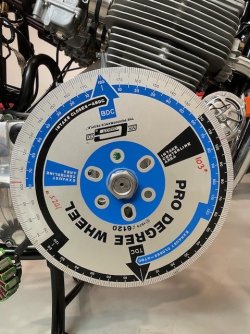
I Installed a piston stop to verify TDC. When timing cams first go around I used a dial gauge.
My new numbers are slightly different. Intake is still 103 degrees BTDC and exhaust is 102.5 degrees ATDC if I'm reading the timing wheel correcly. Picture below with timing marks in red.
I also repositioned the ignition rotor with the degree wheel at TDC to be certain its right.
I checked the crank phasing as well on no. 2 cylinder. Its bang on 180 degrees from TDC on no. 1 cylinder.
I disconnected the reguator to see if that made a difference but no luck. Same no start/ hard to start as before
There is spark on all 3 cylinders but to my untrained eye it looks a little weak. ( i'm not exactly sure what the spark should look like)
Coils are new Nology Profire. Spark looks the same on all 3 cyinders so very unlikley to be a problem with both coils.
I'm not sure what to try next.
Any other Ideas??
 

Attachments

  • timing wheel.jpg
    timing wheel.jpg
    124.9 KB · Views: 11
from across the room if not half a world away, can of ether, throttle wide open, spray a short squirt into all the carbies inlet, ie disconnect the inlet rubber couplings..not engine side of course, see you have pods, just spray the pod gauze. Perhaps a strong battery charger connected to the battery terminals while cranking, voltmeter on the ignition module +12V supply wire...crank away..... what happens? j *** no chokes at this stage, may have a choke issue as i ponder...
 
Last edited:
Hi Jon
I installed a new lithium battery( Shorai 315 CCA)
With a voltmeter hooked up 13.25 V at battery dropping to 11.75 V while cranking starter.
I sprayed the pods with quick start no choke and with the throttle wide open the engine started to backfire through the carbs.
I didnt want to hurt anthing so i quit after a couple tries.
I must have something wrong...

When i opened the tap on the remote fuel tank fuel started to come out of the overflow lines. I couldnt get it to stop by taping the float bowls or snapping the throttle open and closed , I had to remove the float bowl on the middle carb and tap the floats up and down to get it unstuck.
I've had this happen before on my 85 GSXR 750 which has the same Mikuni carbs but usally a couple taps is all it take to get the float un stuck.
Not sure if this is a common problem with the Mukini flat slides.
 
How clean is the tank? Remote chance, but might be worth pulling off the tank and removing the taps to inspect for gunk. Any tiny bit of crap under the float valve seat could cause leakage (and the risk of hydro lock and a bent rod or two!!).
 
Ok, anything above 11 volts battery sag on cold cranking is good, as mentioned, your are doing a good job and decisions all in all, somewhat unfortunate to have this condition, never the mind, it will sort with your good competencies and the gestalt here, a wry smile.

Backfire on cold cranking, that is something to note, mostly a condition associated with incorrect spark timing. More so on an overrich mixture, tend not to backfire unlike a leanout, which can be chronic, mostly unburnt fuel load igniting in the exhaust system. Rule out crossed ignition HT leads as it does run from my topic reading recall.

Overflowing RS carbs is a known suspect, if constant then the seat ( of the needle ) o ring is not functioning. Other lads will point out the thread pertaining to rectify this task, if the case.

Appears you have an incorrect spark timing for cold crank starts. Possibly Quentin can assist there with ignitech map rectification or corrupt lookup table file. Not sure that helps, basics will be the choice of champions in this chasing of the fox..i mean fault... smile, j
 
Ignitech files ...? Hmmm ...? Well, I have been well and truly in the mix with these in the last week or so. Jon has kindly been on the receiving end of some questioning, generous soul that he is.
To elaborate ... since getting the Q back running after its little piston meltdown last December, I've been struggling with an errant idle-bottom end running issue. I had managed to ride the bike on the street and running was good save sitting at lights, when I had to hold it up in the revs to avoid revs hunting, then dropping, then stalling (with a spit back).

All manner of faffing around with slow fuel mixtures had no effect. The problem seemed to be getting worse. What appeared to be a fouled plug causing the motor to drop onto one cylinder at idle to around 2500rpm was not at all a fouled plug. Raising the slides to increase idle speed would result in fluffing and popping on one cylinder. Running V96 Ignitech (file in pic #1 below) with base advance set to zero and rising to 6DBTDC from 500-1400rpm. To cut a long story short, I zeroed the degree wheel and put the strobe onto it. In most bizarre fashion, one cylinder was defaulting to around 45-50DBTDC whenever the popping and farting began; revving the motor had no effect (ie the advance figure remained the same on the strobe).

Tried a combo of two 'identical' backing plates and two TCPI4 units (the V96 and an unused V88). Always the same result, but bizarrely I would also see the anomalous advance on the other cylinder. Fuk, this is getting weird! Assuming the issue is with the sensor plate (Guzzi unit supplied by Ignitech with older style Hall Effect sensors and a rotor with cutout - looks like optical, but definitely is not). So I'm in the process of trying one of Red's Hall Effect sensor systems - in the post today.

Not wanting to waste a weekend, and recalling a conversation with Liam at Fast Bike Gear in NZ about the possibility of Ignitech files becoming corrupted, decided to try one of the old files (pic #2) I had in the unit back when I dyno'd the bike for the first time. Only fundamental diff I can see is that I've set base advance to 6DBTDC (I shifted the backing plate accordingly). Hit the starter button and the thing immediately settled into a perfectly smooth and consistent idle. This allowed me to complete my original task of fiddling with needles and slow fuel jets to try and cure the very slight low rpm stutter when opening the throttle. A leaner root diameter needle and two sizes up ion the slow fuel juts to compensate and I now have the sweetest idling and running motor I reckon I could wish for. Interesting feature of Keihin FCR carbs is that a needle's root diameter WILL affect throttle openings from closed to 1/8 ...

How an electronic system can go so awry and be so random in how that awryness manifests itself is beyond my feeble comprehension of this stuff, but it seems clear that the entire drama was software, and not hardware related. Maybe this saga could be of help to others - dunno.

PS the faint blue line in 6-deg base was one of my attempts to fix the discrepancy between left and right cylinder advance. Unsuccessful as it was. The second backing plate I'm now using is only out by half a degree - i can live with that.

Sorry - log story not so short!!
 

Attachments

  • Igni V96 0-deg base.jpg
    Igni V96 0-deg base.jpg
    100.2 KB · Views: 13
  • Igni V96 6-deg base.jpg
    Igni V96 6-deg base.jpg
    88.6 KB · Views: 13
Last edited:
As maybe not exactly germane to the topic, these are types of slotted Hall Effect sensors, some are ratiometric and others bistable.... not explain further other than to state i used Bosch HKZ101 around 1995, and thought them more trouble than worth, let alone the expense. Fabricated my own HE with success. Performance and reliability paramount, pricing was very good in quantity.

 
How an electronic system can go so awry
Any software engineers in the audience? I’d quite like to know too.
Could the firmware be corrupted due to changes in the power supply at a critical moment, perhaps at boot up? I would have thought a reboot would have fixed that. Could there be some influence from a bad component on the trigger board?
 
Any software engineers in the audience? I’d quite like to know too.
Could the firmware be corrupted due to changes in the power supply at a critical moment, perhaps at boot up? I would have thought a reboot would have fixed that. Could there be some influence from a bad component on the trigger board?
It gets odder and odder the deeper you go Andy. The successful hardware combo is all stuff that gave errant performance previously. No reboot of the V96 or the V88 boxes, just tried a previously successful file. I guess the 'old' trigger board might have had some component failure - but the one that was on the bike when I got the crazy advance with the strobe is still on it now. The vid tells the story in part (the end result). Hey is that mogtor running backwards!!??!! Just like the wagon wheels in the cowdy movies!
 

Attachments

Here is a simplified ignition control in software, 51 macro assembler..... the main code body is omitted for brevity, asking any software engineers out there, i did have giggle. Table corruption can be at compiling or a fail in transfer to target ( CRC is your friend ) or a corrupt cell(s) in the non volatile memory on hardware platform, worst is cross cell contamination.. nightmare to diagnose in the day. Modern coding would be High Level, real men code in assembler... class wars in the 70's to 80's. j
 

Attachments

Here is a simplified ignition control in software, 51 macro assembler..... the main code body is omitted for brevity, asking any software engineers out there, i did have giggle. Table corruption can be at compiling or a fail in transfer to target ( CRC is your friend ) or a corrupt cell(s) in the non volatile memory on hardware platform, worst is cross cell contamination.. nightmare to diagnose in the day. Modern coding would be High Level, real men code in assembler... class wars in the 70's to 80's. j

There is also the option of including assembler in-line with your C or C++ code (this worked for 8086, don't know about 8051). Although I don't think that my TAFE students enjoyed it as much as I did... Assembler can speed up code execution measurably.

cheers,

bazzee
 
Last edited:
Yes Bazzee your correct, and a coder also, 'mazing. Dem were da days. Modern processors running flat out to avoid implementing efficient code execution ( ie proc specific mnemonics ) , which i have to admit does work, the programs of today are dazzling to say the least, coding in assembler would not be possible, assembler had its place in the sun.

Glad to be part of it in the day. Did write code in C on a CP/M platform on home built/assembled S100 based 8086/8088 Godbout computer, 8" floppy drives. More a hardware person that had to learn coding. Did dable with Forth on embedded systems at one time, Mountain View product. Windriver systems another notable at the time. Clever folk in the day. Still have an Intel 4040 somewhere here, a 4 bit proc, similar age to the laverda company. Regards j.
 
Back
Top