Harsh Reality Pics - The Black Museum

That gets my vote as most likely.
Unfortunately, the solution is not that simple.

The previous owner drove about 7,000 km without changes / problems / repairs. he said that only the oil consumption was slightly increased.
Even the previous owner bevor him cannot remember any repairs.
You can trust the words of both pre-owners.

Yes, both inlet valves are struck that way.

I'll be back from Italy next week, then we'll be smarter after opening the engine.

I'm curious what the running surfaces of the rocker arms and the camshaft look like.

Thomas aus LAU
 
Last edited:
Yesterday we stood before the abyss, today we are one step further ...

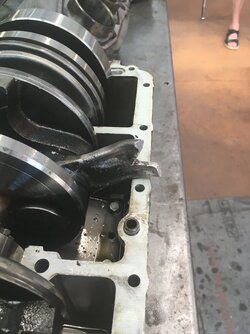
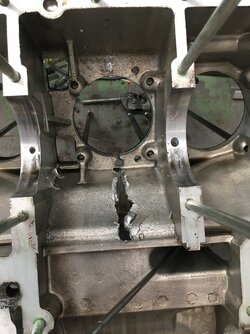
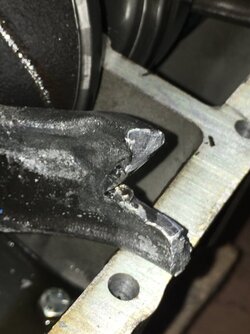
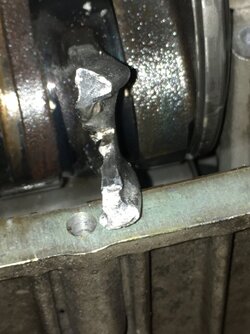
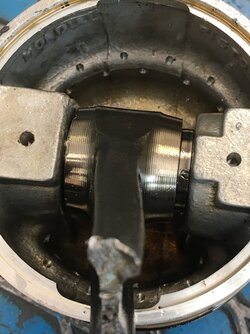
The middle connecting rod seems to have torn off at first as it is still moving normally in the bearing below.

The rest of the engine looks perfect, camshafts and gears don't show the slightest wear.

We will probably organize a different housing and a new crankshaft.
Afterwards we will weld the damaged housing (or have it welded) and repair the crankshaft.

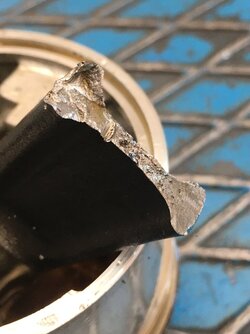
I still want to check the broken connecting rod with the microscope to see whether a fatigue break could have been the cause.
As soon as I have a result there will be an update.

1624992332513.jpeg 1624992231408.jpeg


Thomas aus LAU
 
Last edited:
Bloody hell.......how does that happen 😳
Where?
Test run on the lifting platform after a Mechanic in Breganze had the carburettors perfectly adjusted / renewed.

Why/how?
That‘s the question. Everything inside the motor looks perfekt.

It happened with the engine running, so an overflowing carburetor cannot be the cause.

This workshop already had 5 engines of the same type (120 degrees), where the middle connecting rod was always broken.

So that could be a fundamental mistake. We will check whether the connecting rod was centered on the cylinder / piston.

An investigation of the breakline may bring us further.

Thomas aus LAU
 
5 120 degree triples with rods broken in the same place ? That break looks like a tear originating from the outer edges.
I realise all the broken ones are roughly the same age too. You'd have to wonder about a harmonic specific to the 120's
Or a batch of rods poorly heat treated.
Worth crack testing the two sound rods IMO.
 
Me too, With some odd events over the years requiring crank work maybe 2 or 3 times, I opted to keep the std rods. The last time I was thinking this is the Universe shouting at me to add Carrillos and to Reds surprise I did. You sleep much better doing it.
 
........Or a batch of rods poorly heat treated.

I
If there had been a bad batch, why does it hit the middle cylinder more often? I myself used to be several times in the factory and watched the engine assembly.
That was certainly professional, but not surgical, but rather, let's say a bit “rustic”.
There was no “first in, first out” or KANBAN logistics.

I don't think aging is the reason as some of the "victims" ran <40,000 km. I think it must be because of the design of the crankshaft. This could be vibrations or the position of the middle connecting rod.

I will create a own thread and try to record how often connecting rods are really broken and at what position.
Everything anonymously if you wish.
If I possibly get other pictures, it will be seen whether this is systemic damage.

Thomas aus LAU
 
Ged at GCS told me the problems with snapped rods are mostly the later on bikes, he told me the rods are different and weaker. That's if my memory is still functioning correctly ha ha!
 
Hi Thomas, any update on the 750 valve tip issue?
Yes and no.

We dismantled the engine last Saturday. It was definitely not an oil shortage.

What we have:
- oil pump and oil chanels are perfect
- except for the left inlet valve that had some play, all other valve guides were absolutely free of play and optically great.
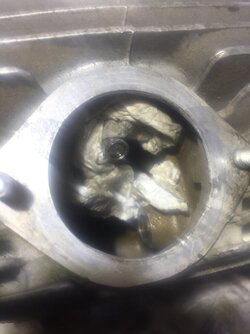
- both inlet valves were incorporated 1-1.5 mm deep, like a clean hole, outlet-valves hat only light marks.
-all inlet-valve ends were flared approx. 0.15 mm, outlet was only about 0,05 mm
- all valve seats and the counter surface on the valve plates still looked very good.
- all the nuts on the valve adjusting screws were original and ok
- all valve adjusting screws had flats or slight indentations
- the cams of the camshaft still look very good, there was definitely no lack of oil.
- the camshaft bearings are ok
- we could find no metal abrasion with a magnet in the oil or in the housing.
- the oil looked rather dark for the few kilometers
- original 80.0 Mondial pistons are installed.
- tThe pistons looked very good, minimal play to the cylinder, all machining marks were still fully visible, no tipping marks.

What wasn't ok:
- three different piston circlips were installed, one was a normal circlip.
- on the left the first piston ring was installed upside down
- the original oil control rings were not installed on both pistons. There are mounted other rings without an internal spring
- the piston pin bearings in the connecting rods have a very poor contact pattern and clearly too much play

Our only explanation for that damage:

The previous owner must have driven with significantly too much valve clearance and the correspondingly louder engine for a long time.

This weekend we are changing the piston pin bearings, we got the other spare parts this week in Breganze (thanks to Matthias and Fabio).

Thomas aus LAU
 
I think you will find the detached hardened tips of the valves in the bottom of the crankcase, you sound as though you were not going to open the bottom end, but maybe you now are.

When the valves were made years ago they were in three pieces, the head, the stem and the tip, they were rotationally fire/pressure welded together, if the hard tips come off, there is enough adjustment on the screw to get the gap right again, but the tips will wear and flare very fast, this happened to me, same big valve head.
CLEM
 
Thanks Thomas, so these are original steel valves with cast iron guides, or newer stainless valves?
99,9 % original. We knew the history of this bike for a very long time. Around 1975 to 1985 you had have enaugh Laverda-ddealers and payable spareparts = no reason to change to external parts.

The lower part of the motor (crankcase) seems unopend, each screw is the right one.

Thomas aus LAU
 
The SFC exhaust valves are quite distinctive, being (to quote Phil T) 'penny on a stick' with a flat surface (not concave as per inlets and other Laverda valves). i'm baffled at how those tips have self destructed - really has to have been a bad batch.
 
..... The noise was from the rhs of the head, but are both inlet valves in this state?
Yes, the louder „click, click,....“ came from the top of the right side. Both inlets where max. catastrophe. Both outlets where not good but had not so deep like drilled holes.

Inlet left:

1626501773405.jpeg (During grinding the ends so we can get the wided ends out of the head.)

Thomas aus LAU
 
Last edited:
The rear wheel of my SF2 had some play.

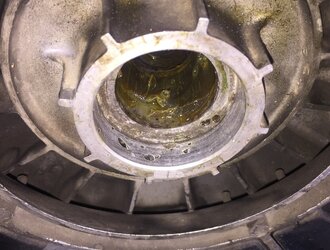
During the check today you could see, that the bearings are good, but the left side of the hub is a bit widened.
In addition, the casting quality is very poor (casting voids). Actually, it shouldn't have been used in that way in 1975 to build a new bike.
It´s not the first time i find such "crap" on a Laverda hub.

The problem can easily be solved with new bearings, Loctite 638 and an additionally shrunk-on steel ring.

Thomas aus LAU
 

Attachments

  • IMG_8910.JPG
    IMG_8910.JPG
    170.2 KB · Views: 31
Part 2 cracked connecting rod during a test run on the lift:

We have more photos.
The straight crack at the end of the connecting rod on the piston side appears to have appeared first.
The V-shaped crack at the other end on the crankshaft side is likely to have been caused by multiple impacts in the housing.
At the top left of the straight crack there is a darker discoloration that could indicate an older permanent crack.

What do you think?

Thomas aus LAU
 

Attachments

  • IMG_7845.JPG
    IMG_7845.JPG
    106.3 KB · Views: 46
  • IMG_7847.JPG
    IMG_7847.JPG
    121.2 KB · Views: 47
  • IMG_7849.JPG
    IMG_7849.JPG
    100.4 KB · Views: 48
  • IMG_7854.JPG
    IMG_7854.JPG
    139.5 KB · Views: 48
Back
Top