Head Gaskets

In the immortal phrase, I'm no engineer but.....I assume the spigot is there to do a job? Does it not offer protection to the gasket from combustion forces, and if so wouldn't it be a retrograde step to mill them off? Why are they not there on the 1200s, a good engineering reason ,or just not enough room perhaps? Yours in curiosity! ;)
 
nick7 said:
In the immortal phrase, I'm no engineer but.....I assume the spigot is there to do a job? Does it not offer protection to the gasket from combustion forces, and if so wouldn't it be a retrograde step to mill them off? Why are they not there on the 1200s, a good engineering reason ,or just not enough room perhaps? Yours in curiosity! ;)

My guess is the cylinder recess was an intentional Laverda design and matched to the OEM headgasket with the flame rings being .3mm thicker than the 1.0mm gasket material. Add the crush factor on the OEM steel flame rings installed and you are fine. With the later 1200 engines (and maybe some 1000s..there is no cylinder recess and a flat 1.0mm OEM headgasket was used. Over the years, headgaskets made aftermarket and sold were presumed to be all flat with the flame rings the same thickness as the gasket material..which is not the case.

I think the 1000 engines with the recess/thicker flame rings was just the Laverda engineering at the time, Laverda being careful about reliability. It is not necessary. I don't recall any motorcycle engine that used a cylinder recess/thick flame ring headgasket (anyone know?). The extra time/expense to machine the cylinder parts was thoughtful, but not needed.  A flat cylinder/head deck and flat headgasket works fine, engineering wise.

Just my non-engineering guess.
 
nick7 said:
In the immortal phrase, I'm no engineer but.....I assume the spigot is there to do a job? Does it not offer protection to the gasket from combustion forces, and if so wouldn't it be a retrograde step to mill them off? Why are they not there on the 1200s, a good engineering reason ,or just not enough room perhaps? Yours in curiosity! ;)

My Matchless G80CS uses a spigot on the liner and no head gasket.

My big bore G80CS has no flame ring and uses a solid copper head gasket. The liner lip fits flush.

However, a single cylinder probably suffers far less heat distortion and assymetric forces.

My old Ariel Square Four had no spigots (squishy head) but the liner lips were meant to stand proud 10 thou in order to prevent the liners moving ! They used composite material with copper flame ring that crushed significantly into the asbestos substrate.

Maybe the magic was the asbestos ?
 
Rusty Spokes said:
My guess is the cylinder recess was an intentional Laverda design and matched to the OEM headgasket with the flame rings being .3mm thicker than the 1.0mm gasket material. Add the crush factor on the OEM steel flame rings installed and you are fine. With the later 1200 engines (and maybe some 1000s..there is no cylinder recess and a flat 1.0mm OEM headgasket was used. Over the years, headgaskets made aftermarket and sold were presumed to be all flat with the flame rings the same thickness as the gasket material..which is not the case.

I think the 1000 engines with the recess/thicker flame rings was just the Laverda engineering at the time, Laverda being careful about reliability. It is not necessary. I don't recall any motorcycle engine that used a cylinder recess/thick flame ring headgasket (anyone know?). The extra time/expense to machine the cylinder parts was thoughtful, but not needed.  A flat cylinder/head deck and flat headgasket works fine, engineering wise.

Just my non-engineering guess.

Not as simple as that...

All Laverda triples used the very same head gasket for the duration of production.

Wasn't any "extra" machining necessary, it was just the way they did it and the way the gasket worked.  My guess is the method allowed greater initial production tolerances, so in the end, it was easier/quicker/cheaper to do it this way.  Same for 1000 and 1200 versions.  Problems started arising after the engines had gone through 1000's of heat cycles and the alloy barrels started to shrink, letting the liners protrude slightly(these will NOT shrink).  We all know what a weeping triple(and twin) head looks like, with the oil dribble over the side panels...  The gaskets were not able to compensate this, as the flame ring was too thick to let the remainder of the gasket to seal the remaining surface properly.  The sealing of the combustion chamber was OK, no issues there, but no number of gasket renewals would stop the dribble.  That's where the recessing of the liners became necessary once more, just to accomodate the thicker flame rings and to keep the oil in where it belonged.

So we are now back at sqare #1, assessing what is needed and having to make do with what is available.  No big deal really...

The spigot is an integral part of the initial design, nothing unusual, lots of other engines that are quite similar.  It disappeared when the bore was opened up to 80mm, the limiting factor being the size of the combustion chamber, as the factory probably didn't want to produce another head especially for the "1200".  Had the chamber been larger from the on-set, the transformation would surely have brought about a few more cubes instead of the 1140-odd that it ended up with!

piet

 
sfcpiet said:
TCS?

piet

Not a TCS.

Just a G80CS motor (Norton oil pump model) with Jawa speedway flywheels, G50 rod and piston ... and a Blue Magnum 36mm carb. This one is going into a Norton P11 chassis (poor man's G85CS) when I finish my 750 GT.
 
Basketcase said:
Not a TCS.

Just a G80CS motor (Norton oil pump model) with Jawa speedway flywheels, G50 rod and piston ... and a Blue Magnum 36mm carb. This one is going into a Norton P11 chassis (poor man's G85CS) when I finish my 750 GT.

Sounds nice! :D

piet (hijack)

About time to turn to more interesting things...

 
Not really a hijack.

The G80TCS used the same barrel and liner as the G80CS but with a 89mm bore as opposed to 86.

They kept the same liner spigot with same OD 92mm for the same head.

So on the first oversize, the spigot thickness was barely more than 1mm thick given tolerances and was prone to breaking.

Also, I suspect that if the thin spigot was not in close thermal contact with the head (alloy counterbore) then it would get hot spots and be prone to detonation.

I suspect Laverda faced the same spigot issues with the 1200 and so omitted them.

 
But why have a spigot at all if it can just be dispensed with at will? Does it not have a function? To the untrained eye it looks like a good idea.....Piet, you say it was simply part of the initial design, but why would the designer design it that way if not for a purpose?
 
nick7 said:
But why have a spigot at all if it can just be dispensed with at will? Does it not have a function? To the untrained eye it looks like a good idea.....Piet, you say it was simply part of the initial design, but why would the designer design it that way if not for a purpose?

It cannot be dispensed with at will, the bore must suit the combustion chamber diameter.  Not much good having a "ring" of gas burning off without exerting pressure upon the piston crown.

Mill off the spigot on a 1000, the piston will protrude above the barrel deck and said gas ring will result around the outside of the piston, sure to make all sorts of trouble like irregular burning or hot spots as Basketcase described.  Shorten the piston so it no longer clears the deck, you'll end up with a compression ratio of about 6.5:1, quite OK if you only have 80 octane fuel to your disposal... but the useless ring remains. :D 

The spigot actually takes up quite a large part of the combustion pressure that would otherwise be exerted on the gasket edge, be it necessary or not.  But Laverda probably included it for the sake of long-term reliability with high-compression engines.

piet
 
Sorry for the delayed response, I had some work out of town with the BBC that came in at late notice right after Phillip Island Races.

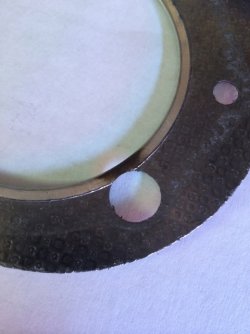
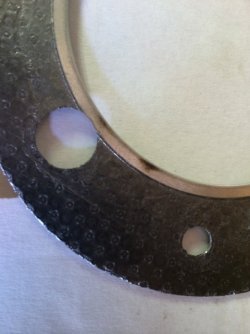
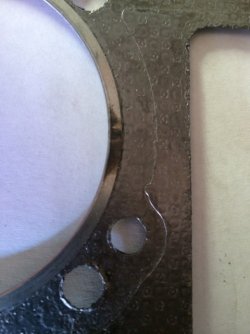
Here's some photos of the blow-by problem after less than 7kms.
 

Attachments

  • DAM Laverda 2630.jpg
    DAM Laverda 2630.jpg
    71.6 KB · Views: 23
  • DAM Laverda 2632.jpg
    DAM Laverda 2632.jpg
    71.8 KB · Views: 17
  • DAM Laverda2631.jpg
    DAM Laverda2631.jpg
    73.4 KB · Views: 15
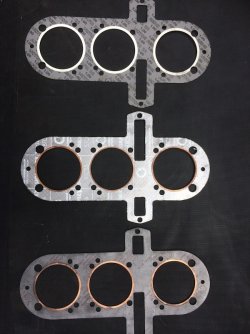
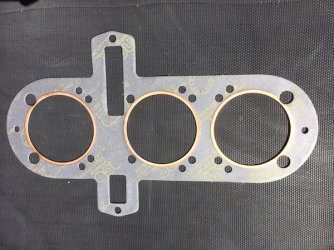
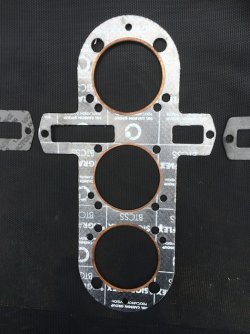
Here is a selection of head gaskets types and brands I had at hand or that were sent to me. (thanks everyone!)
 

Attachments

  • DAM Laverda 2592.jpg
    DAM Laverda 2592.jpg
    164.8 KB · Views: 60
This is the one I chose and, although a bit rough in appearance, would be my preference if I could get more of them.

Anyone recognise the brand?

It has copper (non-magnetic) flame rings and had the greatest difference in thickness on flame ring to gasket of greater than +.2 mm. The bike ran all weekend without a re-tension and without any head gasket problems.
 

Attachments

  • DAM Laverda 2594c.jpg
    DAM Laverda 2594c.jpg
    137.7 KB · Views: 81
What sealant (if any) do the experienced engine builders use on head gaskets? Do you smear it all over or just around the cam chain tunnel and oil ways?

Also, I need to buy some Viton O-rings for the head joint. I've seen a couple of references to the size: One source says BS013. 7/16" (11mm) ID x 1/8" (1.6mm). Another source (parts list) says  DR2043 (10.8 mm ID x 1.8 mm thick). Only real difference is the thickness, so I don't suppose it really matters as long as they are somewhere close to that size range. One will squash a bit more than the other.

Cam
 
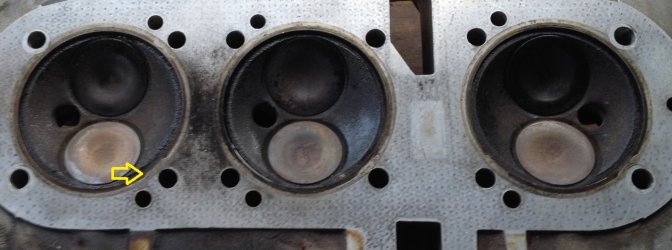
I took my Jota's head in to a head shop recommended by a local bike mechanic. The bloke said he can give it a very light skim (one thou at a time).

However, he asked what was going on around the head stud holes. I had no idea. The alloy appears to have been deformed where it compresses the flame ring near the stud holes. Check out the area indicated by the yellow arrow in the attached photo. It's the same around a couple of other stud holes.

Has anyone ever seen this kind of damage before or have any clue what the cause is?

Cam
 

Attachments

  • head3.jpg
    head3.jpg
    193.8 KB · Views: 115
Hi Cam I believe the thickness of those O rings is a little more critcal than you think I believe the thinner ones I think 11mm fit in the recess better the thicker ones you quoted can sometimes bulge out of the gasket and bingo leaky joint, if you are stuck I can get some for you locally.
 
Thanks Maurice. No problem getting them locally. I've ordered a handful of the BS013 (thinner ones) in Viton. The local bearing shop said they're showing over 500 in stock in their warehouse. They'll have them here for me tomorrow.
 
Dellortoman said:
I took my Jota's head in to a head shop recommended by a local bike mechanic. The bloke said he can give it a very light skim (one thou at a time).

However, he asked what was going on around the head stud holes. I had no idea. The alloy appears to have been deformed where it compresses the flame ring near the stud holes. Check out the area indicated by the yellow arrow in the attached photo. It's the same around a couple of other stud holes.

Has anyone ever seen this kind of damage before or have any clue what the cause is?

Cam

Hi Cam my spare head is like yours, Not sure if I would call it damage, thought it was just where alloy met the cast skull.

ps thanks for giving me something else to worry about  :(

                                                    Dave
 
Back
Top