Hello all - Newbie Laverda owner

SFJOTA said:
So JO55; all's well with the bike then!? I am most interested, as this sounds quite familiar. (I am also owner of a '79 JOTA.)

Not to hijack your thread, but i experience similar problems challenges with it. Bike is unwilling to rev in upper ranges, though not intermittent. I checked plugs and they are quite sooty, so i suspect too rich a mixture. Haven't come round to lowering throttle needles a notch yet.

Yet I suspect your findings to be correct, and your problem an ignition one, due to the intermittent nature of it.

BTW; My Laverda mechanic (quite knowledgable and well known) fitted ND W27ESU's to both my SF and JOTA. However, I had to replace them with NGK B8ES both times, as the too rich a mixture knackered the ND's. (yes I know; due to the too rich a mixture)

However; lowering the needles and fitting NGK's made quite a difference to my SF; the running bettered hugely...

Sorry for all these ramblings, but I though sharing these might be of benefit to you in the future.  Best regards, J.
Hi, not a problem. Always interested in hearing of others with similar woes. When mine runs well, it does rev out cleanly, so I suspect a different issue. I must support Shurminators findings on the Denso plugs, they made an instant difference. That said, there seem to be a lot of NGK counterfeit plugs around, so many that it's hard to trust any source. Mine is running what I believe to be std jetting - 145 mains and 55 pilots. It  currently has the std airbox, but running with no filter. That is soon to change as I'm not a fan of running filter-less.

I'm pretty convinced now that mine is ignition based, especially as it appears to be the centre cylinder that is suffering and it runs separately to the outer 2.
 
Ah!

I seem to recall from Tim Parkers book (check; P. 113) it seems like there's 2 seperate ignition pickups.

Could be one faulty, due to brittle wiring? But you'll need that puller.  :-X

Please check for correctness, prior to taking action. Can someone corroborate my assumption?

Best regards, J.
 
SFJOTA said:
Ah!

I seem to recall from Tim Parkers book (check; P. 113) it seems like there's 2 seperate ignition pickups.

Could be one faulty, due to brittle wiring? But you'll need that puller.  :-X

Please check for correctness, prior to taking action. Can someone corroborate my assumption?

Best regards, J.

That's entirely my thoughts. I've veered away from it, due to being my least favourite/knowledgeable area and use of special tools, but think now I need to bite the bullet and get me a strobe and puller!
 
Sir Sidney Ruffdiamond said:
Interesting vid on fake NGK plugs

https://www.youtube.com/watch?v=2F9Cs-Bd8-U&t=63s
Yes, there's a lot around about fake NGK plugs, less so Denso, hence my reckoning that I have a better chance of striking lucky. They were noticeably better immediately, and my less ham-fisted efforts with the choke on start up no doubt helped.

Cheers,

Julian
 
CLEMTOG said:
its BTZ right?
try this
look under the seat near the battery and electrics metal work for two very short wires coming out of the loom, only about an inch long and both these two wires terminated in a common brass ring, this is the earth connection for BOTH of the ignition boxes, the wires cross a sharp metal edge (very often not always) and the metal can "cut" a notch in the underside of the cable giving an intermittent earth, when on closer examination you may find one or even both of those short wires have parted company with the brass ring, but you haven't lost the earth, you just got a bad and intermittent one.

if you do find this (that would be a great wouldn't it?) then snip the wires clean, solder a three inch extension onto each one, and then put a separate brass ring on each, and then refix them both to the frame tab, much safer, much less stress, and more likely (in the end) to only fail on one side.
CLEM

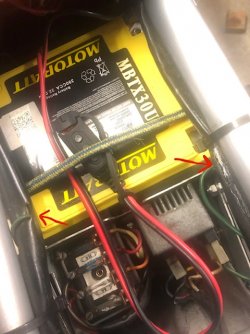
Hi Clem, are these the wires you mean ...

If so, both are attached securely and unfortunately look intact along their length (I was hoping that would be it). I'm pretty sure now that it's a pick up on the ignition - the one that services the middle cylinder. There was a strong spark on checking it today, then there wasn't. This was after trying several plugs. I'm thinking this is the intermittent fault I have.
Something on the ignition side for cylinder 2 is failing from time to time.
 

Attachments

  • Jota ignition earths.jpg
    Jota ignition earths.jpg
    94.2 KB · Views: 125
I haven't gone back through this entire thread, so I dunno what tests you've done. Apologies if I'm covering old territory.

Yes, SFJOTA is correct - two pickups and two ignition circuits. One for the centre cylinder and one for the outer two cylinders which fire the spark plugs together.

An intermittent fault on one of the circuits (in this case the centre one) could be anywhere in that ignition circuit from where the power supply and earth wires divide to the individual BTZ boxes. So it could be pickup, BTZ ignition box, coil, HT lead, spark plug cap or spark plug, or any of the wiring between them.

Just approach it logically and you'll get there. A handy diagnostic tool is to swap components between ignition circuits and see whether the fault follows a component. Try swapping the BTZ boxes over. If the centre plug fires reliably and the outer two become faulty, there's your diagnosis. You don't have to un-bolt the boxes to swap them, just un-plug the multi-pin connectors and plug them into the other boxes.

Also try swapping spark plugs and plug caps around.

Another handy trick is to start the bike in the dark and have a good look around the coils, HT leads, plug caps and plugs. If you see any arcing, then there's a problem. The high voltage current is tracking on the outside of a component and jumping to earth. Can happen if insulation on the HT leads or plug caps has deteriorated.

It's not possible to swap coils because they're different (one is a double coil and the other is single) but you can test the primary circuit resistance with a multi-meter. Should be 3 to 5 Ohms depending on the type of coil. The high voltage side of the coil has a much higher resistance of several thousand ohms (typically 6,000 - 10,000) but an open circuit reading on the meter is not necessarily definitive. Coils that test as open circuit on the secondary can often still work OK because the high voltage can jump gaps (as it does in the spark plug).

Before pulling the alternator rotor off, check the resistance of the pickups. Again, my memory is a bit hazy, but something like 50 Ohms rings a bell (someone will be able to confirm). Best way to do that is to un-plug the harness from the BTZ boxes and put a meter probe on the pickup wire with the other probe earthed somewhere. Doing it that way will also show up a problem with the pickup wire.

If you end up having to remove the alternator rotor (borrow a puller if you don't have one - I'd lend you mine but there's gotta be someone closer to Cornwall than Tasmania!), there's a range of diagnostic tests you can do.

Firstly, visually check the insulation on the wires to each pickup. You can also check the insulation with a meter. Repeat the pickup resistance test while jiggling the wires a little bit at the pickup end. If you get an intermittent change of resistance, it could indicate poor insulation.

As for swapping pickups (to see if the fault follows a pickup), it's been a while since I looked at an original pickup plate, but if I recall correctly, it's not possible to un-bolt the pickups and swap them over. You can however swap their functions if you feel like a bit more of a fiddle. Mark the position of the 2-lobe rotor on the end of the crank so you can put it back in its original position, loosen the rotor (I think there's a couple of grub screws holding it in place) rotate it 90? and tighten it up again. Then swap the pickup wires at the ignition boxes. The engine will run, but the pickups will be firing the opposite ignition circuits. Note that with a BTZ ignition system you don't need to replace the alternator rotor to start the engine. You can test run it OK with the rotor off. (Earlier HKZ system is different, and won't run with the alternator rotor removed).

That should be enough to keep you busy for a while  :D
 
Dellortoman said:
I haven't gone back through this entire thread, so I dunno what tests you've done. Apologies if I'm covering old territory.

Yes, SFJOTA is correct - two pickups and two ignition circuits. One for the centre cylinder and one for the outer two cylinders which fire the spark plugs together.

An intermittent fault on one of the circuits (in this case the centre one) could be anywhere in that ignition circuit from where the power supply and earth wires divide to the individual BTZ boxes. So it could be pickup, BTZ ignition box, coil, HT lead, spark plug cap or spark plug, or any of the wiring between them.

Just approach it logically and you'll get there. A handy diagnostic tool is to swap components between ignition circuits and see whether the fault follows a component. Try swapping the BTZ boxes over. If the centre plug fires reliably and the outer two become faulty, there's your diagnosis. You don't have to un-bolt the boxes to swap them, just un-plug the multi-pin connectors and plug them into the other boxes.

Also try swapping spark plugs and plug caps around.

Another handy trick is to start the bike in the dark and have a good look around the coils, HT leads, plug caps and plugs. If you see any arcing, then there's a problem. The high voltage current is tracking on the outside of a component and jumping to earth. Can happen if insulation on the HT leads or plug caps has deteriorated.

It's not possible to swap coils because they're different (one is a double coil and the other is single) but you can test the primary circuit resistance with a multi-meter. Should be 3 to 5 Ohms depending on the type of coil. The high voltage side of the coil has a much higher resistance of several thousand ohms (typically 6,000 - 10,000) but an open circuit reading on the meter is not necessarily definitive. Coils that test as open circuit on the secondary can often still work OK because the high voltage can jump gaps (as it does in the spark plug).

Before pulling the alternator rotor off, check the resistance of the pickups. Again, my memory is a bit hazy, but something like 50 Ohms rings a bell (someone will be able to confirm). Best way to do that is to un-plug the harness from the BTZ boxes and put a meter probe on the pickup wire with the other probe earthed somewhere. Doing it that way will also show up a problem with the pickup wire.

If you end up having to remove the alternator rotor (borrow a puller if you don't have one - I'd lend you mine but there's gotta be someone closer to Cornwall than Tasmania!), there's a range of diagnostic tests you can do.

Firstly, visually check the insulation on the wires to each pickup. You can also check the insulation with a meter. Repeat the pickup resistance test while jiggling the wires a little bit at the pickup end. If you get an intermittent change of resistance, it could indicate poor insulation.

As for swapping pickups (to see if the fault follows a pickup), it's been a while since I looked at an original pickup plate, but if I recall correctly, it's not possible to un-bolt the pickups and swap them over. You can however swap their functions if you feel like a bit more of a fiddle. Mark the position of the 2-lobe rotor on the end of the crank so you can put it back in its original position, loosen the rotor (I think there's a couple of grub screws holding it in place) rotate it 90? and tighten it up again. Then swap the pickup wires at the ignition boxes. The engine will run, but the pickups will be firing the opposite ignition circuits. Note that with a BTZ ignition system you don't need to replace the alternator rotor to start the engine. You can test run it OK with the rotor off. (Earlier HKZ system is different, and won't run with the alternator rotor removed).

That should be enough to keep you busy for a while  :D

Wow, so much great info, thanks!

Yes, being honest, I've looked at what I'm more familiar with and ignition systems are black magic as far as I'm concerned. I've done the whole swapping plugs and caps thing, which in itself gave me some red herrings. I now believe that there is something on that centre cylinder circuit, so this will give me plenty to check. I was unaware the BTZ boxes were the same and swappable.

Lots to do now. Hopefully I won't need an express delivery from Tasmania!

Thanks again, I really appreciate it.

Julian
 
your picture of the earths is not what I remember, so may not be what I refer to, remove the side panel and on the right side is a "tag" under the frame tube with a ring terminal that has two wires crimped to it, and is very short, maybe an inch from the loom. If that does not throw up something then the generator must come off, but first!!!!!!! the ignition goes through the fuses, and modern torpedo fuses are crap, it took me years to find a problem that was nothing more than those bleeding fuses, I changed the carrier to a modern blade type system and never looked back, so remove each fuse, and clean the carrier ends and the fuse ends, carefully and then re-insert, being sure that there is adequate soring tension and that the end in the brass cast fitting is located in the tiny dimple, might be worth buying new fuses, they are pennies, and that is part of the problem if they made and sold them for two quid each they would probably be OK.

Where are you? I have pullers available, Cornwall is a big place, you might be on the edge, I am in Kent and on the Surrey/Sussex edge.
still a fair way.

CLEM
 
CLEMTOG said:
your picture of the earths is not what I remember, so may not be what I refer to, remove the side panel and on the right side is a "tag" under the frame tube with a ring terminal that has two wires crimped to it, and is very short, maybe an inch from the loom. If that does not throw up something then the generator must come off, but first!!!!!!! the ignition goes through the fuses, and modern torpedo fuses are crap, it took me years to find a problem that was nothing more than those bleeding fuses, I changed the carrier to a modern blade type system and never looked back, so remove each fuse, and clean the carrier ends and the fuse ends, carefully and then re-insert, being sure that there is adequate soring tension and that the end in the brass cast fitting is located in the tiny dimple, might be worth buying new fuses, they are pennies, and that is part of the problem if they made and sold them for two quid each they would probably be OK.

Where are you? I have pullers available, Cornwall is a big place, you might be on the edge, I am in Kent and on the Surrey/Sussex edge.
still a fair way.

CLEM
Clem, I suppose it's possible that it's been reconfigured at some point in that area.

The fuses are something to consider. My focus for now is to get her running right for the summer and then to upgrade and improve during the winter months (I like to feel that I've earned the right to be a fair weather biker now and so has the old Jota!).

I've tried and no matter how much I try and stretch it, I can't make the boundaries of our great counties meet.
 
I had a similar problem on my 3C (or was it the Mirage.. ??? ) and it turned out to be a 'dry' connection between the coil and the HT lead. Took it to a specialist to have a new copper cored HT lead 'sweated' in: problem solved. I think someone on here suggested/identified the problem about 5-6 years ago..

AndyW 8) 8)
 
A cub about to learn something or two about Breganzie's - Welcome to the Lion's Den ;o)
48734456837_7c37019dc5_b.jpg


Do not let any so called Breganzie callers or rivet counter say you can not modify a Breganzie to suite your means or stature - Breganzies were designed for it. She will be apart on your wife's kitchen table sooner or later - And that's what makes a Breganzie so special, a hands on racer - Something your wife will never understand other then that dam bike will surely kill you. Hopefully you know your wife as well as your Breganzie ;o)

A Breganzie is not exactingly an easy bike to ride as she would sooner fall over when parked.

The point is she's is Cafe such that if want to turn right under dourest in a high speed corner you hit the handle bar left (High Siding her) and shift your weight off the seat and drag your knee on the asphalt with your toes on the end of the pegs with a finger on the throttle. 

Your so far off the bike you see the suspension bury, trusting your tires will not burn out.

Yet to find a better performance tire then the old Perilli 18" Rayon Radial Belted Phantoms for our Breganzie's. Sadly Perilli  don't make them any more.

Bridgstone Battle Axe Bias aren't bad but are not near as good. I'm saying 120 back and 100 front with the Phantoms but being forced to go with 130 back and 110 front with Bridgestone are NOT on par. Your probably better of with Avons or Metzler 110 on back and 90's on front. The bike just becomes too cantankerous to roll over with wider tires. You have too consider the tire must fit a 2.75" Barroni 18" spoke rim. Bias 110 over 90 Dunlop's may work ?

When the Perilli Rayon Radial 120 back an 100 front 18" Phantom disappeared, I ran into serious issues racing my Breganzie.

Basically, it all runs to just how fast do want that Breganzie to run and for how long - Kept my 70 750 SFO on the road for over 45 years ? Off course I've melted pistons and tore her apart numerous times and torched her to death to death in a race but I never fell out of love with her because she was a race winner. If you just want a road cruiser, I think you will better for reliability ;o)

By the way, I love KTM.
 
AndyW said:
I had a similar problem on my 3C (or was it the Mirage.. ??? ) and it turned out to be a 'dry' connection between the coil and the HT lead. Took it to a specialist to have a new copper cored HT lead 'sweated' in: problem solved. I think someone on here suggested/identified the problem about 5-6 years ago..

AndyW 8) 8)
Thanks Andy, I got your message and replied earlier.

Hope you got it.

Julian
 
Laverda SF said:
A cub about to learn something or two about Breganzie's - Welcome to the Lion's Den ;o)
48734456837_7c37019dc5_b.jpg


Do not let any so called Breganzie callers or rivet counter say you can not modify a Breganzie to suite your means or stature - Breganzies were designed for it. She will be apart on your wife's kitchen table sooner or later - And that's what makes a Breganzie so special, a hands on racer - Something your wife will never understand other then that dam bike will surely kill you. Hopefully you know your wife as well as your Breganzie ;o)

A Breganzie is not exactingly an easy bike to ride as she would sooner fall over when parked.

The point is she's is Cafe such that if want to turn right under dourest in a high speed corner you hit the handle bar left (High Siding her) and shift your weight off the seat and drag your knee on the asphalt with your toes on the end of the pegs with a finger on the throttle. 

Your so far off the bike you see the suspension bury, trusting your tires will not burn out.

Yet to find a better performance tire then the old Perilli 18" Rayon Radial Belted Phantoms for our Breganzie's. Sadly Perilli  don't make them any more.

Bridgstone Battle Axe Bias aren't bad but are not near as good. I'm saying 120 back and 100 front with the Phantoms but being forced to go with 130 back and 110 front with Bridgestone are NOT on par. Your probably better of with Avons or Metzler 110 on back and 90's on front. The bike just becomes too cantankerous to roll over with wider tires. You have too consider the tire must fit a 2.75" Barroni 18" spoke rim. Bias 110 over 90 Dunlop's may work ?

When the Perilli Rayon Radial 120 back an 100 front 18" Phantom disappeared, I ran into serious issues racing my Breganzie.

Basically, it all runs to just how fast do want that Breganzie to run and for how long - Kept my 70 750 SFO on the road for over 45 years ? Off course I've melted pistons and tore her apart numerous times and torched her to death to death in a race but I never fell out of love with her because she was a race winner. If you just want a road cruiser, I think you will better for reliability ;o)

By the way, I love KTM.
Thank you for the welcome.

Some sage advice there. I look forward to stretching the legs of mine once she is sorted!
 
Dellortoman said:
I haven't gone back through this entire thread, so I dunno what tests you've done. Apologies if I'm covering old territory.

Yes, SFJOTA is correct - two pickups and two ignition circuits. One for the centre cylinder and one for the outer two cylinders which fire the spark plugs together.

An intermittent fault on one of the circuits (in this case the centre one) could be anywhere in that ignition circuit from where the power supply and earth wires divide to the individual BTZ boxes. So it could be pickup, BTZ ignition box, coil, HT lead, spark plug cap or spark plug, or any of the wiring between them.

Just approach it logically and you'll get there. A handy diagnostic tool is to swap components between ignition circuits and see whether the fault follows a component. Try swapping the BTZ boxes over. If the centre plug fires reliably and the outer two become faulty, there's your diagnosis. You don't have to un-bolt the boxes to swap them, just un-plug the multi-pin connectors and plug them into the other boxes.

Also try swapping spark plugs and plug caps around.

Another handy trick is to start the bike in the dark and have a good look around the coils, HT leads, plug caps and plugs. If you see any arcing, then there's a problem. The high voltage current is tracking on the outside of a component and jumping to earth. Can happen if insulation on the HT leads or plug caps has deteriorated.

It's not possible to swap coils because they're different (one is a double coil and the other is single) but you can test the primary circuit resistance with a multi-meter. Should be 3 to 5 Ohms depending on the type of coil. The high voltage side of the coil has a much higher resistance of several thousand ohms (typically 6,000 - 10,000) but an open circuit reading on the meter is not necessarily definitive. Coils that test as open circuit on the secondary can often still work OK because the high voltage can jump gaps (as it does in the spark plug).

Before pulling the alternator rotor off, check the resistance of the pickups. Again, my memory is a bit hazy, but something like 50 Ohms rings a bell (someone will be able to confirm). Best way to do that is to un-plug the harness from the BTZ boxes and put a meter probe on the pickup wire with the other probe earthed somewhere. Doing it that way will also show up a problem with the pickup wire.

If you end up having to remove the alternator rotor (borrow a puller if you don't have one - I'd lend you mine but there's gotta be someone closer to Cornwall than Tasmania!), there's a range of diagnostic tests you can do.

Firstly, visually check the insulation on the wires to each pickup. You can also check the insulation with a meter. Repeat the pickup resistance test while jiggling the wires a little bit at the pickup end. If you get an intermittent change of resistance, it could indicate poor insulation.

As for swapping pickups (to see if the fault follows a pickup), it's been a while since I looked at an original pickup plate, but if I recall correctly, it's not possible to un-bolt the pickups and swap them over. You can however swap their functions if you feel like a bit more of a fiddle. Mark the position of the 2-lobe rotor on the end of the crank so you can put it back in its original position, loosen the rotor (I think there's a couple of grub screws holding it in place) rotate it 90? and tighten it up again. Then swap the pickup wires at the ignition boxes. The engine will run, but the pickups will be firing the opposite ignition circuits. Note that with a BTZ ignition system you don't need to replace the alternator rotor to start the engine. You can test run it OK with the rotor off. (Earlier HKZ system is different, and won't run with the alternator rotor removed).

That should be enough to keep you busy for a while  :D

RESULT!!

I started with the coils today, HV Side came out at 10500 ohms for the single central cylinder coil, the other, out cyl coil recorded as open circuit. But, like you said, that doesn't necessarily mean it's faulty.
LV Side - both coils recorded 4.5 Ohms, pretty much exactly as you said. Next ...
Bosch Units - swapped the block connectors over to their opposite number - Centre cylinder only is firing.
swap them back - outer cylinders only are firing ... RESULT!

I'm guessing that there is nothing else up stream that could have caused this and it's pretty definitive that it's the pesky BTZ box? That said, I don't know which one serves which coil, but that's by the by.

That leaves me with a dilema, but only a slight one. Many guys on here have strongly recommended getting my hands on an aftermarket ignition. That said, my goal for now is to make her ride-able in the easiest and quickest way possible, so that I can enjoy the remainder of the summer in the UK.
I'd happily do this if we were looking at c.?200-300 (?) and I could fit it easily myself as I'm not sure of the nearest specialist Lav guy to Cornwall?

Failing this, there's the simple (I assume) option of buying a new BTZ box so that I can plug and play - literally.

Any thoughts on the best way to proceed, and where to buy what I need?

I can't thank the guys on here enough for the advice, it's been fantastic and not even that much piss taking! Cheers all!!
 
KERMIT1200 said:
Hi ,
For the BTZ box try Alan Bell -

ring-a-ding@hotmail.com

Andy
Cheers Andy,
I've had an offer from a local chap who has one to try/buy. i will try Alan if it doesn't work out.
 
I've given away more BTZ boxes than I can remember. I still have 3 left. They're on my Benelli 900 Sei.
I think some people actually sell them, but as far as I'm concerned they're not worth much so I'd feel like a thief if I accepted money for them.
 
Back
Top