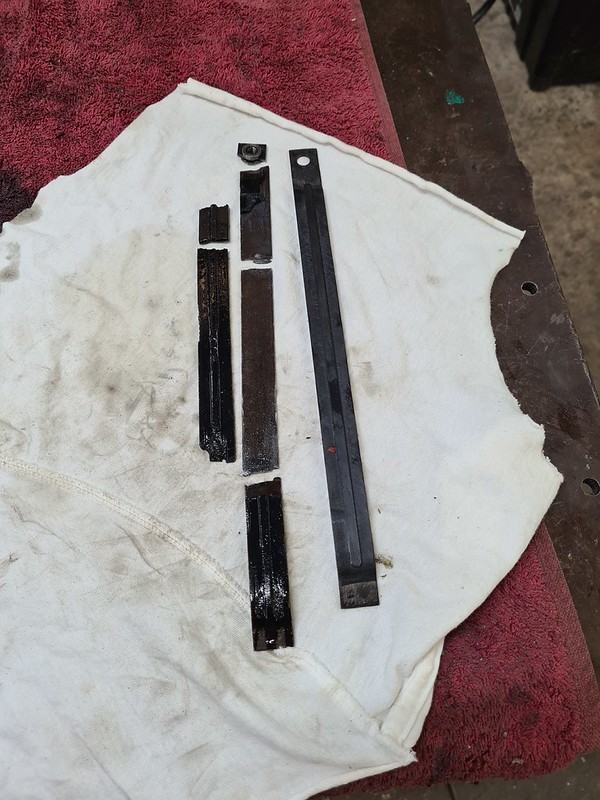
How is the lining added to the cam chain tensioner blade

If you are going to make heavy duty tensioners to combat breakage and are just worried about how to adhere the rubber lining to the blade , would it be possible to forget the lining and have the blades PTFE Teflon coated instead (or something similar) ?
With a race engine a top end inspection at regular intervals would keep an eye on how things are getting on.
I take it that it`s the tensioned blade at the rear that is breaking up , not the static one at the front. ( Yes I see it is).
Makes me wonder if it would be possible to junk the tensioner blade altogether . Whenever I fitted a new (Regina) camchain , play between the sprockets was always on the tight side if anything , so the tensioner never came into play , the adjuster bolt just tightened enough so the roller just made contact with the blade and no more.
I know the blade acts as a guide as well as a tensioner , and the distance between cam and crank sprockets would produce more chain free play than between the two cam sprockets at the top and cause fluctuation with no blade to dampen it down , but wonder if a new camchain fitted each time the engine is used in anger would keep this to a minimum , providing there is enough clearance within the camchain tunnel to accommodate this extra movement .
Actually thinking about it again , with a final drive chain under load , the top run between gearbox and rear wheel sprockets is kept in tension , whilst the lower run is going to fluctuate , so with the camchain run at the front between the crank sprocket and cam sprocket being the one under load , then the run at the rear is most likely to suffer near terminal fluctuation with no blade fitted , so maybe not such a good idea after all .
not certain on the PTFE coating question, looking at a couple of options right now

we service both race engines after every meeting, check shim clearance, check head torque, change oil, change gearing for next track, fix any other issues that have appeared over the weekend, fire them up and check carb balance, etc
constantly working on them

not possible to junk the blade, what you see on your engine with a standard thickness cylinder head and barrel is far from what we have in play now, running these engines they way we do with the horsepower we are making we have an issue with cylinder heads warping, is an ongoing issue so what we find is that every season we race the compression ratio rises as we have to keep skimming the cylinder head to get them to seal
That means two things, one we have loose cam chain runs due to decreasing dimensional issues which we counter to a point with offset billet cam blocks and thicker head and base gaskets but on the Mule for example she is down that far now that we are at 13.8:1 CR currently and still have a loose cam chain run so need that blade in play
 
Hi Red. Thinking aloud...
52019392079_9e8af7c94f.jpg
Did something very similar in the off season before we went to Mount Gambier
Last race meeting last year at Broadford the 2nd bike broke her cam chain blade and debris went through and lunched the engine, cost me 4 crank webs, 3 conrods, 3 pistons, 6 valves, set of billet cam blocks, changed out camshafts and all the rest of the crap like bearings, chains, seals, gaskets etc, very costly rebuild
So I used the broken tensioner blade and used one half on each engine by tack welding the broken blade onto the back of 2 x new tensioner blades right in the middle of the new blades, one survived, other in the Mule didn't
 
Last edited:
It sounds like it's time to replace the chain with gears!

What RPM are you running the motor when the tensioner fails?

You may want to ask Wolfgang as he can possibly talk to whoever is making the new ones now and see how they do it.
at the point of actual failure, no idea, never really know they have failed until cam cover is lifted and the damage is apparent or the loose blade parts jam the gearbox into a certain gear as has happened twice now

we run our engines to 9,500 rpm, is where the rev limiter is set
 
Red,

If it is the steel blade breaking, I'd look into supporting it at the lower end, something along the line of the 500/zane engines. These have a bar between the inner crank mains behind which the tensioner rests, the tensioner screw bends the blade in the middle with the bottom end firmly pressed against the bar. This also keeps the un-coated end away from the chain. The stock design allows the bottom of the blade to flop around too much, added to the hammering it gets from the flailing chain. Bloody things weren't designed to cope with 13000 rpm.

The rubber is vulcanised onto the blade, guess not a job for the hobbyist.

Just saw Paul beat me to it...

piet
thanks Piet and Paul, that idea does have some merit I believe
Have been working on the 2nd bike today getting her ready for the next meeting middle of May, should have the Mule's engine out late tomorrow I hope, engine is ready to drop out just need to finish the back up bike first

Just thinking over what is involved in building a bridge in there I think there is enough room available to achieve that, will know tomorrow

cheers
 
I also wonder that there is a roll which makes the tension to the blade. The blade will be bended around he toching point of the roll.
There should be a block which can follow the shape of the blade a deep as possible.
I also like the proposal of Haggis, but yo already tried a similar version.
As I understand the propsals of Piet and Paul, something should be done at the lower end to limit the movement. I would prefer a rubber part and not a spring. Rubber will have a damping effect, but I do not know the space available.
What about an analysis of he existing material of the blade and are better materials, more elastic or better woehler curve spring materials available?
I am in vaccacion now but I may have a blade at home an if so I bring it to the lab we work with…
Andre
 
not certain on the PTFE coating question, looking at a couple of options right now

we service both race engines after every meeting, check shim clearance, check head torque, change oil, change gearing for next track, fix any other issues that have appeared over the weekend, fire them up and check carb balance, etc
constantly working on them

not possible to junk the blade, what you see on your engine with a standard thickness cylinder head and barrel is far from what we have in play now, running these engines they way we do with the horsepower we are making we have an issue with cylinder heads warping, is an ongoing issue so what we find is that every season we race the compression ratio rises as we have to keep skimming the cylinder head to get them to seal
That means two things, one we have loose cam chain runs due to decreasing dimensional issues which we counter to a point with offset billet cam blocks and thicker head and base gaskets but on the Mule for example she is down that far now that we are at 13.8:1 CR currently and still have a loose cam chain run so need that blade in play
Thanks , that is interesting , probably stating the obvious that has been considered but I guess cam chain length hasn`t quite reached the point that losing a link would cure , but then that would have an effect on valve timing?
13.8:1 - blimey , that must take some effort to start , maybe a bit like the Parry Thomas 27 litre engined car that had to be towed to at least 60 mph before it could be started.
 
Last edited:
OK, why is the blade breaking in the first place? At 9500 RPM you are not spinning the motor all that much faster than the usual redline. If the drive to the camshafts was not designed for this RPM, I would expect the chain to fail first? Where is it breaking at the center or the ends? As the center is supported by the tensioner wheel it can't be moving enough to strees the tensioner blade? Even if it was, the spring steel should not care????????

Very confusing!
 
Last edited:
Just thinking out loud here, but I would suspect that it may be a harmonic oscillation induced in the tensioner blade.
Might be worth trying a damper. Same idea as bar end weights, fix a lump of lead on the bottom of the tensioner blade, steel side. That should dampen any induced oscillation in the blade.
Low cost and it might work.
 
Just thinking: Would it be an idea and possible to design a cam chain tensioner tunnel to better guide the Chain. Maybe a certain amplitude when vibrating destroys the tensioner.
 
Just thinking out loud here, but I would suspect that it may be a harmonic oscillation induced in the tensioner blade.
Might be worth trying a damper. Same idea as bar end weights, fix a lump of lead on the bottom of the tensioner blade, steel side. That should dampen any induced oscillation in the blade.
Low cost and it might work.
is what I am thinking as well, that it is a harmonic issue

Thanks , that is interesting , probably stating the obvious that has been considered but I guess cam chain length hasn`t quite reached the point that losing a link would cure , but then that would have an effect on valve timing?
13.8:1 - blimey , that must take some effort to start , maybe a bit like the Parry Thomas 27 litre engined car that had to be towed to at least 60 mph before it could be started.
both engines actually fire instantly, we use a 24 volt Pingel remote electric starter direct on to the crank
have to ensure the engines are at the start of the missing cylinder though so we crank them over by hand using a socket bar and count the compression strokes and than set the engine at the start of the missing cylinder, that gives the remote starter time to build momentum
Works really well and is good in the workshop as well as I can fire the engines by myself

I have never liked roller systems, do too much damage to gearbox internals and tear the crap out of the rear tyre
 
I work with vibratory bowl feeders that use leaf springs, and what I've noticed over the years is that the most reliable springs have clean radius'd edges to minimise the start of cracks developing from the edge of the spring. These springs are also bead blasted to increase the surface tension of them. I assume that the spring blade used on the Lav's is guillotined from a sheet and could have minoute fractures along the edges which in use would lead to fractures hence the need to clean up the edges and radius them.
IMHO if a dissimilar metal such as aluminium were to be bonded to the non contact side of the blade it would help to dampen the harmonic vibration. I would also look at the possibility of changing the wheel over to a brass or bronze 1/4 moon shaped type of a much greater diameter to spread the contact patch over the blade effectively dampening out the degree of flex.
I also like the idea of restraining the amount the bottom of the blade can move.
 
Hi Red , just one final thought on this ( you`ll be relieved to hear ) .

Like 1200ts I was wondering what the reason might be for the spate of blade tensioner breakages happening in the first place , which I get the impression is something that has started to occur relatively recently...

You mention warpage leads to the need for head skimming which in turn leads to change in cam chain free play and despite extended cam blocks , thicker gaskets , this free play remains due to the ongoing need to continue to skim the surfaces due to warpage. (I think I`ve got this right).

Obviously the reason the blades are now beginning to break is that they are being placed under increasing stress , and I was wondering what might be causing this stress.

Now I`ve obviously no idea if the following may apply to you , sitting here thousands of miles away , but assuming this ongoing problem with the loose chain would need a continual and increasing amount of tensioner adjustment to eliminate this slack , is it possible , if this were the case , that you would be pushing the tensioner / blade set up to a point beyond it was originally intended to go ?

What I mean is that when Mr. Zen put this whole thing together 50 years ago , he maybe envisaged that during it`s service life it would only need one or two turns of the tensioner bolt (If that) to keep the chain within limits , but now , with a continual need for adjustment due to a increasingly loose chain , these one or two turns becomes four or five turns , beyond the scope of that originally thought necessary and placing more strain on the blade.

The blade is supported at the top , but not at the bottom , to allow more scope for adjustment I guess , and the tensioner roller exerts pressure at about two - thirds the way down , maybe ? , so increasing that pressure beyond what was originally intended could maybe put a strain on the blade somewhere between that position and the fixing point at the top , plus adding in the factor of increased friction co - efficient or whatever it`s called between blade and chain.

Again I`m not suggesting any of this applies to you , I have no idea how loose your loose chain is for example , and it may well be elemental stuff you`ve already considered , but it`s just something that crossed my mind thinking about it.

Not much help in solving the problem maybe , but just looking for the reason it may have started happening in the first place.

If any of the above was relevant , then maybe the chain could be shortened to eliminate the slack , but then I guess the cams would have to be re-adjusted relative to the sprockets , but at least it might avoid the need for beefing up the blade to cope with the increasing strain it is being put under.

You also mentioned not using 40 year old blades in a $30 k engine , but I take it they are still standard spec. Laverda stock blades ?
Also wonder with head warpage and so on how you see development continuing or is there an limit now to how much further you can take it?

(BTW - I always changed cam / primary /final drive chains at 15k mile intervals , and in the case of the cam chain never touched the tensioner once during that time , when checking tension with the cams correctly positioned and the two outer pistons at TDC , it was always just fine , although at some other points of the run some slack would eventually begin to become apparent , but by the time this started to happen it was time for a new chain anyway.)


Good luck with sorting it.
Tony
 
Last edited:
Hi Red , just one final thought on this ( you`ll be relieved to hear ) .

Like 1200ts I was wondering what the reason might be for the spate of blade tensioner breakages happening in the first place , which I get the impression is something that has started to occur relatively recently...

You mention warpage leads to the need for head skimming which in turn leads to change in cam chain free play and despite extended cam blocks , thicker gaskets , this free play remains due to the ongoing need to continue to skim the surfaces due to warpage. (I think I`ve got this right).

Obviously the reason the blades are now beginning to break is that they are being placed under increasing stress , and I was wondering what might be causing this stress.

Now I`ve obviously no idea if the following may apply to you , sitting here thousands of miles away , but assuming this ongoing problem with the loose chain would need a continual and increasing amount of tensioner adjustment to eliminate this slack , is it possible , if this were the case , that you would be pushing the tensioner / blade set up to a point beyond it was originally intended to go ?

What I mean is that when Mr. Zen put this whole thing together 50 years ago , he maybe envisaged that during it`s service life it would only need one or two turns of the tensioner bolt (If that) to keep the chain within limits , but now , with a continual need for adjustment due to a increasingly loose chain , these one or two turns becomes four or five turns , beyond the scope of that originally thought necessary and placing more strain on the blade.

The blade is supported at the top , but not at the bottom , to allow more scope for adjustment I guess , and the tensioner roller exerts pressure at about two - thirds the way down , maybe ? , so increasing that pressure beyond what was originally intended could maybe put a strain on the blade somewhere between that position and the fixing point at the top , plus adding in the factor of increased friction co - efficient or whatever it`s called between blade and chain.

Again I`m not suggesting any of this applies to you , I have no idea how loose your loose chain is for example , and it may well be elemental stuff you`ve already considered , but it`s just something that crossed my mind thinking about it.

Not much help in solving the problem maybe , but just looking for the reason it may have started happening in the first place.

If any of the above was relevant , then maybe the chain could be shortened to eliminate the slack , but then I guess the cams would have to be re-adjusted relative to the sprockets , but at least it might avoid the need for beefing up the blade to cope with the increasing strain it is being put under.

You also mentioned not using 40 year old blades in a $30 k engine , but I take it they are still standard spec. Laverda stock blades ?

(BTW - I always changed cam / primary /final drive chains at 15k mile intervals , and in the case of the cam chain never touched the tensioner once during that time , when checking tension with the cams correctly positioned and the two outer pistons at TDC , it was always just fine , although at some other points of the run some slack would eventually begin to become apparent , but by the time this started to happen it was time for a new chain anyway.)

Good luck with sorting it.
Tony

we have broken probably 2 blades in the last 4 years before 2021, we started racing in 2017 and nothing happened in 2020 due to Chinese virus, 2021 was not much happening but broke one at last meeting, but now we seem to break more often, coincidentally since we changed to a faster rider

we are certainly extending the blade further than most owners especially on the Mule's engine, that is for sure
and can see that by deforming the blade that far you start to get fractures in the friction material, especially on the reproduction versions which do not seem to be as robust as the originals

Mule's cam chain run is loose, even with 0.4mm offset cam blocks, we have a run of cam blocks being machined this month so am going to add two sets of 1.0mm offset cam blocks to that order, will certainly help the Mule's issue

yes we buy our cam chain tensioner blades from Wolfgang who gets them made somewhere, probably same supplier who supplies OCT, Laverda Paradise, etc, makes no sense in having multiple suppliers making low volume parts for obscure machinery so am certain no matter where I source the tensioner blades they will be the same item
So the tensioner blades we use are "brand new" but are they correct, that is one of the variables
 
Just staying with the leaf spring concept for a moment - mention has been made of bonding or tack welding the leaf layers together. This shouldn't be done - they must be free to side against each other, as they bend. This sliding not only reduces localised strains, but has a side benefit of damping the spring a little bit.
 
Mules engine is apart, she did the deal on the cam chain blade this time, broken in 4 pieces
have to love that engine she never does anything in half measures, bless her

20220422_144457[1]

so assembled an engine sort off with top case, barrels, head and bolted in a new cam chain blade and rolled it over to see where it sticks out
Not seeing how I can make a lower support, if I was maybe using standard engine studs I may be able to drill and tap in below the engine stud and screw in a retaining bar but our engine case studs are 10mm x 65mm long in the threaded section so they foul any chance of getting a threaded hole in position

I am starting to think my only upgrade option is to make my own heavy duty cam chain tensioner blades

20220422_161157[1]
 
Is this a photo of the blade and how is the position in the top case an we can see marks how it was moving?
That movement should be limited.
How is the chain comming out of the crankshaft gear, maybe it comes out with a big radius an is pushing the blade towards the case. If this behavior of the chain can be limited by reducing the free movement of the blade the issue can be solved. Less movement, less bending forces and maybe frequencies.
Regards
Andre
 
Red,

The tensioner blades are straight as an arrow when they come from Wolfgang, v.Dijk, OCT etc. You are aware you must introduce a bend towards the bottom to avoid metal/metal contact between blade and chain? I give them a generous bend from the last 1/4, sometimes makes it a bit fiddly to get them past the tensioner roller. No problems with metal contact though.

Perhaps a stud screwed into the side of the main bearing lug would be enough support for the bottom end of the blade, well out of the way of the chain run?

Breakages on road bikes are extremely rare, found maybe 2 in the last 8-9 years, so not really convinced it may be a quality issue. They have come from the same source for at least the last 5 years, probably longer.

piet
 
Unable to add anything by way of a solution, but did pull a broken tensioner blade out of a Corsa last year. Believed original factory item. Broke across/below fixing hole. Current supply certainly needs bending to match OE profile.
IMG-20220110-WA0000.jpg
IMG-20220110-WA0001.jpg
 
Back
Top