How is the lining added to the cam chain tensioner blade

I think what confused me was the use of the term "engine braking". I understand engine braking to mean the slow retardation of the engine and drive train on a closed throttle. Whereas Bruce (1200ts) was referring to the sudden increase in revs caused by quick downshifts. Maybe that's also what Piero was talking about. Red might be able to confirm.

If you simply bash down through the gears doing clutchless shifts, the engine revs will jump sharply each time. That will put a sudden load on everything - the drive train mostly, but a sharp increase in engine revs will also put a sudden load on the cam chain as it has to spin up the cams really quickly. I'm struggling to believe that it'll over-stress the cam chain because there's not much rotating mass in the camshafts, but it could cause the slack side of the chain to flap about a bit due to the shock load. I suppose that could lead to premature failure of the tensioner blade.

A slipper clutch will soften the impact of clutchless shifts on the engine and drive train. The engine won't have to spin up quite so quickly so it'll also reduce shock loads on the cam drive system.
 
Whilst downchanging your effectively loading the engine backwards, putting the slack in the system on the wrong side momentarily then back to normal load direction. I have seen racing sidecars and a ZZR1100 racing car over Rev on the down change - they are being physically forced past the Rev limiter .
 
Whilst downchanging your effectively loading the engine backwards, putting the slack in the system on the wrong side momentarily then back to normal load direction. I have seen racing sidecars and a ZZR1100 racing car over Rev on the down change - they are being physically forced past the Rev limiter .
But only in the drive train to the rear wheel. Primary drive, transmission and final drive all affected. But it's still the crank that drives the cams, no reversal there.

piet
 
But only in the drive train to the rear wheel. Primary drive, transmission and final drive all affected. But it's still the crank that drives the cams, no reversal there.

piet
Turn the crank with a spanner from forwards to backwards and there is slack, however minimal, there is slack.
Down changing hard with slicks etc is like an old engine brake Dyno, if your top end has more friction than the bottom end ( high lift cams, massive springs etc) you will put reverse load.
If you theoretically stopped a crank dead in its tracks - which side of the cam chain would snap?
 
Whilst downchanging your effectively loading the engine backwards, putting the slack in the system on the wrong side momentarily then back to normal load direction. I have seen racing sidecars and a ZZR1100 racing car over Rev on the down change - they are being physically forced past the Rev limiter .
True. When you're talking big slicks there's no slippage in the system. I had a ZX1400 in a car which went the wrong way in the box at peak revs in second....Two Carillos out the front.

The whole camchain guidance and tensioning system in the triples has too much inbuilt slack. Current performance 1000's have guides on front and top runs - and a pretty well full length tensioner blade too. Control that chain and most problems will go away.
 
Surely, at no time will the cams be trying to drive the crank, not with large forces anyway. The only way that could happen is if the inertia of the cams/cam wheels/chain was much higher, and that 'slave' system could not accelerate (slow down) as quick the crank wants it to do.

I imagine the forces required to open the valves quickly reduce the kinetic energy of the cam system (although some of that energy is recovered on the back face of the cam as the springs push back). For my money, its the chain flapping about and fatiguing the guide that is the issue. Just my 2p.
 
The crank doesn't stop on downchanges, quite the opposite, it spins up rapidly. The rear wheel might chirp though.

I'm also convinced that if the lower end of the tensioner blade is supported in some manner, the breakages will disappear. Andre has a good point in removing any nicks or scratches that may act as stress-raisers leading to fatigue breakages.

The forces involved in opening/closing the valves in the 180° engines are a bit lumpy and inconsistant, but the 120° valvetrain will provide a rather constant load on the timing chain.

piet
 
Turn the crank with a spanner from forwards to backwards and there is slack, however minimal, there is slack.
Down changing hard with slicks etc is like an old engine brake Dyno, if your top end has more friction than the bottom end ( high lift cams, massive springs etc) you will put reverse load.
If you theoretically stopped a crank dead in its tracks - which side of the cam chain would snap?
I'm not sure what point you're trying to make.

Yes, there's some slack in the cam chain system, but the crank is always rotating forwards. It's only ever likely to rotate backwards if there's a kick-back on start-up.

I agree that there's a "friction" load on the cams caused by having to do what it does - slide cam lobes over followers, open valves against springs etc. But that's what maintains the tension in the tight side of the chain. It also means the the crank always has to drive the camshafts, never the other way around.

If the crankshaft stops dead in its tracks, then yes, the slack side of the cam chain will be momentarily loaded. It might even break, but that has no relevance to normal engine operation.
I meant to put “ and braking hard” hence the reference to a brake Dyno- when the rear wheel locks and stutters & skips then grips and accelerates madly. I know the majority of the forces are in the correct direction but I would imagine the cam chain is going through hell with the loads altering so dramatically and sending back pulses through the tensioner.
I have seen bike engined race cars/ sidecars over rev in this situation irrespective of the ignition Rev limiter causing bent valves, solely due to weight and grip .
Totally different case. Valves hit the piston because they can't follow the cam profile, usually due to incorrect or worn springs and heavy valves.

Even as a valve kisses a piston, there's no extra load on the chain, the follower isn't anywhere near the cam... and even less strain once the valve is bent. It's when valves start to hook up rigidly with one another that things start getting gruesome for the chain.

piet
 
One of the problems - maybe the biggest - is the uneven loading on the chain in a 180 triple. It's possible that is setting up waves in the chain at certain speeds which aren't there at others.
Historically the damping of standing waves in high speed chain drives has been the problem. Usually solved by guides which constrain the chain to follow a desired curve. If the guide isn't stiff enough to do this over the rev range required, then something will break.
This asssumes the loadings are close to or are symmetrical - pull, pause, pull, pause - as they meet loads from the cam lobes evenly spaced around an engine rotation.
But the 180 triple has unevenly spaced load peaks. So standing waves probably aren't the cause. I'd pick that it's the load peak occuring after the long pause that's doing the damage.

Bear in mind here that the cams don't march in lockstep with the crank. They'll have a tight chain going up a lobe - and spring pressure will tend to slacken the chain as it comes down the lobe. So they aren't a constant speed.
In the angular distance which would be occupied by a 4th cylinder, the cams are not loading the chain to any great extent, simply being turned without any valve activity. So point of maximum slack....Then when the next lobe appears, bang straight to maximum load.

There are methods existing to dampen - or limit - cam movement relative to the crank as in gear drives for instance this sort of thing gets very noisy. Most involve some form of cam brake or friction device to make the load as constant as possible. Not really suitable for what's wanted here.

So what is wanted ? Well. IMO, as long as possible tensioner slipper and guide runs. The longer the run on these the less the point load is which should reduce the chances of them breaking. The tensioner blade needs to be curved to the desired chain curvature - and stiff. Very stiff.
It also does not need to be rubber or plastic faced. Plenty of chain tensioners in history running a hardened steel face against a chain. Just put a magnet in the sump.

Plenty to think about over a beer or two.
Read this again - if you read it the first time I posted it. The cams don't march in lockstep with the crank. There are load reversals. Which must be absorbed/controlled. By rigid guides and tensioner.
 
as I wrote in another thread, another race meeting finished and yet another broken cam chain tensioner blade, FFS

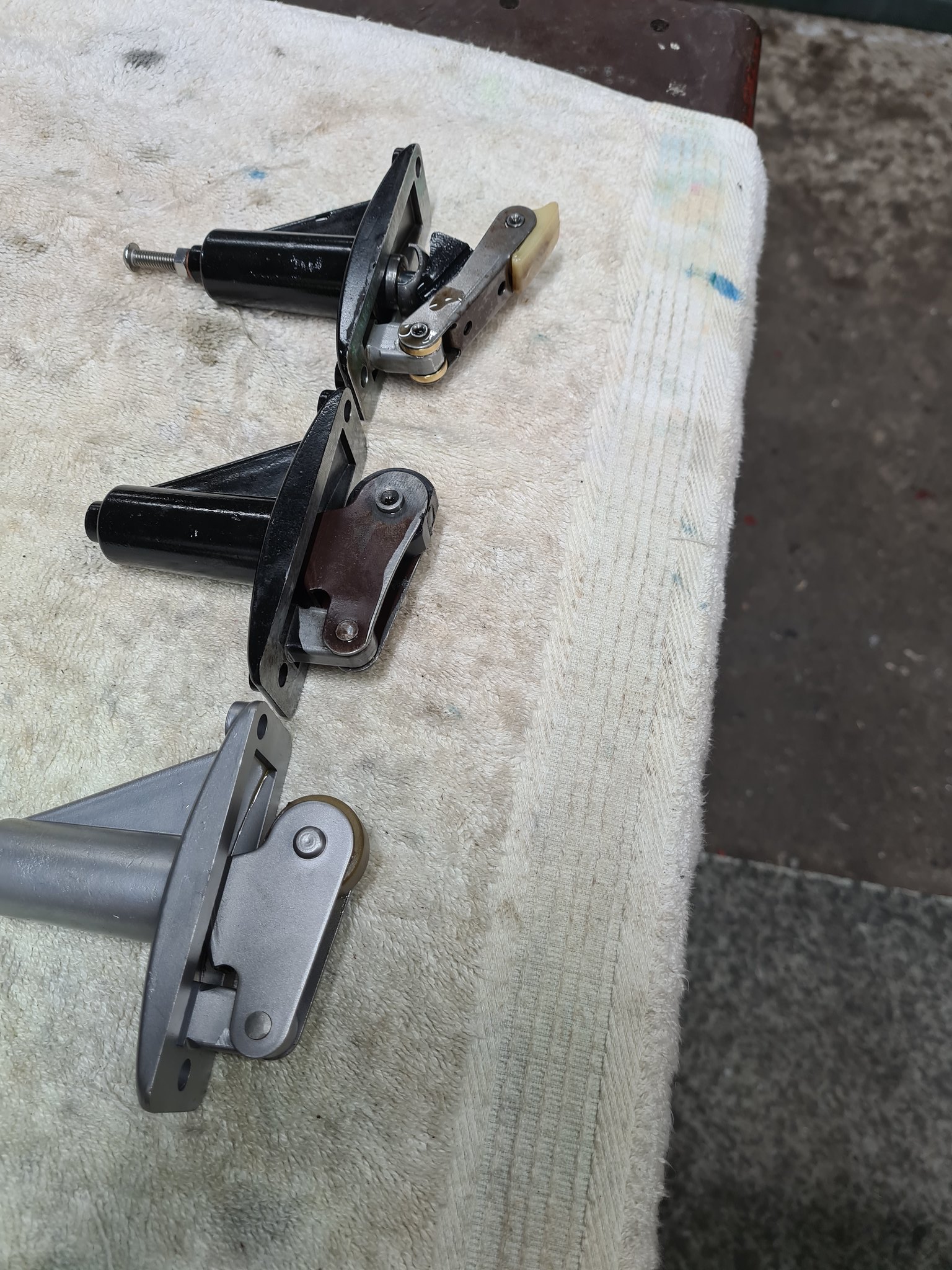
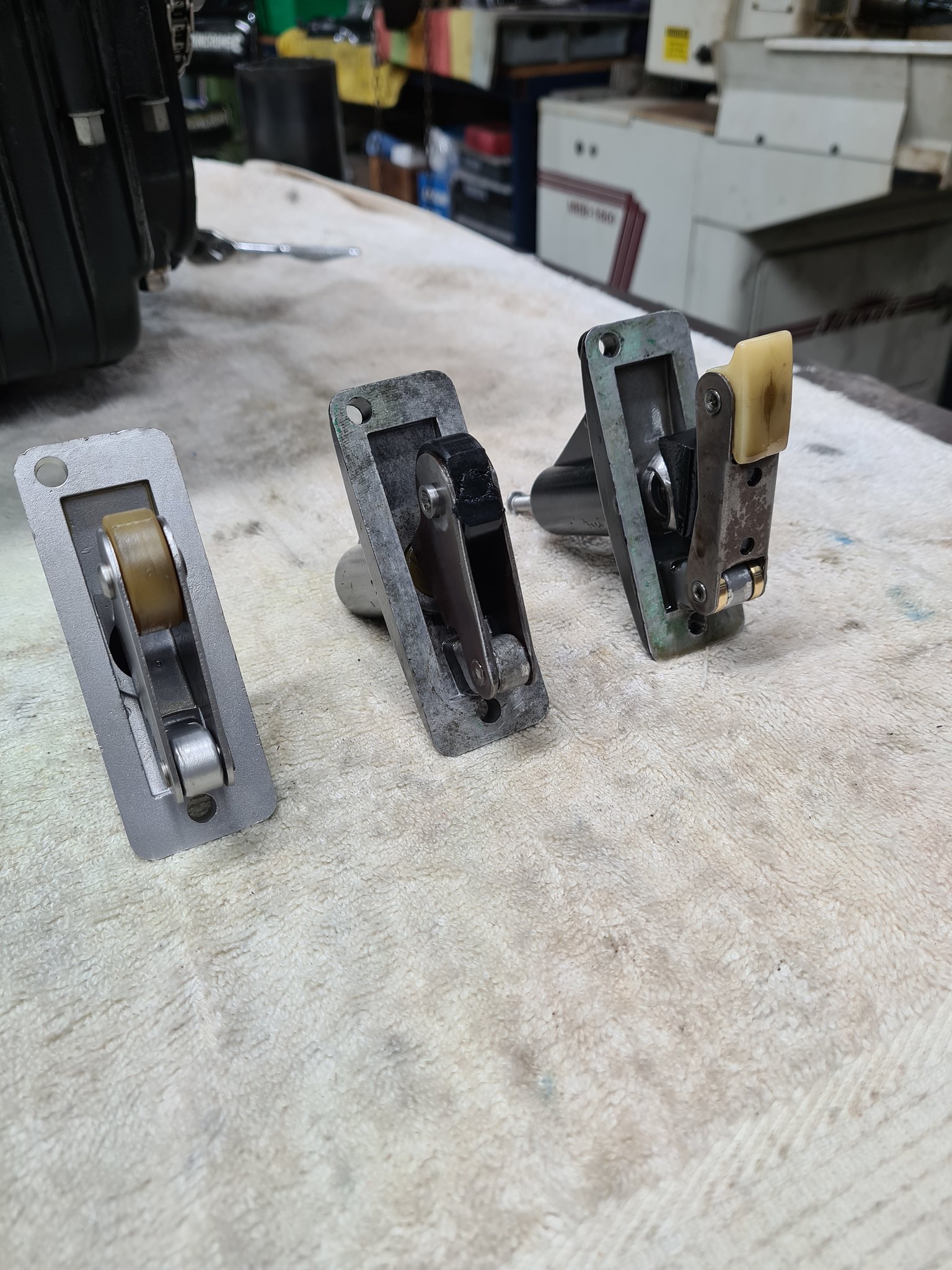
before leaving for Darwin we did a test at QLD Raceway with both bikes and trialed a Delrin roller on the tensioner blade, that did not work out well as just flattened it in a couple of sessions, in the attached photos it is the middle unit with the black roller
Totally hammered which shows how much of a flogging these units are under

So I decided for Darwin I would adapt a 500 unit to fit into the triple which is the unit on the right, advantages that I can see by using this set up is that it avoids point contact where the roller set up bears on a point of the blade whereas the 500 has a foot so contact patch is larger
But best bet is it has the 750 rubber cushion block in play which has to help

End result is that we did not break a tensioner blade with this set up in Darwin so intend to modify another 500 set up to fit in the 2nd race engine

Waiting on Andre's care package to arrive from Europe with new spring steel lengths, according to DHL will be delivered this coming week
So will be making our own stronger blades soon but they will need testing before we go racing with them

Standard unit on the left, Delrin roller in the middle or what is left of it, modified 500 unit on the right

20220804_165613

20220804_165543
 
Makes you wonder why they designed it with a roller pressing on the back of a blade that doesn't really need to roll along it. Sure there will be a little bit of up/down motion but the flat slider evidently gives better support to the blade than the point load of a wheel.

Interesting development process from flattened roller that had in effect turned itself into a flat shoe, to using one designed as a shoe from the beginning. There's a possibility you're duplicating the design development process that may have happened in the factory years ago.

I reckon you could modify the original system to hold a slider shoe rather than a wheel. Then you might be able to make it longer than the 500 version if you find you need to.
 
maybe the slider might be shaped in that way that the rolls of the chain will contact just the middle of the slider, then the rolls of the chain will roll and the links of the chain will not touch the slider. If awailable I would recommend to use PA 12 G material.
Andre
 
There's a steel blade between the tensioner slider and chain Andre, so the chain doesn't contact the slider at all. But you brought to mind an interesting thought. It might just be the key to the difference between roller type tensioner and slipper shoe type.

With the roller acting as a point contact on one side of the tensioner blade and a lumpy thing like a chain sliding over the other side of the blade, there will be times when the roller contact point will be aligned in the middle of a chain link and times when it's on a pivot between two links. That will put the tensioner blade under alternating bending stress of quite high frequency at that point. That'll create high frequency waves which will be transmitted along the length of the blade and be reflected back again from the ends. It'll vibrate like the string on a violin. At some revs you could get standing waves in the tensioner blade. That sort of thing can be very destructive. Think of the Tecoma Narrows Bridge in miniature.

There are 15 teeth on the crankshaft sprocket for the cam chain, so for every revolution of the crank, 15 chain links will pass over the bending point on the tensioner blade. So the vibration frequency is actually (15 x rpm)/60 Hz. For example, at 8000 rpm the frequency will be 2000 Hz, which is well within the audible range. If you want to know what 2000 Hz sounds like, have a play with this online tone generator: https://www.szynalski.com/tone-generator/
The violin string isn't a bad comparison.

The slipper shoe type of tensioner appears to be long enough to cover several links of chain, so you're not going to get the same bending stress as the chain passes over the other side of the tensioner blade. So it pretty much eliminates the generation of that high frequency wave signal.
 
Last edited:
As i read it, the shoe has a longer contact patch with the flexible tensioner blade. This is more likely to damp out harmonics in the chain which are what will destroy a tensioner blade. I'm still saying more chain guidance and stiffer guiides.
 
Back
Top