Hi, Just split the cases on my 1981 Jota and found the sealant I used last time is a little disappointing. Bits in contact with oil have gone black and crumbly. I used Loctite Master Gasket 518. Mind you last time it was apart was 20 years ago. So, anything better I should be using ??? Thanks Steve

You are using an out of date browser. It may not display this or other websites correctly.
You should upgrade or use an alternative browser.
You should upgrade or use an alternative browser.
Jota Crankcase Sealant
- Thread starter Jota1981
- Start date


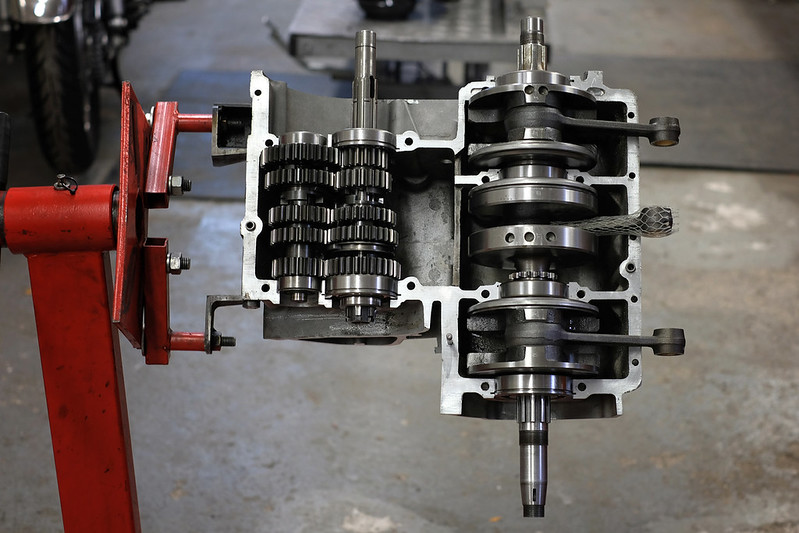
Looks like you applied it as if it was for free! 
I use 518 a lot on my brit single, it has the advantage of remaining a little flexible. For Laverda cases, I've used 510 sucessfully for a number of years. A tiny bead, about 1mm, around the outer case edges and around the stud bores is more than enough to seal them reliably.
piet

I use 518 a lot on my brit single, it has the advantage of remaining a little flexible. For Laverda cases, I've used 510 sucessfully for a number of years. A tiny bead, about 1mm, around the outer case edges and around the stud bores is more than enough to seal them reliably.
piet

tom3c75
Hero member
- Location
- Cape Town South Africa
Ditto Loctite 510. Used it recently on my Jota cases, applied as shown in Piet's pic.
Sets between the joint into a thin, firm film, but remains fluid and is easily cleaned at the exterior of the joints.
Has sealed the cases perfectly, so far.
Tom
Sets between the joint into a thin, firm film, but remains fluid and is easily cleaned at the exterior of the joints.
Has sealed the cases perfectly, so far.
Tom

Thomas aus LAU
Hero member
Loctite 510 is perfect but
- don‘t use it when it‘s older than about 8 years (storaged cold/dark)
- don‘t buy cheap fake, there are a lot of them in ebay
Thomas aus LAU
- don‘t use it when it‘s older than about 8 years (storaged cold/dark)
- don‘t buy cheap fake, there are a lot of them in ebay
Thomas aus LAU
Last edited:

Thomas aus LAU
Hero member
510 is not a French red wine that gets better with age.I use 510 as well.
I've had the same tube for 20 years Thomas, what's the problem?
Paul
I already had older storage loctite 638 and 648 that are no longer fully cured.
Loctite products have a longer shelf life than advertised, but some day they age.
Because of some EUR, I don't risk having to dismantle an engine again.
Thomas aus LAU

Tippie
Hero member
- Location
- Dr?bak, Norway
ThreeBond 1104 is all I have used for decades. Also sold as Yamahabond etc. If you can't get the Loctite stuff.

piranha-bro2
Hero member
- Location
- Melbourne
Yep, we love our ThreeBond! I'll second that.

Jo
Hero member
- Location
- Cologne, NRW Germany
I like to remember how you completed my engine - including applying the sealant. Unfortunately, my engine doesn't have such nice connecting rods:Looks like you applied it as if it was for free!
I use 518 a lot on my brit single, it has the advantage of remaining a little flexible. For Laverda cases, I've used 510 sucessfully for a number of years. A tiny bead, about 1mm, around the outer case edges and around the stud bores is more than enough to seal them reliably.
piet
View attachment 57753
Of course I know I got exactly what I paid for ...


Cheers,
Jo

GregT
Hero member
- Location
- Christchurch NZ
Permatex Ultra gray works well too. Basically the same stuff. Used it on my 3CL.
Threebond where they're cases nicely dowelled together - like a Laverda.
Permatex where there can be some movement - classic British comes to mind.
Excessive application of sealing compound doesn't do much in the way of preventing oil leaks, but it wreaks havoc in regard to bearing fitment/clamping. If you have some of that crap still to hand, scrape off a larger bit and measure its thickness! This amount is then missing from clamping the crank and gearbox bearings in place. Spun bearings are quite common, usually found in conjunction with a liberal application of gasket goo. Then there is the excess that finds its way inside the cases, blocking oil passages and filters.
Absolute cleanliness and intact sealing surfaces are required to prevent oil leaks, only a minimum amount of sealant is then needed to complete the picture.
piet
Absolute cleanliness and intact sealing surfaces are required to prevent oil leaks, only a minimum amount of sealant is then needed to complete the picture.
piet
Tippie
Hero member
- Location
- Dr?bak, Norway
It is nothing like RTV silicone.OK thanks ... Loctite 510 looks the go. Its anaerobic ... the threebond stuff looks to be a RTV silicone which by my reading is better for sealing large gaps. Hey Piet ... yeah mate I probably do lay it on a little too thick. I hate oil leaks !!

The Sock
Hero member
- Location
- London, England
I had an Alfa twincam engine destroy a set of newly developed 'hot cams', causing all sorts of soul searching by the developer as to the hardening process.OK thanks ... Loctite 510 looks the go. Its anaerobic ... the threebond stuff looks to be a RTV silicone which by my reading is better for sealing large gaps. Hey Piet ... yeah mate I probably do lay it on a little too thick. I hate oil leaks !!
It was only after it ate a second set that we dropped the sump and discovered the oil pick up strainer was almost completely blocked by a spaghetti clump of silicone bead which resulted from an OEM over-enthusiastic application of sealant.
The pump was maintaining pressure but with critically impaired flow.
Remember, while you're wiping the bead off the outside of a crankcase, there's one the same size on the inside that may fall off inside, later.

piranha-bro2
Hero member
- Location
- Melbourne
That's why Piet recommends a thin bead on the outer edge of the cases.Remember, while you're wiping the bead off the outside of a crankcase, there's one the same size on the inside that may fall off inside, later.
Similar oil issue if flakes of cam adjuster wheel gets into the rocker spindles of an SF - ugly cam outcomes!

Dellortoman
Hero member
- Location
- Tasmania, Australia
I don't think you should be using it as toothpaste. Although I suppose it could seal up the spaces between your teeth and prevent plaque forming in there.I wish I could test that its not past its sell by date, its as big as a family jumbo toothpaste tube.
Apparently that Loctite stuff is oil-soluble in its liquid state. Any sealant that gets squeezed out of the joint on the inside of engines will be washed away by oil circulation once the engine is running. So even if you apply too much, the squished-out excess won't block oil galleries. Remember that it sets anaerobically. There's air inside the engine, so any exposed blobs or dribbles will remain as liquid after the stuff inside the joint has set.
Correct Cam,
It is oil-soluble, with very little to no excess to be found in engines that for some reason have to be opened again. Does afford peace of mind, compared to silicon-based sealants!
A thin bead will result in thicknesses of less than 0.02mm If applied liberally, as in applied with a brush, thickness can be as much as 0.2mm! This stuff will not flow readily under pressure, the more you apply, the more will remain in the joint. As in my photo, the sealant will only just appear externally when the cases are buttoned up, hardly anything needs to be wiped off. Of course, this does mean the joint surfaces need to be in perfect condition. I prepare them with a fine oil stone to keep them flat and square. Loctite offers other products that are suitable for reclaiming buggered sealing joints.
I haven't had any issues with Loctite products that have reached their use-by date. Some do seperate from their solvents and require a bit of kneading before squeezing from their container (518 e.g), haven't noticed this with 510 (probably because it's in constant use and doesn't get that old...).
Bloody expensive stuff, I buy it in bulk 500gr. tubes, which is loads cheaper than the workshop sized 50gr. bottles.
Another very handy Loctite product is 572, used as a thread sealant on oil plugs, etc. Just saw Clem has already mentioned it...
piet
No, I don't have any Henkel/Loctite shares... just bloody good products that can be unconditionally recommended!
It is oil-soluble, with very little to no excess to be found in engines that for some reason have to be opened again. Does afford peace of mind, compared to silicon-based sealants!
A thin bead will result in thicknesses of less than 0.02mm If applied liberally, as in applied with a brush, thickness can be as much as 0.2mm! This stuff will not flow readily under pressure, the more you apply, the more will remain in the joint. As in my photo, the sealant will only just appear externally when the cases are buttoned up, hardly anything needs to be wiped off. Of course, this does mean the joint surfaces need to be in perfect condition. I prepare them with a fine oil stone to keep them flat and square. Loctite offers other products that are suitable for reclaiming buggered sealing joints.
I haven't had any issues with Loctite products that have reached their use-by date. Some do seperate from their solvents and require a bit of kneading before squeezing from their container (518 e.g), haven't noticed this with 510 (probably because it's in constant use and doesn't get that old...).
Bloody expensive stuff, I buy it in bulk 500gr. tubes, which is loads cheaper than the workshop sized 50gr. bottles.
Another very handy Loctite product is 572, used as a thread sealant on oil plugs, etc. Just saw Clem has already mentioned it...
piet
No, I don't have any Henkel/Loctite shares... just bloody good products that can be unconditionally recommended!
Last edited: