leak down test procedure

TeddyG

Hero member
Location
Portland Oregon
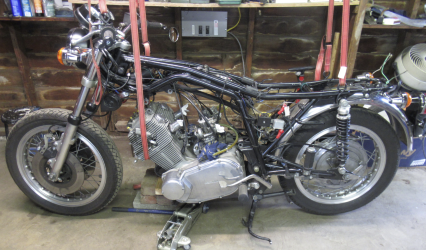
I tried a leak down test on my 750SF2, but was unable to lock down the motor to prevent the pistons from moving at 100 lbs pressure, so what’s the best method- putting the bike on the side stand and then putting the front wheel against a garage wall? Trying to use a breaker bar on the crank bolt doesn’t work.
Thanks
 
. Trying to use a breaker bar on the crank bolt doesn’t work.
Why not? Should work with the breaker arm (and extension?) is locked against the footpeg. If the nut is undoing , then can't you set it so that the breaker arm is on the opposite side of the foot peg? I've never done a leakdown, but do the pistons have to be at TDC?
 
Yes, the pistons need to be at TDC and 100 lbs of pressure is hard to counter w a breaker bar, so I’ll try locking the motor w the front wheel pressing against the garage wall w bike on the side stand and in gear. I want to do the leak down test to determine the state of the motor after seeing those wear marks on the cylinder that I showed you. Wolfgang said there should be no cylinder marks nor the uneven compression I’m seeing after the top end rebuild, and thinks the marks are from either too loose or too tight rebore. He asked if I’m hearing piston slap, and I am hearing a sort of metallic “pinging” near the top end, but I thought it was valves.
 
Don't rely on the case/starter clutch marks for TDC unless you have checked them with a dial gauge or piston stop. I found mine was 5deg retarded
 
Mr Beast is right. Get it close enough to TDC and it'll stay put.

But if you want to check leakage with the piston at other positions in the bore (bore wear is generally more in the middle of the stroke where the side load on the cylinder wall is greatest), just lock the crank with a some kind of wrench on the primary drive nut.

I don't know why your breaker bar on the crank nut (primary drive side) isn't working. 100psi on the piston won't generate enough torque to undo the nut. But just to be sure, I'm a great believer in doing the arithmetic. In this case it's simple enough. You've got 100psi on an 80mm dia piston. With the crankpin at 90° to the cylinder bore, the lever arm on the crank is 37mm (half of the 74mm stroke). Do the arithmetic and you get a torque of 128 Nm or 94.5 ft.lb. If that unscrews the nut on the primary drive end of your crankshaft then it was too loose to begin with. But if you're worried about undoing the nut, just make sure the crankpin is toward the front of the engine. That'll tend to turn the crank in the normal direction of rotation and will tighten the nut rather than loosen it.
 
Thanks guys,
The problem I’m having is holding the breaker bar in place after I release the 100 lbs of pressure, and the timing was strobed earlier to prove the case marks for TDC are accurate. So I’ll try locking the bar against the foot peg or put the front wheel against a wall. I bought a better boroscope which showed the marks and scratches better, and some look nasty, so I’ll remove the top end to inspect and take clearance measurements. During warm up, there has been a sort of rattling/ pinging from the engine top end which I thought was the valves, but now I’m thinking it could be piston slap, which makes me think the bores are too big. Hopefully I can get a decent leak down test to tell me more before I take the top end apart. The next challenge will be finding a good machinist since I don’t want to use the one who did this work.
 
Maybe it’s old age, but of all the bikes I’ve owned, I can only think of one that had piston slap, and that was a two stroke. It had a definite lip at the top of the bore, where there was no ring contact, so was properly worn out.

Given yours is a fresh rebuild, if it’s been rebored oversized and creating piston slap, once the head is off you’d likely see and feel it by moving the pistons forward and back in the bores at various points of the stroke.
 
I may be wrong but strobing TDC wont tell you it's TDC. If you set the ign using those marks the strobe with confirm your your setting.
Only way to check is with a piston stop and degree wheel or dial gauge. More than likely the marks will be correct. I only found out than my 750 was 5deg out when fitting an electronic ign and using a piston stop to get it bang on. I've been using those marks for over 40 years to set the points.
 
Sounds like you'll definitely be pulling the head and barrels off, so no point conjecturising (:cool:) about possible causes. I'm interested to see what you discover.

As for piston slap, I've already commented on another thread that my SF1 bores were so far gone that I had to go straight to a 0.6mm OS rebore. The ridges at the top of the bores were like ski jumps and the top rings were in about 10 pieces. The bike had been ridden for years without an air filter and the last 10,000km had been from Melbourne to Darwin to Perth over loads of dirt roads. It ran faultlessly, didn't rattle and didn't use excessive amounts of oil. It wasn't until after it was rebored and the head tidied up that I realised it was producing about half its potential horsepower.
 
After getting advice from here and others, I've decided to pull the cylinder off to see what's inside and here it's almost ready for that. A breaker bar locked against the foot peg kept the engine locked and the leak down test had no hissing anywhere on both cylinders w the valves closed and motor at TDC. I'm hoping the wear marks aren't too deep and a hone is enough. A friend who has a machine shop will measure the clearance to determine the next steps. This is the second time around taking it apart so I'm getting pretty good at it !
 

Attachments

  • apart.png
    apart.png
    931.1 KB · Views: 17
As for piston slap, I've already commented on another thread that my SF1 bores were so far gone that I had to go straight to a 0.6mm OS rebore. The ridges at the top of the bores were like ski jumps and the top rings were in about 10 pieces. The bike had been ridden for years without an air filter and the last 10,000km had been from Melbourne to Darwin to Perth over loads of dirt roads. It ran faultlessly, didn't rattle and didn't use excessive amounts of oil. It wasn't until after it was rebored and the head tidied up that I realised it was producing about half its potential horsepower.

But could you hear piston slap Q?
 
After getting advice from here and others, I've decided to pull the cylinder off to see what's inside and here it's almost ready for that. A breaker bar locked against the foot peg kept the engine locked and the leak down test had no hissing anywhere on both cylinders w the valves closed and motor at TDC. I'm hoping the wear marks aren't too deep and a hone is enough. A friend who has a machine shop will measure the clearance to determine the next steps. This is the second time around taking it apart so I'm getting pretty good at it !
At least you'll have peace of mind, Ted. Once the head's off, with valves closed, pout some kero/parrafin/petrol down the ports and see if you can see any leaking past the seats. I'm wondering why you have a discrepancy between newly rebored cylinders. Good luck with the measuring and hopefully a hone and spirited run-in will get the psi up and even.

As an interesting aside, Brooke Henry (V-Two Ducati founder, expert engineer and engine builder) recommends using WD40 on rings and bores at assembly - to aid bed in. I like the idea of running in a motor on a dyno - as often done with race motors.
 
At least you'll have peace of mind, Ted. Once the head's off, with valves closed, pout some kero/parrafin/petrol down the ports and see if you can see any leaking past the seats. I'm wondering why you have a discrepancy between newly rebored cylinders. Good luck with the measuring and hopefully a hone and spirited run-in will get the psi up and even.

As an interesting aside, Brooke Henry (V-Two Ducati founder, expert engineer and engine builder) recommends using WD40 on rings and bores at assembly - to aid bed in. I like the idea of running in a motor on a dyno - as often done with race motors.
I put mine together dry (no lube of any type on rings or bore) and then hold the cylinders down with a couple of spacers and cylinder nuts and spin the crank over with a drill or speed wrench slowly and you can watch the rings bed into the cylinders. The process takes about 2 or 3 minutes.

Lots of different ideas and opinions out there. I have a couple of hundred dyno pulls on one of my Harley's and close to 25,000 miles of spirited riding since I put the larger bore kit on it with no oil consumption or even a hint of oil on start up.

A lot of the decisions to bed in rings needs to be based on cylinder bore and material , and the ring tension and material type as well. And I have also learned over the years that the importance of proper honing cannot be overstated, it carries as much weight as the bore or the rings.

I also really enjoy watching the Vee Two YouTube vids........ Mr Henry doesn't seem the type to suffer fools gladly.
 
Those vids are great- so much specific knowledge, and thankfully he gives it to Ducati owners freely. Lots of great Laverda comments every now and then; he appears to be a fan. He appears to be a funny buggar as well; I get a laugh out of him and Chris Pickett, a long-time ex-jurno and bevel racer.
 
I put mine together dry (no lube of any type on rings or bore) and then hold the cylinders down with a couple of spacers and cylinder nuts and spin the crank over with a drill or speed wrench slowly and you can watch the rings bed into the cylinders. The process takes about 2 or 3 minutes.

Lots of different ideas and opinions out there.
Interesting, Ian. Haven't heard of that method before. I;ve read that one of the benefits of running the motor is to use cylinder pressure to increase ring pressure on the bores, aiding bedding, and hence why high loads are recommended, accelerating under load with high throttle opening (not high rpm, not slogging). Heat cycles also come into it, ie allow to cool somewhat and repeat. Could be total BS - so many theories and methods out there.
 
Interesting, Ian. Haven't heard of that method before. I;ve read that one of the benefits of running the motor is to use cylinder pressure to increase ring pressure on the bores, aiding bedding, and hence why high loads are recommended, accelerating under load with high throttle opening (not high rpm, not slogging). Heat cycles also come into it, ie allow to cool somewhat and repeat. Could be total BS - so many theories and methods out there.
So the procedure I've been taught at my friends shop is to bed in the rings as I've described (it's really cool watching the surfaces bed in right before your eyes).

The next step once the engine has been assembled is to build and confirm oil pressure.

Once that is confirmed the engine is started and run at approx 1000rpm to listen for any naughty sounds for approx 15-20 seconds.

After that the bike is gently revved between 1200-2500 rpm for just under 5 min making sure that there is always a load on the rings. The engine is not left to idle at any point.

The bike is left to cool for approx an hour (tidying up tools etc during that period) and then a second heat cycle is performed as previously described but the rpm will increase to gentle revving up to 3000 or so.

Once the second heat cycle is completed the bike is shut down and then wheeled into the dyno room for tuning.

The bike gets brought to temp on the dyno by spinning the drum GENTLY through all of the gears...... it's really important to get the heat into the cases so that everything is up to temp and expanded prior to any serious dyno pulls.

If everything is up to temp, looks and sounds good it's game on.

Just as a point of information, there is close to 8 hours in boring and honing 2 cylinders. Don is festidious about every step and procedure, there is no room for shortcuts on a successful build. The bores are perfect, as is the hone. Piston metallurgy, taper, ring lands as well as ring end gap..... everything gets scrutinized and measured and nothing is left to chance.

This certainly isn't a revelation to competent engine builders and most will have a procedure that is close to this but may vary slightly due to personal experience or machinery that they work on. I've assembled approx 40 engines (pistons, cylinders and cams) this way and have not once had a smoker.... mind you Don keeps a close eye on me as it's his name on the door.
 
Back
Top