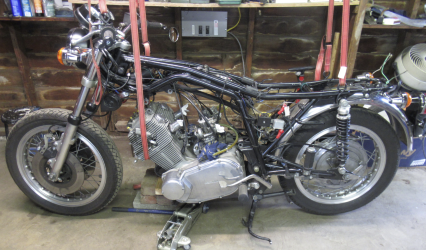
Interesting, Ian. Haven't heard of that method before. I;ve read that one of the benefits of running the motor is to use cylinder pressure to increase ring pressure on the bores, aiding bedding, and hence why high loads are recommended, accelerating under load with high throttle opening (not high rpm, not slogging). Heat cycles also come into it, ie allow to cool somewhat and repeat. Could be total BS - so many theories and methods out there.
So the procedure I've been taught at my friends shop is to bed in the rings as I've described (it's really cool watching the surfaces bed in right before your eyes).
The next step once the engine has been assembled is to build and confirm oil pressure.
Once that is confirmed the engine is started and run at approx 1000rpm to listen for any naughty sounds for approx 15-20 seconds.
After that the bike is gently revved between 1200-2500 rpm for just under 5 min making sure that there is always a load on the rings. The engine is not left to idle at any point.
The bike is left to cool for approx an hour (tidying up tools etc during that period) and then a second heat cycle is performed as previously described but the rpm will increase to gentle revving up to 3000 or so.
Once the second heat cycle is completed the bike is shut down and then wheeled into the dyno room for tuning.
The bike gets brought to temp on the dyno by spinning the drum GENTLY through all of the gears...... it's really important to get the heat into the cases so that everything is up to temp and expanded prior to any serious dyno pulls.
If everything is up to temp, looks and sounds good it's game on.
Just as a point of information, there is close to 8 hours in boring and honing 2 cylinders. Don is festidious about every step and procedure, there is no room for shortcuts on a successful build. The bores are perfect, as is the hone. Piston metallurgy, taper, ring lands as well as ring end gap..... everything gets scrutinized and measured and nothing is left to chance.
This certainly isn't a revelation to competent engine builders and most will have a procedure that is close to this but may vary slightly due to personal experience or machinery that they work on. I've assembled approx 40 engines (pistons, cylinders and cams) this way and have not once had a smoker.... mind you Don keeps a close eye on me as it's his name on the door.


 cool
cool