My Malaga 1200

Make sure you losen the nut that you want to re-torque first, not just fastening it, please. I assume you know that though, just writing it for others that read and maybe don't know ;-)

It always amazes me to see how much more you can turn the nut when you re-torque them (losen it 1/4 turn, then re-torque with the right setting). Mostly, it is a 1/4 turn more than the original position, sometimes even more, sometimes less... (at least on the first re-torquing after 300 - 500km)
 
yeah - it is quite nerve wracking when you wait for the click and it just doesn't... or later than you expect...

Since I use the settings Piet recommended though, I have never had a pulled stud ever since.
 
What torque wrench do you use, has it been tested and what settings are you using, please? This sounds really weird... Only ever had one or maximum two on one engine. 7 sounds like a fault in the wrench or in the settings; especially if they were timeserted! With Helicoil, I had that, too, several times. but never with timesert...
 
What torque wrench do you use, has it been tested and what settings are you using, please? This sounds really weird... Only ever had one or maximum two on one engine. 7 sounds like a fault in the wrench or in the settings; especially if they were timeserted! With Helicoil, I had that, too, several times. but never with timesert...
The settings were probably about 400 C°.
Paul
 
you can turn off a light bulb by throwing a stone, too. I just wouldn't recomend it.

Same for this adjustment. First of all: the setting of these kind of torque wrenches involves a lot of guess work... it has nothing to do with precise, repeatable settings.

Second, these scales are typically found on the cheaper torque wrenches. Adjusting them to one setting, doesn't mean they are precise on other settings... I have had a cheap torque wrench here that showed a range of 20 - 300Nm. At 180Nm, the force needed to make it click was actually 250Nm. We adjusted it to 180Nm (which wasn't really easy...) as my friend uses it for his Car wheel bolts. Testing it at lower settings and at higher settings showed a difference of up to 30Nm to the adjustment... Even when we turned it to zero and back to 180Nm, the setting wasn't at 180Nm anymore every time we checked and re-adjusted.

From my tests and experiences with an adjusted controle tool, the torque values needed to make it click differ mostly on the cheaper ones between the first and all following clicks by up to several Nm. OK if you want to fasten the nuts/bolts on a car's wheel that needs 150 Nm or more, but imagine you are off 2-3 Nm on the cylinder head nuts that partly are fastened with only 23Nm. That would be 10 - 15% more than you want it to be...

My recommandation: get yourself a professional or at least semi-professional torque wrench (Gedore, Hazet or similar) with a proper scale and a not to wide range that has been set by the factory, is sold with a guarantee to stay within 0,3% difference and you will safe yourself a lot of money at the end... And ALLWAYS put it to Zero when you put it back on the shelfe or stop working for longer than a day. That way, it stays adjusted over a LONG period. And when your kids ask you what you whish for christmas, this is what I would go for... still time to order one... ;)

The best torque wrench I ever tested was a professional, roughly 50 year old Gedore. Heavy as an anker, but still top precise! It wasn't used much though, just once in a while. but owner kept good care on it by always setting it back to zero after usage. makes a big difference over time...
 
Last edited:
The settings were probably about 400 C°.
Paul
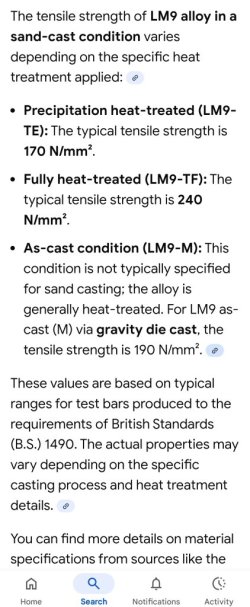
The difference between tf treated lm9 and as cast or as annealed is massive.
I think the safe maximum temp is 180⁰C for engineering operations.
I'm fairly certain that another 100⁰ on that figure and it's going lose its heat treatment.

There's a good reason they fitted those skull caps.
I had my head err cylinder heat treated to TF and it seems to have worked quite well.

Just look at the difference in tensile strength between TE and TF heat treatment.
They don't give a figure for " as sand cast" but you can assume its lower than " as die cast" and likely not useable without at least TE treatment.
 

Attachments

  • Screenshot_20251130_135117_Google.jpg
    Screenshot_20251130_135117_Google.jpg
    101.7 KB · Views: 4
Just go to the dealer and get them to calibrate it.
Paul
on cheap ones, that does not help, Paul. I have tested around 50 different torque wrenches over the past 2 years. If you adjust the cheap ones at a certain Nm setting, most of them were way off at other points. Even the semi-professional ones were obviously adjusted to be precise at one range, totally up or down their claimed range, they got more tolerance than in the center of the torque range.

If you have a cheap one and want to keep it, buy yourself a device to measure the torque settings every time you use it and make sure you "click" it several times before usage. This way you can have accurate settings with a cheap Torque wrench. Everything else is maybe "good enough" but not precise. Just sharing my experience.
 
on cheap ones, that does not help, Paul. I have tested around 50 different torque wrenches over the past 2 years. If you adjust the cheap ones at a certain Nm setting, most of them were way off at other points. Even the semi-professional ones were obviously adjusted to be precise at one range, totally up or down their claimed range, they got more tolerance than in the center of the torque range.

If you have a cheap one and want to keep it, buy yourself a device to measure the torque settings every time you use it and make sure you "click" it several times before usage. This way you can have accurate settings with a cheap Torque wrench. Everything else is maybe "good enough" but not precise. Just sharing my experience.
I don't have a cheap one Lothar.
If you want quality work, use quality tools.

I have a Facom torque wrench, bought over 40 years ago and costing at the time, 1 months average salary.

Paul
 
If you want quality work, use quality tools.
That's what I said, no? You said though "just get them adjusted". Quality ones, yes. Cheap ones: just bin and replace them or use them to losen the bolts on your cars wheels when you change them. But else, they are just crap in most of the cases.
 
Anyway onwards and upwards with the bike. The cam cover was cracked and broken so I dug out another manky one which is taking quite a bit of cleaning up. Even the rev counter drive was seized. Am I allowed to use my cheapo Dremel copy on it to clean the decorative ribs out or is that forbidden? It's coming along though and will look reasonable but it has had some pretty drastic rough sanding already at some time.
Funnily enough the carbs aren't bad, in fact they are surprisingly good, not full of gummed up fuel, no slop in the linkages and there were even two new accelerator pump diaphragms fitted as well as a brand new slide. Unfortunately the slide is a 60/3 and not a 60/2.
I have ordered new K1 needles plus atomisers, main and pilot jets to suit a 1000 engine, the carbs having come off a 1200 originally. I would have ordered them from Paddy but I didn't realise he was still in business and had the parts I wanted so I went to Eurocarb instead. I will need some float valves though because I forgot them.
It's a bit odd that the engine was so badly knocked about and must have been rattling like hell but the carbs, airbox and rubbers look almost new. The slide doesn't look like it was ever used. Maybe someone put them on the bike to try and get it going and then gave up?
 
Anyway onwards and upwards with the bike. The cam cover was cracked and broken so I dug out another manky one which is taking quite a bit of cleaning up. Even the rev counter drive was seized. Am I allowed to use my cheapo Dremel copy on it to clean the decorative ribs out or is that forbidden? It's coming along though and will look reasonable but it has had some pretty drastic rough sanding already at some time.
Funnily enough the carbs aren't bad, in fact they are surprisingly good, not full of gummed up fuel, no slop in the linkages and there were even two new accelerator pump diaphragms fitted as well as a brand new slide. Unfortunately the slide is a 60/3 and not a 60/2.
I have ordered new K1 needles plus atomisers, main and pilot jets to suit a 1000 engine, the carbs having come off a 1200 originally. I would have ordered them from Paddy but I didn't realise he was still in business and had the parts I wanted so I went to Eurocarb instead. I will need some float valves though because I forgot them.
It's a bit odd that the engine was so badly knocked about and must have been rattling like hell but the carbs, airbox and rubbers look almost new. The slide doesn't look like it was ever used. Maybe someone put them on the bike to try and get it going and then gave up?
Wouldn't worry too much over that, Pat.

The /2 and /3 only define at which position the accelerator pump comes into action, I doubt the engine will even notice... the "60" is the more important bit.

piet
 
I have another 60/2 in decent nick so I might as well fit it and keep the unused 60/3 one just in case. By the way, thanks for looking for those neutral light shims recently, I managed to get hold of some eventually. I haven't actually fitted them yet though.
 
Back
Top