You are using an out of date browser. It may not display this or other websites correctly.
You should upgrade or use an alternative browser.
You should upgrade or use an alternative browser.
RGS front end
- Thread starter Dellortoman
- Start date


drikko said:Why not use the BMW wheel and brakes as well?
because the front BMW wheel will not match whatever rear wheel you are using as it is damn difficult to use a rear wheel from a BMW on a Laverda with a right hand chain drive
plus I have already purchased around 28 Suzuki wheels and I have to use them up

Dellortoman
Hero member
- Location
- Tasmania, Australia
In my case I'm using the RGS wheel because that's the wheel I've got, which is a pretty good reason when working with my kind of budget!
Russ suggested using a 17" wheel for better (and cheaper) tyre choice, but I don't want the hassle of that kind of conversion at this stage. Might be something to think about in future if I can't get good 18" race tyres at a reasonable price.
Cam
Russ suggested using a 17" wheel for better (and cheaper) tyre choice, but I don't want the hassle of that kind of conversion at this stage. Might be something to think about in future if I can't get good 18" race tyres at a reasonable price.
Cam

markQLD
Hero member
- Location
- QLD Australia
'cause i reckon fork axles work like a fork brace, and the bigger diameter the better the bracing.Davo said:Somewhat confused here. If the RGS axle is 20mm, Beemer is 25mm why not just sleeve the Beemer fork clamps to suit the 20mm RGS axle?
i don't think the new MV's 'av a big hollow front axle just for the artwork.
a Suzy 750 front wheel is a significant improvement. it surprised me!Dellortoman said:In my case I'm using the RGS wheel because that's the wheel I've got, which is a pretty good reason when working with my kind of budget!
as for ya budget? i suggest if ya can't afford to put a Suzy front wheel on,, consider staying home with ya cat?

cheers, Mark

Cam,
I have sucessfully mated a Suzuki wheel to the Beemer axle just by swapping bearings, so a Laverda wheel should also fit, as it shares basic bearing dimensions. You might need a spacer to take up any room behind the bearings' outer race, as the larger ID means the bearing will be narrower. Thought at first the bearings might not be up to the job, but they have been OK for the past years in my track bike. Don't know how well they will cope with normal road shocks though. Reckon the stock speedo drive can be taken out to 25mm ID as well, problems solved..
Disc spacing might be a bit different though.
Several good 18" tyres appearing on the market in the wake of the classic "boom". Sticking to the stock front wheel limits choices anyway...
Cheers,
piet
Dellortoman
Hero member
- Location
- Tasmania, Australia
OK, I've been doing a bit more measurement and some research on bearings which may be of use to anyone contemplating the Beemer front end graft onto a Laverda.
The steering head bearings are in fact different.
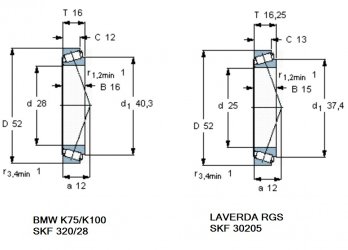
Laverda RGS - 30205 tapered roller top and bottom: 25 x 52 x 16.25 (thanks to the forum for confirming this)
BMW K75/100 & K1100 - 320/28 tapered roller top and bottom: 28 x 52 x 16 (seems all Beemers later than the /5 series use these bearings)
Note that they have the same outside diameter (52mm) so either will fit the laverda steering head, but the inner diameter is different. The BMW has a 28mm head stem, whereas the laverda is 25mm.
While I was able to fit the conical roller assembly on the BMW bearing into the cup of the Laverda bearing, and it seemed OK, it actually wasn't. The inner diameter of the cup on the Laverda bearing is slightly smaller than the BMW bearing, so the roller assembly doesn't fit all the way into the cup. I checked it with dye marker and there's about 1mm of roller hanging out over the edge. There's no guarantee that the cone angle is the same either (not given in the specs). If the angle is only a wee bit different the roller will only contact at one point and the load rating of the bearing will be massively reduced.
The solution is to buy a set of BMW head bearings. The 0.25mm difference in thickness is unlikely to be an issue.
As far as the wheel bearings are concerned, nobody makes a 25 x 42 x 12, so I'll use a 9mm wide bearing and make some 3mm spacers to put behind them (and a longer internal spacer tube).
The 9mm bearing has about a 25% lower load rating than the 12mm, but shouldn't be a problem if I can keep the weight on the front wheel down to about 1½ tons. I'd better go on a diet
Cam
Attachments
Dellortoman
Hero member
- Location
- Tasmania, Australia
Mark, Suzuki wheels won't comply with period 5 racing rules as they weren't available in 1982.
G
Grant
Guest
Was the RGS????
Dellortoman said:OK, I've been doing a bit more measurement and some research on bearings which may be of use to anyone contemplating the Beemer front end graft onto a Laverda.
The steering head bearings are in fact different.
Laverda RGS - 30205 tapered roller top and bottom: 25 x 52 x 16.25 (thanks to the forum for confirming this)
BMW K75/100 & K1100 - 320/28 tapered roller top and bottom: 28 x 52 x 16 (seems all Beemers later than the /5 series use these bearings)
Note that they have the same outside diameter (52mm) so either will fit the laverda steering head, but the inner diameter is different. The BMW has a 28mm head stem, whereas the laverda is 25mm.
While I was able to fit the conical roller assembly on the BMW bearing into the cup of the Laverda bearing, and it seemed OK, it actually wasn't. The inner diameter of the cup on the Laverda bearing is slightly smaller than the BMW bearing, so the roller assembly doesn't fit all the way into the cup. I checked it with dye marker and there's about 1mm of roller hanging out over the edge. There's no guarantee that the cone angle is the same either (not given in the specs). If the angle is only a wee bit different the roller will only contact at one point and the load rating of the bearing will be massively reduced.
The solution is to buy a set of BMW head bearings. The 0.25mm difference in thickness is unlikely to be an issue.
As far as the wheel bearings are concerned, nobody makes a 25 x 42 x 12, so I'll use a 9mm wide bearing and make some 3mm spacers to put behind them (and a longer internal spacer tube).
The 9mm bearing has about a 25% lower load rating than the 12mm, but shouldn't be a problem if I can keep the weight on the front wheel down to about 1? tons. I'd better go on a diet
Cam
What I did...
piet

breganzane
Hero member
- Location
- NSW Australia
Dellortoman said:Mark, Suzuki wheels won't comply with period 5 racing rules as they weren't available in 1982.
You'll probably find you'd get away with it Cam, most of the runners use 2000's era wheels etc in 17" up to 6" wide these days, with 180 rear tyres. Period? Not. Talk to one of the eligibility guys for your state body first, or someone in MA. Seriously doubt the old GSXR 18" wheels would not be accepted as legal.
Whether that's the way you want to go is a different question.
Dellortoman
Hero member
- Location
- Tasmania, Australia
G'day Steve
I have asked MA a couple of questions re eligibility of components that fall into the "doubtful" category. The answers have tended to be a strict interpretation of the rules. If it's not visually indistinguishable from a component that was available in the period, then it's not allowed. Even if it is visually indistinguishable, if it's made from carbon fibre (in the case of bodywork) it aint allowed. Although how they'd know what sort of fibre is in there when it's painted is beyond me. I did try to argue the case that a carbon fibre tank is safer than a fibreglass one in the event of a crash, but to no avail.
Given that this is my first foray into historic race bike preparation, I'd prefer not to step too far over the line. The BMW front end will test the amenity of MA as it is. Prototyoes were built in 1982, but didn't hit the general market until 1983. I'll try to blag that one over the line with smoke and mirrors. Hopefully nobody will delve too deeply into the pedigree of the forks. At least the Showa forks don't exceed the 41mm maximum diameter (the Fitchel and Sachs forks fitted to the same model BMW's were 41.3mm).
As for Grant's question about the RGS falling into the 1982 category. Yes it does, but only just. Even though the RGS model didn't become available to buyers until 1983, a pre-production model was raced in F1 category at Misano in 1982.
While I'll try to stay within the rules, I'm aware that others bend them quite a bit. I don't think any small transgressions on my part will bother anybody too much. If I was winning every race than they might start looking closely, but I have no delusions about my race skills. I'm quite confident that I won't be anywhere near the sharp end of P5. I'll be lucky not to come in half an hour behind everyone else.
Cam
breganzane
Hero member
- Location
- NSW Australia
Don't stress it too much Cam. The quick guys running 41mm forks use ones off an R6N (current model, or very recent) including cartridge internals standard and looking nothing like 1982 units. As for wheels, what a load of tosh, I've seen every kind of crappy 90's and 2000's model 3-7 spoke 17" rims fitted to P5 bikes. They didn't exist in the period but have been made legal so they can run the current slicks. The class is out of control, a very loose silhouette class at most, the leaders are only 6 seconds off the MotoGP lap record at Phillip Island. 
Dellortoman
Hero member
- Location
- Tasmania, Australia
This is may be of specific interest to anyone contemplating a K-series BMW front end swap, but there are some general conclusions that apply to any bike.
I've done some measuring, drawing, calculating and general head scratching.
Before getting into actual measurements, the general rule is that (within sensible limits) reducing trail makes a bike steer quicker, but it will be less stable. Increasing trail makes the steering more ponderous and improves stability.
The standard RGS Marzocchi front end spec is 195mm wide x 45mm offset triple clamps and 29? steering head angle with forks parallel to the steering axis. The nominal trail (according to Falloon) is 125mm. From that info I can calculate that the specs were based on a front wheel rolling radius of 318mm. The BT45 tyre I have on my Jota has a radius of 322mm which would give a theoretical trail of 127mm if I put it on a standard RGS. So for each millimeter increase in tyre radius, you get about 0.5mm increase in trail. That doesn't change much with castor angle so it's pretty much a general rule of thumb for any bike. So replacing a worn out front tyre should (in theory) increase your trail and give you a bit more stability.
Another way of adjusting trail is to change the attitude of the bike. Raising the rear end (or lowering the front) reduces trail. I've worked out another rule of thumb here that's pretty much universal: For every 6mm (?") that the rear is raised, the trail reduces by 1mm. So unless you're jacking ride height up and down by a fair amount, you won't see a lot of difference in trail. But there may be a difference in handling due to weight bias though. I haven't done any research on that.
Another handy relationship I discovered by playing with numbers is that a 1? change in steering head angle will change the trail by about 7mm. So going from 29? to 28? will reduce the trail from 125 to 118mm. That's the theory behind the cut and shut modification of the early triple frames - lengthening of the top frame tube gives a steeper steering head angle, which shortens the trail and makes the steering quicker.
All this stuff has undoubtedly been figured out years ago by people smarter than me, but I don't have acces to anyone else's data so I'm working from first principles.
The BMW front end (I have Showa forks, but the Fitchell & Sachs appear to be the same) has 192 x 56 triple clamps that move the forks 11mm further forward of the steering axis than the normal RGS clamps. But they also have an offset axle that trails by 6mm, so the wheel is only 5mm further forward than the original setup. That results in a 5.7mm decrease in trail to around 119mm. That 5mm reduction should in theory make the steering a little quicker but less stable, but I doubt the difference would be very noticeable. It's still well within the sensible ballpark for a road/track bike.
I see from photos that Team Lavergnac's RGS framed race bike (Renata) has a K-series Beemer front end, and I haven't heard any reports of wayward handling.
As for actually fitting the BMW triple clamps to the RGS frame, all you need to do is use BMW head bearings (320/28 tapered rollers) and put a 3mm spacer in the bottom of the steering head to push the bottom bearing down by that amount. All that does is duplicate the BMW bearing spacing so the top nut on the steering stem is in the right range of the thread. It also provides the correct gap for the rubber dust seals that come with the BMW bearing kit. Piece of piss really.
I've not yet sussed out the caliper/disk offsets because I don't have a suitable pair of calipers. The BMW forks have 108mm mounting lugs for Brembo F08 calipers with the thread in the calipers (as with Ceriani forks). I'll figure that bit out when I get my hands on a set of calipers.
Cam

henry
Hero member
- Location
- bottom left hand corner of germany
Dellortoman said:As for Grant's question about the RGS falling into the 1982 category. Yes it does, but only just. Even though the RGS model didn't become available to buyers until 1983, a pre-production model was raced in F1 category at Misano in 1982.
Cam
my RGS is a road registered 82 model - swizterland
Dellortoman
Hero member
- Location
- Tasmania, Australia
Thanks Henry. I'll keep that in mind. I may get back to you if they give me a hard time about date eligibility.
breganzane
Hero member
- Location
- NSW Australia
Dellortoman said:Thanks Henry. I'll keep that in mind. I may get back to you if they give me a hard time about date eligibility.
Don't tell me you're worried about your date being eligible now? Surely THAT'S pre-82?
Dellortoman
Hero member
- Location
- Tasmania, Australia
I'd be pleased if that was a problem Steve. A post '82 date is a bit of a fantasy at my age. 
Dellortoman
Hero member
- Location
- Tasmania, Australia
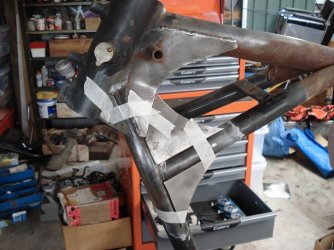
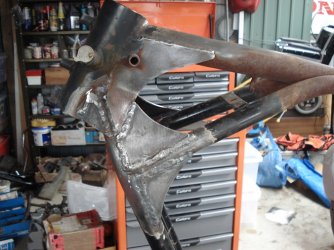
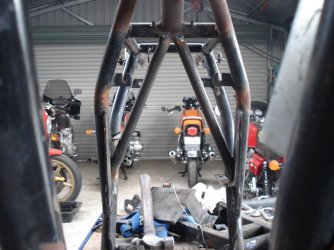
I gusseted up the steering head today. I dunno whether gusseted is a word, but it'll do. Also put a pair of triangular braces in the rear section of the frame above the swing-arm pivot. Not quite the same as the usual bracing method (as used by Steve B, Chris Pritt, Team Lavergnac and maybe some others). They used a X brace whereas I've gone for an inverted V. Does the same job. The reason I went for the inverted V is that the upper tube ends land on the main frame spine, which is an immensly strong point, and it's less welding. The other advantage is that the top ends of the tube sit a little further back than the X brace and don't interfere with the original RGS intake airbox. I dunno whether I'll use the airbox yet, but the option is still available if I want to.
Either the X or V triangulate the open box in the middle of the frame and makes it much stiffer against torsional deflection, such as you'd get in the event of a wobble or weave. It may only serve to increase resonant frequency of any wobble. Who knows, it's all a bit of an educated guess really.
I didn't do any bracing around the actual swing arm pivot itself because I didn't think it needed any. The pivot shaft is only in shear load over a very short distance (between frame and swing arm bush) so can't really deflect much at all, and the frame lugs for the swing arm are about 1/4" thick steel plate. There's no real lateral load on them. All loads are in the direction of the plate, so they're not going to deflect much either.
Yes, my welds are crap. It's my first effort at TIG welding with a scratch start torch. Quite honestly I could have done a way better job with either oxy or stick welding. I guess it's a case of an old dog trying to learn a new trick, and not doing very well at it. Not really impressed with TIG. It's a bit of a pain in the arse. Seems a lot more difficult to control the weld pool than with oxy, but maybe I'm not doing it right. The rear V brace is only tacked in position in the photo. By the time I'd welded it, it was way past beer O'clock and in the meantime I'd left my camera in the house and wasn't about to go looking for it. Suffice to say the welds are just as ugly as the steering head bracing.
Cam