stainless engine bolts of 750sf2?

mikeb

New member
Location
new zealand
Hi. PO has used shiny A2-70 stainless bolts (and nyloks) for the engine mounts on 750sf2. i've read some threads on this forum and there appear mixed views on their suitability, especially given the stressed nature of the engine. i would have thought steel 8.8 or 10.9 were better choices.

so... change to steel or don't worry about it?

thanks!
 
I run stainless hardware on lots of bikes and have never had a problem in 50 years. That is even on high stress bolts like the brake calipers and motor mount bolts. Don't worry about it.

And newer model BMW bikes have a number or stainless bolts on them,
 
I’ve used stainless bolts in almost every bike I’ve owned since 1978. Most were for the bling factor, some in stressed areas.

Never had one break, even when on a bike that a car modified into scrap metal.

Occasionally they would bind up (nut and bolt, not stainless into aluminium) and the bolt only broke while using a breaker bar with a 3 foot pipe on the handle, trying to remove the bound nut.

A forum member, metallurgist boohared the use of them, point taken, but doctors say I shouldn’t drink alcohol….. again, point taken. 🍺
 
Stainless steel is a very hard metal and I’m not sure how it compares to machine grade, but nylock nuts are a very idea good for that vibrating motor. Personally I’ve used stainless allen head bolts on my 750 engine case, much to the distain from the rivet counters here.
 
SFQ has M12 fine thread bolts with original SF1 nylocs on the four lower engine mounts. I had to import the fine thread bolts from the UK. 14,000km and never had an issue. I've proven plenty of naysayers wrong over the decades. A mate's SF2 I've worked on over the years had broken the original lower engine bolts before I met him ... absolutely no idea why - it wasn't a bad motor ... maybe he didn't tighten them enough.
 
Thanks for comments. Raises an additional point. Are these engine bolts specified as standard or fine metric threads? I haven't seen the spec anywhere.
 
I had a Stainless rear shock mounted with an Alan bolt, gauled and seized, and I couldn't get an angle grinder near it. I eventually managed to break it using a long pipe on a spanner. Taught me a good lesson on lubing Stainless fixings.
 
I once worked on a massively expensive Unit Block right in Millionaire's Row, Palm Beach, they used top-flight boat industry Stainless hardware and fixings. It still rusted in a couple of years.
 
Correct torque is important for whatever grade of bolt is used for a given application.
8.8 high tensile bolts will tolerate a small amount of flexing without breaking, going up in tensile strength makes the bolts more brittle and prone to breaking. For an example the long bolt that holds the rubber mounted spigot for the RGS fairing is prone to fracture if a 12.9 bolt is used and comes loose, in this instance an 8.8 bolt would tolerate the vibrations better. FWIW I would stick to 8,8's for the engine mounts knowing that the vibration generated by the motor could easily loosen the joint and add stress to the bolt. important to torque the bolts up correctly.
Stainless steel bolts have a much lower tensile strength, just a tad higher than mild steel. 304 and 316 stainless steels have a tensile strength equivalent to 5.8 bolt. Higher strength stainless bolts are available from specialist suppliers but the normally available ones are 304 or 316.
Just Saying.
I,m not against stainless steel bolts, use them myself.
Stainless steel nuts and bolts of the same grade have a tendency to gall together if used dry, use some lubrication. Differing the grade of steel , ie, 316 matched with 304 stainless is less problematic. My preferred option is to use bright zinc coated Nylock nuts with stainless bolts.
 
Correct torque is important for whatever grade of bolt is used for a given application.
8.8 high tensile bolts will tolerate a small amount of flexing without breaking, going up in tensile strength makes the bolts more brittle and prone to breaking. For an example the long bolt that holds the rubber mounted spigot for the RGS fairing is prone to fracture if a 12.9 bolt is used and comes loose, in this instance an 8.8 bolt would tolerate the vibrations better. FWIW I would stick to 8,8's for the engine mounts knowing that the vibration generated by the motor could easily loosen the joint and add stress to the bolt. important to torque the bolts up correctly.
Stainless steel bolts have a much lower tensile strength, just a tad higher than mild steel. 304 and 316 stainless steels have a tensile strength equivalent to 5.8 bolt. Higher strength stainless bolts are available from specialist suppliers but the normally available ones are 304 or 316.
Just Saying.
I,m not against stainless steel bolts, use them myself.
Stainless steel nuts and bolts of the same grade have a tendency to gall together if used dry, use some lubrication. Differing the grade of steel , ie, 316 matched with 304 stainless is less problematic. My preferred option is to use bright zinc coated Nylock nuts with stainless bolts.

This conversion on bolts reminds me of a magazine article I read, back when I had more hair on my head than on my back, yep the tide has turned.

It was about a bloke attempting to make his, not so old, Z900 handle really well 🤔

In his efforts he had drilled out the frames engine mounts and motor mounts to some random imperial size and squeezed in titanium bolts with a very tight tolerance.

Question remains, because I’m not an engineer, are Ti bolts in this application any better, read stronger, than other more traditional options?

I’m aware of a little weight saving, but that’s not the point. Recently I priced Ti bolts nuts and washer to fit a 180 triple and am doubting the near AUD$85 per nut bolt and washer combo being a prudent purchase 😳
 
Titanium bolts are not universally stronger than steel. However, they boast a significantly superior strength-to-weight ratio. While titanium is roughly 40 to 45% lighter than steel, high-grade titanium can match or exceed the strength of many standard steel fasteners.

Strength Comparison
  • Absolute Strength: In terms of maximum sheer load and tensile strength, specialized ultra-high-grade steel (such as Class 12.9) is generally stronger than common Grade 5 titanium bolts. However, Grade 5 titanium easily outperforms many factory-standard steel bolts (like Class 8.8).
  • Strength-to-Weight: Because titanium provides similar strength to steel at nearly half the mass, it is the superior choice when weight reduction is a priority, such as in aerospace or competitive racing.
  • Fatigue Resistance & Flexibility: Titanium is highly resistant to high-frequency vibrations. It can endure millions of vibration cycles without developing the micro-cracks that commonly cause breakage.
 

Attachments

  • 1779416758044.gif
    1779416758044.gif
    43 bytes · Views: 18
  • 1779416758317.gif
    1779416758317.gif
    43 bytes · Views: 19
  • 1779416758102.gif
    1779416758102.gif
    43 bytes · Views: 12
  • 1779416758203.gif
    1779416758203.gif
    43 bytes · Views: 19
If you are going to use stainless steel bolts on your bike may I suggest you consider where you are using them.
If the bolt is passing through aluminium, the crankcases for example, I would advise using a copper based grease to avoid galvanic corrosion between the two metals, this does help stop the nuts seizing on threads too.
I would also suggest a product called Tef Gel, on threads when the risk of nuts galling, self welding, onto bolt threads is possible.
Better than copper grease but a lot more expensive.
Please be aware that TelGel is not conductive. Tef Gel anti seize grease for stainless steel components.
Tel Gel is not cheap but works. Primarily for the maritime industry.
A little goes a long way.

Lots of manufacturers use stainless steel fasteners nowadays and in my previous life I spent a lot of time removing seized fasteners from bike where no thought to the incompatibility of materials had been considered.
 
I put stainless everywhere on my Laverda without any seizing. Or breaking, my discs on the SF2 have been mounted with stainless since 1992.
Vincents had stainless in a lot of places ex factory.
Paul
 
This conversion on bolts reminds me of a magazine article I read, back when I had more hair on my head than on my back, yep the tide has turned.

It was about a bloke attempting to make his, not so old, Z900 handle really well 🤔

In his efforts he had drilled out the frames engine mounts and motor mounts to some random imperial size and squeezed in titanium bolts with a very tight tolerance.

Question remains, because I’m not an engineer, are Ti bolts in this application any better, read stronger, than other more traditional options?

I’m aware of a little weight saving, but that’s not the point. Recently I priced Ti bolts nuts and washer to fit a 180 triple and am doubting the near AUD$85 per nut bolt and washer combo being a prudent purchase 😳
It won't be the titanium that has any effect Chris, it will be the tight tolerances that could make a difference.

Any bolted-up connection will flex to a degree, reducing this flex through snug-fitting bolts in precise bores will increase rigidity. A good example is the Bimota/SFC I brought to Eastern Creek, all engine mounting bolts are titanium with a smooth sliding fit in both the frame and engine lugs, there's no wobble at all. Definitely a royal pita offering it all up when assembling! The frame tubes are extremely thin-walled and I suspect they will not tolerate much bending and twisting through bendy engine mounts.

Slathering your GSX with titanium bolts will certainly gain a few "oohs" and "aahs" when parked in front of the ice cream parlor... but not much else I'm afraid. ;)

piet
 
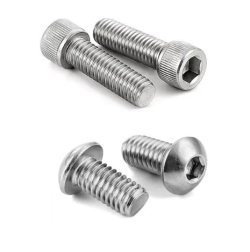
ok one additonal slightly lame question. i'm going to change the various case screws that are SS A2 cap heads to ZP.
purely for looks on these bikes (with their big manly square profiles...), are there any views on what looks better - cap heads or button heads? (eg for M6, M8 etc..). i'm veering button head...
Edit - or hex head? (original, is that right?)
cheers
 

Attachments

  • screw cap button.jpg
    screw cap button.jpg
    22.6 KB · Views: 1
Last edited:
I use stainless cap screws, button heads have too smaller hex and being stainless will round out without effort. There’s quite a few screws to replace and that equates to a lot of ‘FUCKS’ if you use button heads.

Make sure you measure and take note of each lengths location before you buy. They are not all the same lengths, too short and you risk pulling threads just as you tighten, and that leads to a series of FUCK Fuckity FUCKS!!!!
 
Back
Top