The fall and rise of a works SFC engine

Perhaps somewhat random comment, but I was just checking some gasket materials.
I have found that perhaps the best cylinder lower end gaskets for triples has material Victor Reinz AFM 22 1.00mm thick.
Not sure if the same applies for 750s.

Just bought a similar kit than this one at my local shop. One of the sheets on this assortment is Victor Reinz AFM 22 1.20mm thick. The size is 500x300mm, not A3 as stated (A3 is 420x297mm):

At least several of my local suppliers are offering the same gasket paper assortment.

-Jouni
You may have noticed that the large majority of gaskets as supplied by Athena and Centauro are made from Reinz materials. Reinz and Elring share a large part of the european automotive gasket market.

I've aquired a laser cutter for the sole purpose of cutting gaskets. Not necessarily Laverda, as these are mostly readily available, but those that are no longer made for my Matchless. These produce off-cuts large enough to supply me with the smaller Lav gaskets until I croak... Paper gaskets are no problem for the 30W laser, don't think it will manage to cut the steel sheet reinforced stuff that is used for the Lav cylinder base though. Reckon I'll just have to modify stock gaskets for this engines' 12mm cylinder studs.

piet
 
If they hadn't been able to pull off that fluke in Imola '72, they'd have sunk by 1980.
How dare you call it a fluke? That was engineering excellence coupled with the supreme riding talent of Paul Smart and Bruno Spaggiari. ;)

Same as the 1978 IOM win by Mike Hailwood. That bike was perfectly engineered to last the exact distance of the race. The engine blew up as it crossed the finish line, forcing MH to pull the clutch and coast to a stop. You can't get better engineering than that. It did exactly what it needed to do and no more!

Joking aside, I'm glad my MHR has a completely different engine to the older bevel twins with the historically troublesome roller bearing big ends. The later engines with plain bearing big ends and high oil pressure seem to be pretty robust. They finally got the bevel engines to be strong and reliable, then stopped making them.
 
Well, the crank came apart without too much drama, took my hydraulic press to its' limits though. My concerns through prior experience with SFC cranks were again justified, the webs and crank pins have almost 0.08mm interferance! Going to be a challenge getting the bugger back together.

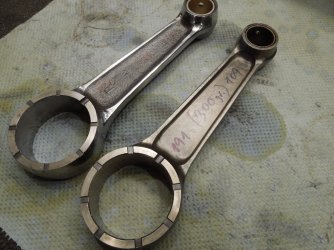
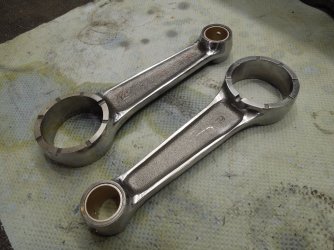
Thanks to the generosity of a very kind forum member, 2 very usable '74> SFC conrods have found their way to Hennef. Surprisingly, these had almost 40gr. weight difference, so out came the belt grinder as well as the grinding mops... down to less than 4gr. difference now! But still almost 30gr. heavier than the special '73 rods. I calculated the '73 crank to have been balanced to 62%, with the rods as they now are it will come out to around 59%. A few years ago at OCT we calculated a stock '74 SFC crank to be balanced at 58%, which contrasts starkly with the road-going SFs at 68-70%, so the crank is now very much in the ball park for an SFC! The big difference in balancing factors is due to the emphasis the factory obviuosly put on crank bearing loadings. The lower balance factor loads the bearings a lot less but puts out harsher vibes than the higher factor. Sounds a bit counter-intuitive, but our computer programme came out with the same results over and over again! Obviously the bikes were built to last the 24 hours of an endurance race while to hell with the rider, he had a chance to recuperate every couple of hours!

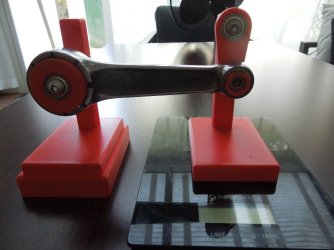
Printed/built a quick 'n dirty rod weighing/balancing jig while I was at it, works quite OK with consistant results.

Anyway, the "new" rods recieved new small end bushes, the big ends require some honing to accept the over-size rollers that will be fitted. The big ends are somewhat worn, but not worn out... Crank pins are still excellent, when it all comes together the big end clearance should come out to 0.015mm again.

DSCN1967.JPG
Rod weighing jig


DSCN1976.JPG
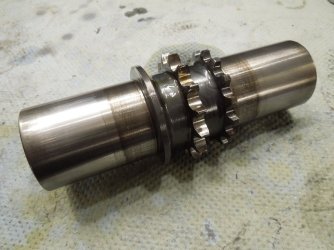
The rarest of the rare... ;)


DSCN1982.JPG

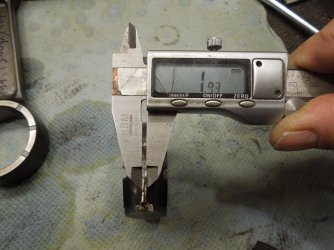
'74 on the left, '73 right. The main weight difference stems from the thickness of the inner web. The '73 is only 2mm thick near the big end, the '74 is a good 3mm!

DSCN1985.JPG

DSCN1983.JPG
Nice and shiny.


DSCN1975.JPG
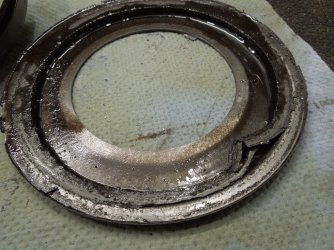
50+ years of sludge in a supposedly well-maintained racing engine. Nothing in there that may cause suspicion of big blow-ups though, just normal wear and tear crap.

piet
 
Last edited:
2mm thick at the big end, Piet ... which is 1mm less than the 74's ... and right where the two ends of the lovely skinny little suckers went their separate ways! Lee did 12 race seasons on his 74 rods and they were still in fine fettle when he retired them for new Carillos.

Surprising amount of silt in those slingers for a motor that was 'only ridden on weekends' :ROFLMAO:
 
I measured even less on a section of the 1973 Bol d’or engine’s conrod..

Marnix
I take it the beast in question was well dead in order for you to measure it ... and I take it the numbers on the vernier are the reason said beast was separated into the pieces that allowed you to actually get the vernier onto it!

I wonder if they got a justifiable performance benefit worthy of the risk of not making it to 24 hours!!
 
Dead it certainly was.. it's a section of the shattered conrod that partly ruined the engine, but not after it had succesfully run the full 24 hours at the 1973 Bol d'Or finishing 9th. After that it competed in more short (mostly mountain) races. Years later a French enthusiast bought it, and ran it on the road. He was quite amazed with the engine's performance, not knowing how special it was. He rode it a few years until the conrod finally called it a day. It was only then that he found out how special it was, took it to Breganze hoping to get it repaired there, but the only reaction was that the entire engine was very experimental and that no such parts were available anymore..

Marnix
 

Attachments

  • img719[1].jpg
    img719[1].jpg
    77 KB · Views: 26
Last edited:
Dea it certainly was.. it's a section of the shattered conrod that partly ruined the engine, but not after it had succesfully run the full 24 hours at the 1973 Bol d'Or finishing 9th. After that it competed in more short (mostly mountain) races. Years later a French enthusiast bought it, and ran it on the road. He was quite amazed with the engine's performance, not knowing how special it was. He rode it a few years until the conrod finally called it a day. It was only then that he found out how special it was, took it to Breganze hoping to get it repaired there, but the only reaction was that the entire engine was very experimental and that no such parts were available anymore..

Marnix
Didn't it do 2 Bol d'Or?
1 in the modified drum brake frame I gave you and the other in a disc brake frame now in Belgium?
Paul
 
Didn't it do 2 Bol d'Or?
1 in the modified drum brake frame I gave you and the other in a disc brake frame now in Belgium?
Paul
It is possible, but the machine that ran the Bol d'Or in 1974 looked more like a works racer of that same year. Still looking for better pictures of that bike, without the full fairing for instance.

Marnix
 
It is possible, but the machine that ran the Bol d'Or in 1974 looked more like a works racer of that same year. Still looking for better pictures of that bike, without the full fairing for instance.

Marnix
The version I had was that the engine did 2 Bol before Couturiers bike was sold by YE Motori.
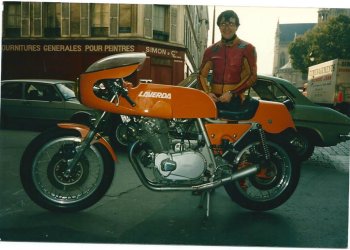
I suppose that you sent me this photo of the bike with an Electronica engine fitted after the rod in the Bol engine broke.
Paul
1783014621108.jpeg
 
Back
Top