The fall and rise of a works SFC engine

Quentin,

I had planned to fit Carillo rods, but that doesn't look like it will materialise. I'm also quite worried about the weight difference between Carillo or Arrows rods compared to the mega-thin '73 items, there's simply not enough metal in the crank webs to compensate. I'm pretty reluctant to fit huge lumps of tungsten to regain balance, this would defeat the whole exercise in large parts. IIrc, the entire crank with bearings weighed in at under 11kg. Although I reckon the engine will never again be used in anger, I would like to preserve the lightning-quick revving characteristics of the crank.

I've come to the conclusion that standard SFC rods might be preferable, if anybody has a pair surplus to requirements, I'd be interested. ;) Failing that, I've thought about reducing the width of a standard 750 rods' big end. Quite a few grams can be shed from the stock rods without compromising strength, but they'll still end up a good deal heavier than what's in the crank now.

Anyway, next stage is to machine a support jig for crank disassembly. If any of the other SFC cranks I've done are to go by, this one is going to be a challenge. Nothing much to support it and probably an enormous amount of tonnage needed to get it apart. Not particularly looking forward to that, but I guess I've just gotta pull my finger out and do what needs to be done.

piet
It's gonna be a fine balance, Piet. The last thing you want is a compromised crank in order to retain the works originality. Might be worth researching how far the balance factor will shift with a couple of options. Don't SFC rods start life as SF rods (a quick X-ray, a trim in big end width and some spit and polish)? It's not as if you'll be entering the next 24 Hr race that comes along. ;)
 
It's gonna be a fine balance, Piet. The last thing you want is a compromised crank in order to retain the works originality. Might be worth researching how far the balance factor will shift with a couple of options. Don't SFC rods start life as SF rods (a quick X-ray, a trim in big end width and some spit and polish)? It's not as if you'll be entering the next 24 Hr race that comes along. ;)
My thoughts exactly, Quentin.

I have a pair of nice SF rods with big ends that should clean up nicely for over-size rollers.

piet
 
If money would be the least problem, Titanium rods could cover strength and weight... :unsure: Not sure though, you can get just 2 and looking for the cost of 4 - that would cause a big hole in the pocket... (roughly 1.200€/rod)
 
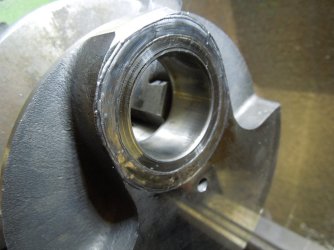
One of my 1973 SFC engines has this crank which already strongly resembles the 1974 crankshaft, yet with the single row sprocket. Don’t know if this can be identified as a late 1973 shaft or a prototype 1974 (or both!) but it already has the stronger conrods which greatly reduces the risk of the engine throwing a rod, which the racing dept had already experienced a few times in the course of the year.

Personally, I’d always mount such rods instead of modified SF items, especially after all the effort you put into saving the crankcase.

Marnix
 

Attachments

  • eZy Watermark_08-06-2026_09-17-46-7640AM.jpeg
    eZy Watermark_08-06-2026_09-17-46-7640AM.jpeg
    215 KB · Views: 36
Looks very much like a '74, Marnix - how many single row sprocket cranks were ever made for SFCs? Were they all factory works cranks?

And correct me if I'm wrong, but wouldn't all SFC rods start life as SF rods?
 
Hi, From what I know you can not use titanium rods , due to fact that the titanium cannot be made hard enough for the rollers to run on.
To use titanium you'd to line the big end with steel for the rollers to run on.
Way forward would use a higher grade steel, which would allow more metal to be removed, thus reducing the weight.
Arrow quoted me £800.00 per rod + vat , on a order of 9, triple RGS spec rods! 70gram saving per rod, 210 aprox over the three.
 
. IIrc, the entire crank with bearings weighed in at under 11kg. Although I reckon the engine will never again be used in anger, I would like to preserve the lightning-quick revving characteristics of the crank.
These cranks usually weigh 12,7-12,8 kilos, which is already pretty light for a 750 crank.

Marnix
 
Looks very much like a '74, Marnix - how many single row sprocket cranks were ever made for SFCs? Were they all factory works cranks?

And correct me if I'm wrong, but wouldn't all SFC rods start life as SF rods?

I have no idea how many of these cranks were made in 1973, 10? 20? Most of them self destructed. I know 6 survivors. Most of them are different, sometimes in detail, sometimes different shape of the webs.

Conrods: It a different casting, but you can get pretty close modifying SF ones, sure. All drum brake SFCs had highly polished SF rods anyway.

Marnix
 
Guess both rods would start from much the same forging, with only more metal being removed from the big end for SFC applications.

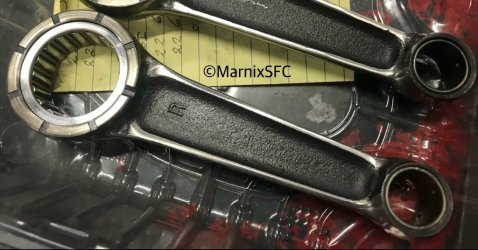
How many oil apertures do those rods have Marnix? I can detect only 2 very small ones. The SFC rods I've come across were castellated around the entire big end circumference whereas the SF rods only have 2 semi-circular openings, diagonally offset to the rod centre. Got a couple spare? ;)

There are minor differences across the production span of SF rods, some seem to have slightly thicker big end "walls".

Installing a steel sleeve in a Ti rod wouldn't be such a big deal, these rods have other limitations such as alternating loads over a period of time. IIrc old Porsche Ti rods had a specified replacement interval. Maybe modern Ti alloys have a longer lifespan.

piet
 
This indeed what they look like. These are the ones that are inside the ex Larry Strung 1974 SFC,

I have a few spare pairs rods, but they are all attached to crankshafts..

Marnix
 

Attachments

  • eZy Watermark_08-06-2026_08-32-05-0760PM.jpeg
    eZy Watermark_08-06-2026_08-32-05-0760PM.jpeg
    209.4 KB · Views: 61
This indeed what they look like. These are the ones that are inside the ex Larry Strung 1974 SFC,

I have a few spare pairs rods, but they are all attached to crankshafts..

Marnix
Looks like that rod has experienced a bit of side-load Marnix...

Thanks, exactly as I remember them.

The forging has the same "R" marking and the little end is just as cock-eyed as most other 750 and triple rods. ;)

piet
 
SFC 750 Carrillo conrods weigh 385 grams, I have a couple of sets left in stock

If you want the rotating and reciprocating weights I'll weigh them tomorrow and let you know
 
Last edited:
SFC 750 Carrillo conrods weigh 385 grams, I have a couple of sets left in stock

If you want the rotating and reciprocating weights I'll weigh them tomorrow and let you know
Many thanks Red, but I've yet to tear down the crank in order to weigh the originals. Will be interesting!

Quite likely I have a set of OE SFC items making their way to Germany shortly.

piet
 
The more data, the better; who knows, there might be variations. I really want to see this succeed after seeing it in action at Eastern Creek in Sydney and hearing its out-there history from Piet.
 
That’s why Gijs pressed it apart. Neatly solved.

Marnix
I've managed that in the past with laser welding.

Easy with the removable crank pins, I can do that with my tool post grinder! The integrated pins require eccentric mounting for grinding, but quite do-able. ;) Weld is around Rockwell 62-65, around the same as ball bearing steel.

pietDSCN9937.JPG
 
Seem a few rounded side journals on SF and SFC rods - and the corresponding wear groove in the web. Nice fix laser welding it. I did an SF crank with a surface grinder and added a 1mm Ducati big end shim (that sits between the rods) to compensate.
 
I've found lots, Quentin.

Bearing clearance too tight in conjunction with a slight taper of either the big end or crank pin, sometimes both. Sometimes also a result of a bent rod, bright areas at the sides of the piston top land are the giveaway.

It's really surprising to find cranks with really tight big ends even after zillions of miles, mainly triples.

Give the big end bearing 0.010-0.015mm clearance and (most) all problems go away...

piet
 
Brooke Henry mentions Laverdas when talking about the infamous Ducati big end problems. He says Lavs have larger clearances and that's why they last so well. Goes on to talk about a race motor at Daytona where they had to do an emergency fix and fotted a crank with 'huge' big end clearances ... that motor continued to run without issue for years.
 
Tight tolerances call for precise machining to make them work long-term.

The heyday of the bevel Ducati twins coincided with hard times in Borgo Panigale. Overall quality suffered while the goal was to produce and sell as many bikes as possible to remain afloat. Ducati lived off a myth while struggling to build over-complicated engines that would last more than 25000km. If they hadn't been able to pull off that fluke in Imola '72, they'd have sunk by 1980.

The few Ducati twin cranks I've done over the years all showed the same failing, far too much taper in the crank pin, forcing the rods to one side and munching the thrust washers, big end and web faces. Not a design fault per se, but a manufacturing fault. Aftermarket crank pins were far better than OE items in regard to parallelism and roundness. I applied Laverda bearing clearances to the Ducati cranks I built, to my knowledge, they're still running nicely...

Keith Nairn once joked; "You know what those fancy windows on the bevel covers are for? So the owner can watch their big end float by..."

piet
 
Back
Top