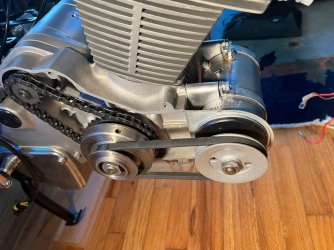
Toothed belt 750 generator drive

No, it's a 'V'-belt, designed to more easily go round a small pulley.
This design allows the tensioning corded outer to go from straight to semi-circle more readily, without having to compress the inner grippy section of the 'V'-belt.
Ok, well it woiks just fine, for a very long time.
Paul
 
Sheesh!! I'm positive this conversation was had less than a fortnight ago on here! You DON'T have a toothed belt, Paul. It might have slits in the inner section but that is NOT a toothed belt.
Yes!! I thought for a moment I was experiencing some sort of Deja Vu. Seems many people don't know the difference between types of belt drives.

Maybe it's time for a bit of education on belts ...

The wavy edged belt that Paul posted a photo of is NOT a toothed belt. It's a type of V-belt. The power transmission is via friction between the wedge-shaped cross-section of the belt jamming into the V groove of the pulley. The wavy edge is only there to give it a bit more flexibility than the traditional solid (non-wavy) V-belt. It'll run on the same V-belt pulleys, so it's an option when fitting a new V-belt to go to the wavy-edge type. Indeed, some sellers only stock the wavy edge type nowadays. V-belts are the traditional drive for many automotive applications including fans, water pumps, and the Laverda 750 generator. In some applications there may be 2 or more belts used in parallel. I've seen up to 6 belts in industrial applications running in multi-groove pulleys. I won't bother pasting in a picture of a V-belt. We all know what they look like.

Poly V belts are flat belts that have longitudinal ribs in them. They run on special pulleys with multiple grooves. They work a bit like a whole bunch of little v-belts in parallel, but all joined together across their backs. Their main advantage over V-belts (either wavy or straight) is that they are much thinner and more flexible, so they take up less space. Their flexibility allows them to bend around much smaller pulleys which is also a space-saving benefit. They can also tolerate being bent backwards, so external roller tensioners can be used.
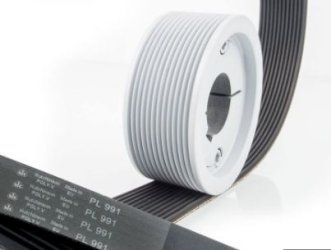
poly v.JPG

Toothed belts are also thin flat belts with all the same flexibility advantages as poly v, but they have transverse ribs, or teeth in them that engage in transverse grooves in the pulleys.
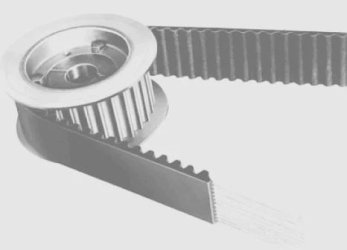
toothed belt.JPG

A toothed belt is the only type of belt that provides a positive drive, so it can be used for timing applications that would otherwise use chains. A very common application is camshaft timing belts (such as in the later incarnation of Ducati engines). But it is often used for non-timing applications such as motorcycle primary and final drives to eliminate slip and run quieter than chains, without the need for messy lubrication. Harley Davidson has been using toothed belt final drive systems for many years.

It's probably slight overkill to use toothed belts like Piet and PB2 have done with their generator (or alternator) drives because that's a light-duty application where a bit of slip is tolerable. But they have their own good reasons for doing it and the belts will be more than up to the task.
 
Gates Micro V belt which has almost invisible grooves, then cold form to the associated pulleys form factor, in the case of the Mazda V6 here, alternator drive to water pump to crank shaft, different belt for the power steering, segmented V belt, then a timing quad cam Gilmer belt. Multiple longitudinal groove belts 4PKxxx up to 7 or 8 PKxxxx ie first number is the number of grooves, after the PK, length in m/m. Sometimes the micro grooves can squeal, tightening the belt tension little values and run the risk of bearing damage, CRC out here have a product Belt Grip, which is exactly what is does, a tactile to the touch spray, which i had to use. Micro Groove belts are amazing as serpentine tortured routes on modern motors.

BTW why on earth do people insist "soap" is slippery? Been watching video on replacing front windscreens, "use plenty of soapy spray..." what to have your hands slippery as the caustic soda stripes the oil from your fingers..as it is not slippery on rubber, in fact the old squealing belt were subdued by rubbing soap on the belt... not making it more slippery to squeal more.. all across the yt university... bizarre... have proper wheel mount lube here, or silicon spray to ease rubber parts into position....another ramble...j
 
I struck one thing with polyvee belts which caught out an experienced race team. Thre was a supercharged speedway car built locally which used a polyvee belt for the blower drive. They'd seen the one I did which gave no probs. This one though had belt probs from the start. It wasn't till a South Island Champs meeting where I got a look at it for the first time. It was slicing the belt into strips. I ran my fingers over the pulleys and sure enough they were pointed. Like a single V belt it's supposed to run on the sides of the vees - not the tips.
They pulled the pulleys and shot into town to get the tips machined off. I shouldn't have said anything, that car won and the one I was looking after came second....Who'd have guessed - it was the first meeting that car had ever finished.
 
It's probably slight overkill to use toothed belts like Piet and PB2 have done with their generator (or alternator) drives because that's a light-duty application where a bit of slip is tolerable. But they have their own good reasons for doing it and the belts will be more than up to the task.
Yes Cam, definitely technical overkill.

Ran my engine yesterday and am very pleased with the result, the toothed belt runs centrally on the pulleys and evenly without the slightest sign of flutter. No load on the generator bearings as no tensioner is involved, I'm not expecting any wear at the belt for quite some time, should go on forever...

It could also be mentioned that modern automobile poly-vee belts, aka serpentine belts, can drive all manner of ancilleries in a single plane due to their flexibility, where conventional vee-belts were usually limited to maybe 2 driven components. If more was called for, there'd be 2 or more vee-belts running next to another, lengthening the crank nose considerably. My old Skoda TDI even has a double-sided poly-vee, driving AC compressor, power steering, and alternator from the crankshaft. It runs over an idler and a tensioner wheel. I swapped it out for peace of mind at around 350000km.

piet
 
When I was a kid I worked at an MOT station, helping with the inspections, wobbling wheels, beeping horns, turning steering wheels etc. I was warned never to put a DAF Variomatic on the brake tester “ or it will break the belts..”
Never did find out why? 🤔
 
Just installed my rebuilt generator with the V-belt that Wolfgang sent me, and it seems absurdly tight.. Wedged a piece of wood between genny and front tire to get the outside clamp started. I think that the Green Book describes usung a screwdriver to install the belt. Would destroy pulley or screwdriver with this setup. Help Mr Wizards! What am I doing wrong?
 

Attachments

  • Laverda gen belt.jpeg
    Laverda gen belt.jpeg
    163 KB · Views: 34
Used to put mine into the genny pulley and then wind the crank over while threading the belt onto the steel crank pulley. There's enough stretch to get it on without damaging it. Never needed to undo the genny nuts, but with my Mini-V I do.
 
As said it should wind on by rotating the engine. If it is too tight to wind on I would say the belt is too short, but new belts are bloody tight. Removal I use a screwdriver as a lever to start it climbing off the starter clutch pulley, not the aluminium one on the genny.
 
Yes that God Damn 750 generator belt is a weird size (Narrower then Standard). If you find the correct size buy more then one. A Woman's Nylon Panty Hose wrapped around the pulleys will work in a FIX ;o)
 
You selling kits Piet?
I've had a 750 of some sort for 50 years now, collectively ridden probably well over 300,000 kays and can only remember replacing that V belt a couple of times. Maybe they don't make V belts like they use to. As the crank end is the starter clutch how do you change the V to a tooth?
I like the idea of the upgrade. Maybe someone could be bothered to make replacement kits if there was enough interest.
Not intending to, Rob.

There seem to be pretty large tolerances in engine cases and mounts, the 2 engines to which I have fitted this required different adjustments for the belt tension. Only minor, but it may make THE difference in the long run. So it's not a simple plug 'n play solution.

The vee was machined from the starter clutch hosing, leaving a spigot onto which the alloy toothed pulley was shrunk. No further fasteners required. Don't know how I'm ever going to get it off though... should I need to. Easiest would be to simply machine it off I guess.

piet
 
I left my V on the starter freewheel, Piet. Faced the outer section of the V and reduced the OD a tad then threaded for three M6 bolts (low profile to clear the sidecover).
 
Back
Top