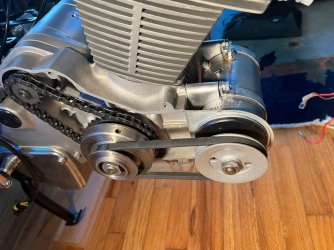
Sheesh!! I'm positive this conversation was had less than a fortnight ago on here! You DON'T have a toothed belt, Paul. It might have slits in the inner section but that is NOT a toothed belt.
Yes!! I thought for a moment I was experiencing some sort of Deja Vu. Seems many people don't know the difference between types of belt drives.
Maybe it's time for a bit of education on belts ...
The wavy edged belt that Paul posted a photo of is NOT a toothed belt. It's a type of V-belt. The power transmission is via friction between the wedge-shaped cross-section of the belt jamming into the V groove of the pulley. The wavy edge is only there to give it a bit more flexibility than the traditional solid (non-wavy) V-belt. It'll run on the same V-belt pulleys, so it's an option when fitting a new V-belt to go to the wavy-edge type. Indeed, some sellers only stock the wavy edge type nowadays. V-belts are the traditional drive for many automotive applications including fans, water pumps, and the Laverda 750 generator. In some applications there may be 2 or more belts used in parallel. I've seen up to 6 belts in industrial applications running in multi-groove pulleys. I won't bother pasting in a picture of a V-belt. We all know what they look like.
Poly V belts are flat belts that have longitudinal ribs in them. They run on special pulleys with multiple grooves. They work a bit like a whole bunch of little v-belts in parallel, but all joined together across their backs. Their main advantage over V-belts (either wavy or straight) is that they are much thinner and more flexible, so they take up less space. Their flexibility allows them to bend around much smaller pulleys which is also a space-saving benefit. They can also tolerate being bent backwards, so external roller tensioners can be used.
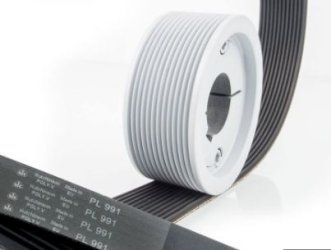
Toothed belts are also thin flat belts with all the same flexibility advantages as poly v, but they have transverse ribs, or teeth in them that engage in transverse grooves in the pulleys.
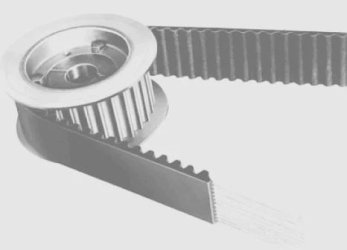
A toothed belt is the only type of belt that provides a positive drive, so it can be used for timing applications that would otherwise use chains. A very common application is camshaft timing belts (such as in the later incarnation of Ducati engines). But it is often used for non-timing applications such as motorcycle primary and final drives to eliminate slip and run quieter than chains, without the need for messy lubrication. Harley Davidson has been using toothed belt final drive systems for many years.
It's probably slight overkill to use toothed belts like Piet and PB2 have done with their generator (or alternator) drives because that's a light-duty application where a bit of slip is tolerable. But they have their own good reasons for doing it and the belts will be more than up to the task.