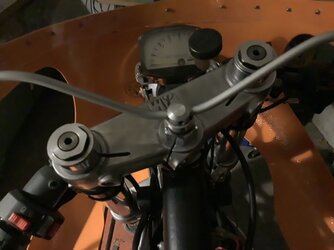
Ok here’s the question
Has anyone played with the offset of the steering head on their Laverda’s if so what was the results.
Standard is 45mm in the new money
If were bring the legs in by say 20 or 25mm to round 20mm such as Ducrappy use what would the real word affect.
So theory suggests that
“ Greater offset will decrease trail making the steering turn lighter, where-as less offset will increase trail making the bike more stable but also putting more weight on the front tire and this can lead to increased front end traction.
Some people feel that increased front wheel traction means "better turning."
So on an RGS what will this equate to less head shake and better turn in or the opposite hmm it seems Laverda ran with the 45mm offset all the way through but why ? Was there a valid reason or just that is what they figured was correct. An RGS has a different rake than the earlier bikes but same offset.
So if one was to reduce the triple clamp offset then what would on a Laverda specifically the down sides be.
First hand experience would be a lot more valuable than theory as I can read about it all day but until someone has it in practice on the bike in question then that is all it is Theory.
Yep I hear ya that I can do it and report back and it’s likely exactly what will happen but well if there is already some pioneers out there... I know we mucked around with it in the 90’s but cant remember what the outcome was and we didn‘t have modern tyres and such back then to compare with.
Hope Im not confusing folk here by what I mean by offset so have attache an drawing ...
At least it aint no oil or tyre thread LOL
Has anyone played with the offset of the steering head on their Laverda’s if so what was the results.
Standard is 45mm in the new money
If were bring the legs in by say 20 or 25mm to round 20mm such as Ducrappy use what would the real word affect.
So theory suggests that
“ Greater offset will decrease trail making the steering turn lighter, where-as less offset will increase trail making the bike more stable but also putting more weight on the front tire and this can lead to increased front end traction.
Some people feel that increased front wheel traction means "better turning."
So on an RGS what will this equate to less head shake and better turn in or the opposite hmm it seems Laverda ran with the 45mm offset all the way through but why ? Was there a valid reason or just that is what they figured was correct. An RGS has a different rake than the earlier bikes but same offset.
So if one was to reduce the triple clamp offset then what would on a Laverda specifically the down sides be.
First hand experience would be a lot more valuable than theory as I can read about it all day but until someone has it in practice on the bike in question then that is all it is Theory.
Yep I hear ya that I can do it and report back and it’s likely exactly what will happen but well if there is already some pioneers out there... I know we mucked around with it in the 90’s but cant remember what the outcome was and we didn‘t have modern tyres and such back then to compare with.
Hope Im not confusing folk here by what I mean by offset so have attache an drawing ...
At least it aint no oil or tyre thread LOL