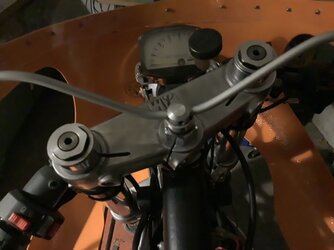
Triple clamp offset and the pro’s and con’s of 25 vs 45 mm on a triple ( RGS to be exact )

2622

Hero member
Location
Sydney
Ok here’s the question
Has anyone played with the offset of the steering head on their Laverda’s if so what was the results.
Standard is 45mm in the new money
If were bring the legs in by say 20 or 25mm to round 20mm such as Ducrappy use what would the real word affect.
So theory suggests that
“ Greater offset will decrease trail making the steering turn lighter, where-as less offset will increase trail making the bike more stable but also putting more weight on the front tire and this can lead to increased front end traction.
Some people feel that increased front wheel traction means "better turning."
So on an RGS what will this equate to less head shake and better turn in or the opposite hmm it seems Laverda ran with the 45mm offset all the way through but why ? Was there a valid reason or just that is what they figured was correct. An RGS has a different rake than the earlier bikes but same offset.
So if one was to reduce the triple clamp offset then what would on a Laverda specifically the down sides be.
First hand experience would be a lot more valuable than theory as I can read about it all day but until someone has it in practice on the bike in question then that is all it is Theory.
Yep I hear ya that I can do it and report back and it’s likely exactly what will happen but well if there is already some pioneers out there... I know we mucked around with it in the 90’s but cant remember what the outcome was and we didn‘t have modern tyres and such back then to compare with.
Hope Im not confusing folk here by what I mean by offset so have attache an drawing ...

At least it aint no oil or tyre thread LOL
 

Attachments

  • 0B5D06BD-059A-4005-9668-602BDBA53406.jpeg
    0B5D06BD-059A-4005-9668-602BDBA53406.jpeg
    46.9 KB · Views: 20
Bloody good question, that difference is HUGE and always surprised me at how big a change it is. I have seen really big changes on modern bikes with tiny, 5mm push-through of fork legs but they usually have small trail dimensions already. Just swapping the 3C 1.5deg offset trees to SFC style parallel trees was, don't remember their offset, suppose to help stability APARENTY. And there is steering angle clearance, especially on an RGS tank?
 
Valid point but it’s off topic in that it’s not addressing the question
Understand could be issues with tank, pipes and such but what about handling as angle will still be the same only the offset

probably pass on the Ducrappy ones and get customs made to 45mm but thought it was interesting question none the less
 
I think there are a couple of blokes who build RGS based race bikes in Oz, I wonder what trees they used? I think one used BMW 41mm forks, but I don't remember what trees he used.
 
No please read the post
I am going to put a set of M1R‘s on the bike they have 41.7 tubes need a set of triple clamps but no one seems to have a set so its either custom or Ducrappy ones... which are only 20mm offset But a cheaper option though already have explored the possibility of getting some sets made up so will most likely go that way.. the head shake on the RGS is when slowing down from 50 to 40ish MPH quite typical and no when I put the radials on as per el Presidente advice its kind of better but still there a tad.. new tyres and its fine.. all my RGS‘s are like that and since even new though with the old ribbed phantom back in the day was hardly noticeable I must say.. so a new tyre on front of RGS its fine until it gets some wear then heaven forbid taking the hands off the bars when coming into a town as I do on my early bikes... but everyone knows that feeling on RGS’s anyway that is not the real reason why the change am doing it cause have the forks.. and just quietly it may not be the RGS am putting them on but that is another topic for another day ...

So can we get back on point what is the affect pro and con about the change in offset has anyone experience on a triple doing this ??
 
Trail on a stock RGS is around 114mm.

I fitted a BMW K100 front end to the RGS track bike I built a few years ago, which had 50mm offset. It reduced the trail to 108mm, which is still a pretty large trail measurement by modern standards. The bike rode and handled OK (no sign of head-shake at any speed). But I also added some stiffening around the steering head and swing arm pivot that may have made it more tolerant of shorter trail. I dunno how different it felt from the original setup because I got the bike as a basket case and never rode it in its original form.

Small adjustments in triple clamp offset would have a negligible affect on weight distribution, so I'm very sceptical about your comments on front end traction.

As you say, the usual wisdom is that increased trail makes a bike more stable, and reduced trail makes it more twitchy. The larger the trail measurement, the more forcefully the wheel will self-align, and the more difficult it will be to initiate a steering input. That's why long trail bikes like bevel Ducatis are slow to steer but tend to track well over bumps etc.

But that's only part of the story. Frame and swing arm stiffness, suspension geometry, spring and damping rates, weight distribution, tyres, unsprung weight, rotational inertia of the wheels, etc. all play a part in a bike's stability. Modern sports bikes with supremely stiff frames, light wheels and good suspension can get away with much less trail than our old clunkers, while still maintaining good stability.

Instability (a tank-slapper for example) can be thought of as a feedback problem. Imagine the front wheel being jerked a wee bit off-line by a pebble. The trail effect will bring it back to centre. But the self centring force will normally over-correct and offset the steering in the opposite direction. It can sometimes take a few cycles for the oscillations to damp out and settle down. Normally such oscillations are quite small not detectable amongst all the other bumps and vibrations coming through the handlebars. But if the period of the steering disturbance and self-correction is somewhere near the natural frequency of the frame, wheel, tyre combo, it can set up an oscillation with increasing amplitude = tank slapper.

While short trail TENDS to be less stable, that's not necessarily the case for every bike. If your change in the trail dimension (regardless of whether you increase or decrease it) brings the steering response period into synch with the frame's natural oscillation frequency, then your bike will become less stable. It's not something that's easily determined empirically. Experimentation is pretty much the only practical way to get an answer.

So I'd suggest you try it and see what happens.
 
The answer IMO anyway, is quite simple. If you're having custom yokes made, make them adjustable.

The Harris pattern with inserts of variable thickness is probably the simplest.

You can then have the fun of finding the perfect trail figure - and tell everyone else.
 
The wobble isn't going to go away with the stronger forks, but the tendency may decrease a bit with more trail.

I use SFC1000 yokes in my RGS, which have the same off-set as the stock 38mm items, the wobble is much the same as before. After many years on BT45s, I succumbed to the Conti hype... not enough improvement to make it worthwhile, much the same wobble as before. OK when brand new, but 2000km on, as soon as tyre dampening starts deteriorating, the wobble sets back in with a vengeance. Besides that, the Conti feels quite vague and nowhere near as reassuring in the wet as the BT, going straight back when the Conti wears out!

piet
 
The wobble isn't going to go away with the stronger forks, but the tendency may decrease a bit with more trail.

I use SFC1000 yokes in my RGS, which have the same off-set as the stock 38mm items, the wobble is much the same as before. After many years on BT45s, I succumbed to the Conti hype... not enough improvement to make it worthwhile, much the same wobble as before. OK when brand new, but 2000km on, as soon as tyre dampening starts deteriorating, the wobble sets back in with a vengeance. Besides that, the Conti feels quite vague and nowhere near as reassuring in the wet as the BT, going straight back when the Conti wears out!

piet
Interesting, sorry must have confused you all,
I am not trying to solve the wobble on the RGS its not the reason why am asking the question been riding them since the beginning... Now beginning to wish I had never mentioned that part now to be honest...............ha ha re the Conti comment I got much the same on the RGS and here in Aus they are not cheap.. I just put a Dunlop roadsmart 4 on it and it seems better but its new but half the dam price. With the old rubbed front from back in the day it was not an issue or if it was I was too young and stupid to notice it.

Figured re the offset that It was a simple question obviously not.....

Hey Cam the facts I stated about the load were actually from a suspension guru over on another site but they were addressing this question on a BMW RR but seemed to get more info from there to be honest but not a conclusive answer so figured would put it to the brains trust here.......

So I am going to speak to someone who will give me a proper answer on Monday easy he is a suspension specialist ..........just had a deal on a set of adjustables but no they wont go all the way to 45 from 20.
 
OK. No experience with an RGS but I can offer my discoveries with my SF and 'modern' fork installations - but all in conjunction with 17 inch wheels (which with 38mm M1Rs and std Jota 45mm offset parallel clamps) gave me the first tank slapper I'd ever experienced in 30 of years of ownership (very fukken scary, BTW) - that turned out to be zero rebound damping in the forks - someone at Gowanlochs had taken the pistong ring out and replaced it with a piece of scrap plastic - brands new forks).

I then had Honda non adjustable VFR forks and triple clamps (probably 30mm offset). Fork springs were way too soft but alternatives never gave me a front end I could trust so they were tossed not long after.

Early Suzuki GSX-R750 forks and triple clamps followed (25 or 30mm offset). Worked OK but even being short forks (which shortened the rake and steepened the front end) it felt wrong. Considering a std SF is something like 29 deg of rake the trail figure would have been huge. It was stable, and full song at a track day at the island was fine, except for lack of cornering clearance. On the road, it never felt 'in balance' - hard to describe, but ads if the front end (ie steering) was pivoting in too horizontal a plane. The bike was always rideable and stability was fine with forks that had lower stiction and adequate rebound damping, but it definitely had a tendency to bump steer.

My conclusion is that a std Laverda rake figure of 29 deg is never going to work with a 30mm offset triple clamps. Not sure what RGS (or other triples) use, but the trail figures on my bike were all wrong. So - the new incarnation - the SFQ - has a 25-26 degree rake, 30mm Yamaha YZR750SP triple clamps and forks (low stiction, fully adjustable USD), 17 inch wheels, a longer (probably stiffer) swingarm to counteract the loss of wheelbase from the tighter head angle and modern rubber. I've also fitted an Ohlins steering damper just in case.

From my mixed experiences (the early ones being born of lack of knowledge and ignorance) you can't use modern geometry without going the whole hog. If you do the calcs and the trail figures are upwards of 110mm and you run long rake, your bike will steer like a barge. Modern 30mm offset clamps are made for bikes running steep (26 deg MAX) head angles, short low-stiction rigid forks (so low head tubes, strong rigid frames) and probably 17 inch wheels. Add to that the effect when cornering of wide tyres (back much wider than front) and you can see how it all works as a combo.
 
Last edited:
Ok here’s the question
Has anyone played with the offset of the steering head on their Laverda’s if so what was the results.
Standard is 45mm in the new money
If were bring the legs in by say 20 or 25mm to round 20mm such as Ducrappy use what would the real word affect.
So theory suggests that
“ Greater offset will decrease trail making the steering turn lighter, where-as less offset will increase trail making the bike more stable but also putting more weight on the front tire and this can lead to increased front end traction.
Some people feel that increased front wheel traction means "better turning."
So on an RGS what will this equate to less head shake and better turn in or the opposite hmm it seems Laverda ran with the 45mm offset all the way through but why ? Was there a valid reason or just that is what they figured was correct. An RGS has a different rake than the earlier bikes but same offset.
So if one was to reduce the triple clamp offset then what would on a Laverda specifically the down sides be.
First hand experience would be a lot more valuable than theory as I can read about it all day but until someone has it in practice on the bike in question then that is all it is Theory.
Yep I hear ya that I can do it and report back and it’s likely exactly what will happen but well if there is already some pioneers out there... I know we mucked around with it in the 90’s but cant remember what the outcome was and we didn‘t have modern tyres and such back then to compare with.
Hope Im not confusing folk here by what I mean by offset so have attache an drawing ...

At least it aint no oil or tyre thread LOL
You might find the fork tubes hit the tank
 
I have reduced the offset on my own SFs both road and race by 20mm from 65mm to 45mm with parallel clamps, the difference in feel is not much but I prefer it. The bike feels that it steers more neutral, the amount that it steers slower is not really noticeable, but it feels more neutral and has no tendency to stand up if braking in corners or fall into in corners on tip in. Both these bikes now have about an inch longer rear shocks to speed up the steering, but the clamp change came first. RGS and SF have both pretty long rake figures and are naturally very stable - except for this wobble when slowing down that apparently RGS suffer from. That said, going another 20mm is unknown territory and I am too happy with my bikes to want to even try it.
 
Not RGS...

My 3C has M1R fork legs from a Ducati 851 mated to modded GSXR yokes, reckon they have about 20mm less off-set than the SFC1000 yokes I used before that. Bike tracks beautifully, but I also have a RGS swingarm to more than compensate "lost" wheelbase at the front. This also gets weight bias to where I want it. Head angle has not been altered, but the whole bike has been lifted with the longer fork legs and revised rear shock mounts to achieve half-decent cornering clearance.

piet
 
Interesting, sorry must have confused you all,

Figured re the offset that It was a simple question obviously not.....

Hey Cam the facts I stated about the load were actually from a suspension guru over on another site but they were addressing this question on a BMW RR but seemed to get more info from there to be honest but not a conclusive answer so figured would put it to the brains trust here.......

So I am going to speak to someone who will give me a proper answer on Monday easy he is a suspension specialist ..........just had a deal on a set of adjustables but no they wont go all the way to 45 from 20.

No it's not a simple question.
Your suspension guru is going to want hard facts. Headstock angle, fork length and wheel diameter. Also what the current figures are.
Given the fixed numbers he's going to make an educated guess at what trail range will suit you. That's the point where you have an adjustable set made up,
Once on the bike, the variables continue. Some tyres have a strionger inbuilt self centering effect than others. Ride height will have to be adjusted.

If your guy can or will give you a "proper answer" you're lucky. It's a wide ballpark.
 
I use those at my self build bike which have 20 mm less offset (Duc?) than the original with 45 mm.
Later Scrumpy sold me a set of orinales.
maybe I am not very sensitive but the bike is running well, I had no difficulties with the steering forces and no issue with less or to much stiffnes of the bike. In theory the trail is longer which should make steering stiffer and worse handling.
But I use 380 mm dampers and the fork as you can see is pushed through abaut 30 mm which compensates the longer trail a bit.
I use a BMW K 1100 fork which is also 41,7 mm. The fork is much stiffer as the sliders are much longer.
 

Attachments

  • F7ACF588-8A06-4EE0-A7EC-A5E0193AA299.jpeg
    F7ACF588-8A06-4EE0-A7EC-A5E0193AA299.jpeg
    151.1 KB · Views: 45
  • 35E577CC-16AB-4303-8CBE-8B49E9523696.jpeg
    35E577CC-16AB-4303-8CBE-8B49E9523696.jpeg
    68.6 KB · Views: 36
  • 51781044-50BE-4EFC-B1DF-E04B6392A754.jpeg
    51781044-50BE-4EFC-B1DF-E04B6392A754.jpeg
    70.9 KB · Views: 45
I used to frequent the Speedzilla site and they had a lot of 4 valve Ducati racers there. Other than the crazy money they loved to spend on Carbon Wheels, this was maybe 15 years ago, the other big mod was fitting factory Magnesium Swingarms. But that couldn't be done unless the bike ran the steepest rack angle they could get with the standard adjustable trees the bikes came with. Apparently, you couldn't do one without the other or the bikes would be unrideable. But this was obviously on modern bikes with hairline geometry, trail figures in the 70 to 80mm range, and when we did a quick measure of Crispins Space Frame thats close to what they run, I wounder what offset trees they many used?
 
Hey Cam the facts I stated about the load were actually from a suspension guru over on another site but they were addressing this question on a BMW RR but seemed to get more info from there to be honest but not a conclusive answer so figured would put it to the brains trust here.......
It depends how they changed the trail. If it was just adjusting the triple clamp offset, it wouldn't have much of an effect on weight distribution. If it was done by pulling the forks up through the triple clamps, then it would probably have more of an effect.

I admit that I'm just giving an opinion without actually working it out. But it's not difficult to do the sums if you want a definitive answer. Just draw a diagram of the bike, locate its centre of gravity and wheel contact points on the ground. Using the distances from CG to each contact point you can figure out the weight distribution. Plug in the numbers for your proposed geometry alteration and you have the answer.

If you don't know where the CG is, you can work it out from the bike's existing weight distribution. For example, if it's 50/50, then the CG is at the mid point between the wheel axles.

Actually, it's good to know all this stuff before you embark on any frame or steering alterations. As a starting point, the table below gives a few measurements for a stock RGS.

Note: I got the trail figure wrong in my earlier post. Sorry about that. I was working from memory which is never a good idea. Looking at my notes, I can see where I got the 114mm trail measurement from. The castor angle on my RGS was reduced to 27° which reduced its trail.

Obviously tyre radius will have an effect on trail. Higher profile tyre will increase trail. For instance, if I increase the tyre radius to 322 (probably about average for a new tyre) with all other measurements remaining the same, the trail increases to 127mm

Fork length 805mm
Wheelbase 1520mm
Castor degrees 29° (from factory spec)
Rolling radius 318mm (refers to the actual front tyre of my RGS, which was a bit worn at the time of measurement. This will vary depending on tyre profile)
Triple clamp offset 45mm
Trail 125mm

If you have CAD software, it'll make a lot of this geometry stuff easier. You don't need spend thousands on full-blown AutoCAD. Any cheapo 2D CAD will be more than sufficient for this sort of stuff.
 
Hmm I'm learning all sorts of stuff here. I don't want to bog down the thread with dumb questions, but maybe it'll help...
Would it be correct to say that a 20mm change in offset is going to make quite a large change compared to say, raising the rear suspension by 20mm? Also am I right to think that the distance of reduction in offset is almost equal to the increase in trail?
 
Back
Top