Tubeless conversions

Interestingly Enduro or Extra thick inner tubes are not recommended for road use due to excessive heat build up. Thicker will not resist a puncture by nail or thorn any better but will be more resistant to rim pinching when running low pressure off road. Laverda are heavy with narrow, heavy carcass tyres so heat build up could be a factor. I’m not going to tempt fate by recalling my last puncture but I have never had a front puncture but in my work I have fixed one front for every hundred rear punctures- which I find odd because you must ride over the nail with the front wheel? I have removed an engineers scriber, a broken fox bone and half a set of nail clippers from punctured tyres and also found a tyre lever inside one! I have used Continental inner tubes and they seem good .
I don't ride at high speed for any kind of distance, so there's no risk my tubes getting too hot.
Maybe from time to time 30 or 40 km on a motorway at 120 km/h.
Paul
 
Did you try the explosion method, it either works or you burn your workshop down. That fix in a can has worked for me in an emergency but like plugs, it won't fix everything. That close to blowout was so lucky for me, lately we haven't had a trailer backup much, we get pretty remote sometimes. That ride for some odd reason we had a trailer, it rescued me Saturday afternoon and we also lucked out fixing my flat, and it also rescued another bike with gearbox issues the next day. It's good to be lucky.
 
I am surprised that people are converting tubed wheels with tape or fitting tubeless tyre on tubed rims, I wouldn’t.
I don't ride at high speed for any kind of distance, so there's no risk my tubes getting too hot.
Maybe from time to time 30 or 40 km on a motorway at 120 km/h.
Paul
But you do have panniers and very hot French roads- not to mention extra wind resistance to overcome with those sticky out feet!
 
Paul,after suffering a front tubed puncture last week on the way to Willersey we used some of this to repair and inflate the wheel by the roadside.
Worked well and we even managed to get home safely on it 100 ish miles.

On a European trip I generally carry spare tubes with me but funny enough I don't carry the tools in order to change one!......I have now purchased a small self contained tyre compressor (battery operated) and will certainly carry some of this repair foam with me on future trips.
View attachment 91602
I always carry one on long trips but on the two or at the most 3 times I've used it, it was to no avail.
I have used the liquid rubber preventive stuff though and have never had a puncture with it but punctures are a pretty rare occurence if you don't wear your tyres down to the carcass. I presently have some of that stuff in my Falcone which has tubed of undetermined age and was slowly loosing pressure. It doesn't any more.
Paul
 
That key thing is important, Once it was a locked fuel cap with that key left at home and another time we spent a good hour searching for a single key, who uses a single key, that was lost. It was eventually found in the bloke's Jacket liner, it had gone through a pocket hole. We rarely travel at really high speeds, especially close to major roads. The licence risk is way too big. Mostly we are on tight windy roads that also don't allow really high speeds either. It does happen occasionally but even then it's for maybe 30 minutes and then it's back to tight stuff.
 
In all my decades of riding - including everywhere in and around Australia a couple of times in the 70s - and not owning a car for the first 15 years of my motorcycling life, I only ever suffered one flat - on my own between Cloncurry and Mt Isa (we're talking outback remote here). Had the tyre levers, the one spare tube, and the mini pump. Maybe just lucky but it seems with decent tubes, flats ARE rare.
 
I have had maybe 3 on road in 40 plus years, and a few more offroad, 12psi and big hits and jumps product pinch flats.
 
In all my decades of riding - including everywhere in and around Australia a couple of times in the 70s - and not owning a car for the first 15 years of my motorcycling life, I only ever suffered one flat - on my own between Cloncurry and Mt Isa (we're talking outback remote here). Had the tyre levers, the one spare tube, and the mini pump. Maybe just lucky but it seems with decent tubes, flats ARE rare.
If you where waterproofs it doesnt rain! The fact that you take the tube means you also check your tyres/ pressure condition etc - people who get a lot of punctures also have chains that snap and flat batteries🤔
 
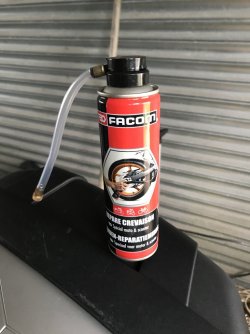
I buy this in Super U in France, the can is a little smaller than most so can be carried more easily and it’s one of the few which actually states it’s suitable for tubed as well as tubeless tyres. Doesn’t always work but when it does I’ve been very glad.
There’s a builders silicone/glue called CT-1 which will seal spokes should you want to try tubeless.
IMG_8837.jpeg
 
I buy this in Super U in France, the can is a little smaller than most so can be carried more easily and it’s one of the few which actually states it’s suitable for tubed as well as tubeless tyres. Doesn’t always work but when it does I’ve been very glad.
There’s a builders silicone/glue called CT-1 which will seal spokes should you want to try tubeless.
View attachment 91603
Facom- French equivalent of Snap-On
 
3 flats rear tire in one day, North Island of NZ, 1979.
For the first flat, I had a spare tube so in it went, and checked the inner and outer surface of the tire to no avail I could not find the cause of the puncture. About 40km down the road I got another puncture f...,! Luckily for me, I had a puncture repair kit, one of the old-school vulcanizing kits, I have not seen those for years. Once again a detailed intense examination of the tire did not reveal the culprit and lucky for me I had a couple of mates (BMW riders) who helped out with the changes.
Well, 30 km down the road it happened again I was not a happy man. A comparison between the two tubes showed that each puncture was happening in the same spot. A detailed inspection and pressing down on the tire from the tread side revealed that there was a sliver of sharp metal embedded in the tire carcass, it looked like part of a saw blade maybe 5mm long. Whenever I hit a big enough bump in the road the compression of the tire would push that little sliver of metal through the tire and into the tube, problem solved. Lucky for me I had tire levers, patches, a BMW pump, and help. Metzler's tire was a bitch to break the bead.
but I have never had a front puncture but in my work I have fixed one front for every hundred rear punctures- which I find odd because you must ride over the nail with the front wheel?
I read the reason why the rear tire is punctured more frequently, which applies to all vehicles, not just motorcycles. It is because the nail or other object is lying flat on the road and when the front wheel rolls over the nail it raises it off the road sufficiently enough that it is at a perfect angle to pierce the rear tire.
 
3 flats rear tire in one day, North Island of NZ, 1979.
For the first flat, I had a spare tube so in it went, and checked the inner and outer surface of the tire to no avail I could not find the cause of the puncture. About 40km down the road I got another puncture f...,! Luckily for me, I had a puncture repair kit, one of the old-school vulcanizing kits, I have not seen those for years. Once again a detailed intense examination of the tire did not reveal the culprit and lucky for me I had a couple of mates (BMW riders) who helped out with the changes.
Well, 30 km down the road it happened again I was not a happy man. A comparison between the two tubes showed that each puncture was happening in the same spot. A detailed inspection and pressing down on the tire from the tread side revealed that there was a sliver of sharp metal embedded in the tire carcass, it looked like part of a saw blade maybe 5mm long. Whenever I hit a big enough bump in the road the compression of the tire would push that little sliver of metal through the tire and into the tube, problem solved. Lucky for me I had tire levers, patches, a BMW pump, and help. Metzler's tire was a bitch to break the bead.

I read the reason why the rear tire is punctured more frequently, which applies to all vehicles, not just motorcycles. It is because the nail or other object is lying flat on the road and when the front wheel rolls over the nail it raises it off the road sufficiently enough that it is at a perfect angle to pierce the rear tire.
I’d be interested to see if that is true of front wheel drive vehicles- if you think of what a bad idea a pneumatic tyre is, it’s a wonder we don’t get punctures daily.
 
No way I'll be riding with enduro tubes. Might be ok for cruising along enjoying the scenery but not if you enjoy getting stuck into it. I'm running tubes in my 17 inch Sportmaxes but might have to consider the tubeless conversion. I've avoided it on my road bicycle because I don't fancy having a tubeless tyre that has flatted out in the middle of nowhere (eg today up in the Streszleckis) and possibly can't be inflated to seal against the rim. Have had a MTB tyre in the shop workshop that simply would not inflate, even with a compressor and every trick thrown at it.
Doing a little googling on tapes available here i see that the MTB tubeless conversions have the tape going to the edge of the rim. The bead is supposed to seat on a taped area. I'm looking at going tubeless on the 250 AJS when new rubber goes on it at the end of the month.
Shouldered alloy rims WM2 and 3 so not wide. Doubt it would be a problem taping right out to the bead seating area. We'll see.
 
I first converted the rims on my Thruxton R , they have a rough edge on the rim to prevent tyre slip, I found that the first set of Pirelli tyres sealed well, the Continentals developed a slow leak around around the rim edge. What I found was that the sealing lip of the Pirelli's was softer and able to seal against ribbed edge of the rim. The Conti's had a harder compound seal that couldn't deform enough to fully seal the rim.
My solution was to polish out the ribs on the wheel rim to gain a proper seal against the tyre sealing lip.
When converting aluminium rims over to tubeless check that the sealing area of the rim is nice and smooth, chances are that they have gauges and corrosion marks on the walls. These need to be polished/smoothed out to obtain a seal. This works well.
Another factor to aware of is the sealing of the tubeless valve into the rim, the rubber sealing washer needs to seal well and it would be necessary to counter bore the surface of the rim slightly to obtain a flat surface, care needs to be taken not to weaken the rim. Might be easier to put a flat on the hub side of the rim and seal from the outside.
Can't comment on the MTB kit but would be concerned about taking the tape out to the sealing area, would imagine it working well for the first tyre placement but subsequent tyre changes may wreck the tape.
 
Last edited:
Another factor to aware of is the sealing of the tubeless valve into the rim, the rubber sealing washer needs to seal well and it would be necessary to counter bore the surface of the rim slightly to obtain a flat surface, care needs to be taken not to weaken the rim. Might be easier to put a flat on the hub side of the rim and seal from the outside.
I have used engineering epoxy to bond a suitable flat washer into rims for the valve to seal onto. “Off highway use only” and other disclaimers.
 
Given how thin alloy rims are, I suspect that a suitable flat could be achieved simply by tightening a nut, bolt and washers onto the area around the valve hole.
 
Converting a tubed rim to tubeless was originally made popular by the off road guys in the US. Tape, epoxy, silicone rubber in fact anything to stop the air leaking out of those pesky spoke holes. Bear in mind they are riding at half the speed you are on the motorway on a bike that weighs half that of yours, with incredibly stiff tyres that are designed to run with virtually no pressure.
Honda ( then BMW and the rest..) spent a lot of time and money developing the spoked tubeless rim , literally reinventing the wheel- makes you wonder why they didn’t just wrap the old ones in tape or seal up the holes with glue?

First problem I have with this is in my work I came across wheels that had gaffa/ duck tape instead of a rim tape- they all had corroded bead seats and corroded spoke nipples/ spoke ends, Why ? Beacause water/ salt becomes trapped above the tape ( unlike metals, water etc..) which it wouldn’t with a real rim tape. So you now have a situation where you have sealed this important area below the spoke holes from any possible inspection , fizzing away with corrosion- then you subject it to massive centrifugal loads. So your slowly corroding epoxy, silicone, taped up sub rim is clinging on for dear life- bear in mind also that corrosion is sped up because you have subjected the inner rim to high pressure air which it didn’t have when you had an inner tube ( think dive bottles) Finally, your home modded rim doesn’t have the two inner “ safety lips” - these interestingly enough are designed to keep a deflated tyre on the rim “ for safety”…but yours doesn’t have them🤔
What you lot do to your own bikes is down to you, my self and every motorcycle, tyre and wheel manufacturer would suggest you don’t.
 
Just some comments, do stainless spokes and alloy rims corrod, are nipples made out of brass or stainless? We don't get salted roads. in Oz I watched another Laverda rider this time with a cast rear wheel that had a 100mm bolt flatten a tyre out of pure necessity ride it wobble like hell for 30ks at maybe 40kph on a very flat tyre. It was in the middle of nowhere. It was ugly to watch him struggle but even that torture didn't detach the tyre. My last comment, Woodys Wheels in the USA did a lot of this, they would do rear wheels but NOT front wheels. I haven't done this to any bike yet, but I like learning about all the pluses and minuses.
 
Just some comments, do stainless spokes and alloy rims corrod, are nipples made out of brass or stainless? We don't get salted roads. in Oz I watched another Laverda rider this time with a cast rear wheel that had a 100mm bolt flatten a tyre out of pure necessity ride it wobble like hell for 30ks at maybe 40kph on a very flat tyre. It was in the middle of nowhere. It was ugly to watch him struggle but even that torture didn't detach the tyre. My last comment, Woodys Wheels in the USA did a lot of this, they would do rear wheels but NOT front wheels. I haven't done this to any bike yet, but I like learning about all the pluses and minuses.
With regards corrosion - it’s all to do with the galvanic table, basically if you have two metals and one has a higher resistance to corrosion the weaker one will corrode faster ( see sacrificial blocks/ plates on boats and positive earth vehicles) Add water and you’ve got yourself a battery! Case in point they don’t do stainless brake lines with alloy fittings for road use.
If Woodys Wheels only do rear wheels and not fronts ….
 
Back
Top