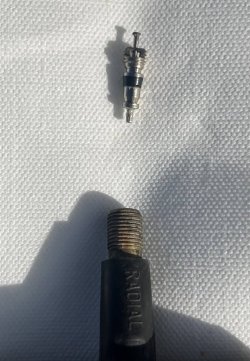
Tubeless tires?

No race scrutineer will accept plastic valve caps. Must be a reason for that.

Pretty horrifying losing pressure at high speed through centrifugal forces opening the valves. Metal caps are pretty much foolproof, plastic can fracture through over tightening.

Guess they're better than none at all though...

piet
 
I understand the theory of centrifugal force opening a tyre valve, but does it really happen in practice? Surely all you'd need to prevent that happening is a valve spring of sufficient strength to keep the valve closed at any speed a motorcycle is capable of. It would be pretty rubbish design practice for valve manufacturers to ignore such a critical requirement.

I've done some silly speeds on motorcycles, well in excess of 200kph, but I don't know if the tyre valves were affected because I always use valve caps.

One of these days when I have nothing better to do, I'll pull the valve out of a tyre and measure the force required to lift the valve off its seat. Then remove the valve plunger part so I can weigh it. Those data, together with the diametric distance of the valve from the wheel centre will provide sufficient information to do the rotational dynamics number crunching to calculate the wheel RPM required for centrifugal force to overcome the combination of valve seat spring pressure and internal tyre air pressure. obviously wheel RPM is directly related to road speed.

The only thing stopping me is that I don't have a scale sensitive enough to weigh the little valve plunger or measure the spring pressure accurately enough. I reckon I need a jeweller's scale with a resolution of 0.01 gram. All I've got is a digital kitchen scale that has 1 gram increments.

Perhaps I should suggest it to my local high school as an experiment to be done in their physics practical sessions.
 
Apparently it happened to a local Guzzi racer on the straight at Eastern Creek track, or at Least he had a sudden, unexplained loss of front tyre pressure, and it was put down to that. I've run steel tyre caps since an ex-racer told me about this a few decades ago. It's so easy to do, so why not.
 
I understand the theory of centrifugal force opening a tyre valve, but does it really happen in practice? Surely all you'd need to prevent that happening is a valve spring of sufficient strength to keep the valve closed at any speed a motorcycle is capable of. It would be pretty rubbish design practice for valve manufacturers to ignore such a critical requirement.

I've done some silly speeds on motorcycles, well in excess of 200kph, but I don't know if the tyre valves were affected because I always use valve caps.

One of these days when I have nothing better to do, I'll pull the valve out of a tyre and measure the force required to lift the valve off its seat. Then remove the valve plunger part so I can weigh it. Those data, together with the diametric distance of the valve from the wheel centre will provide sufficient information to do the rotational dynamics number crunching to calculate the wheel RPM required for centrifugal force to overcome the combination of valve seat spring pressure and internal tyre air pressure. obviously wheel RPM is directly related to road speed.

The only thing stopping me is that I don't have a scale sensitive enough to weigh the little valve plunger or measure the spring pressure accurately enough. I reckon I need a jeweller's scale with a resolution of 0.01 gram. All I've got is a digital kitchen scale that has 1 gram increments.

Perhaps I should suggest it to my local high school as an experiment to be done in their physics practical sessions.
And then calculate how a hard plastic screw cap can split in just such a way as to penetrate down the hole and depress the spring.
 
It isn’t something that scrutineers check here, although I always make sure I’ve got a valve cap on, metal or plastic in good condition, ya never know!
And I’ve got plenty of spares, I keep finding them near the air pump at garages, bit like the shoes I find outside the mosque
 
I understand the theory of centrifugal force opening a tyre valve, but does it really happen in practice? Surely all you'd need to prevent that happening is a valve spring of sufficient strength to keep the valve closed at any speed a motorcycle is capable of. It would be pretty rubbish design practice for valve manufacturers to ignore such a critical requirement.
Yes, it most definitly does!

Experienced it first-hand on a mates' bevel Ducati on the Nürburgring, way back when.

Angled, srew-in valve stems on cast wheels can be a safeguard, the angle of the valve insert counters the centrifugal force to a large degree. Not game enough to try it out though...

The Schrader valve is indeed a pretty old design and was more than capable of coping with the attainable speeds of the time. Manufacturers specify fitting caps on the valves, they're part of the design.

piet
 
And then calculate how a hard plastic screw cap can split in just such a way as to penetrate down the hole and depress the spring.
Doesn't even need to depress the little plunger.

I've found loads that had simply split around the end of the cap preventing it from sealing properly. V-max over a 10km stretch of autobahn will have you riding on the rim... thankfully, the air escapes gradually.

piet
 
OK I understand now that the problem with the valve is that it needs a metal cap with a proper gasket to prevent air escaping as the valve core is depressed by centrifugal force. Plastics should have been banned decades ago. My VFR still has the original plastic, and the spare tube I recently bought also has one. With luck it is a case of faulty valve cores but I will get rid of them.
 
Metal valve caps have been a requirement at race meetings in the UK/IOM for some years now.
However, I have somehow managed to survive 40+ years of high speed riding with plastic valve caps on some bikes, and even no caps at all on some occasions. 😱
 
Metal valve caps have been a requirement at race meetings in the UK/IOM for some years now.
However, I have somehow managed to survive 40+ years of high speed riding with plastic valve caps on some bikes, and even no caps at all on some occasions. 😱
Never had a problem, with plastic caps, including max chat, plug chops.
 
Hang on …… I’m not a mechanic or engineer, but Piets comment on SFC valve springs made me wonder🤔

If that little shit spring is all it takes to keep the valve closed. Surely the air pressure of the inflated tyre is the keeper of pressure against the valve seat, not some piddling biro spring
 
Chris I think it's similar to Bevel valve springs; the Desmo bits are similar to the air pressure in the tyre and do the heavy work, and the biro spring does something similar to the very light valve spring in some Desmos that just starts or centralises the valve. It's a similar thing to getting a tyre to start to seat to inflate, blowing the tyre up to seat with stater fluid and a flame. My head hurts after all that thinking.
 
Maybe in Newtonian Physics, but in the Quantum realm, cats can and cannot be dead. Too much Richard Feynman on Facebook lately.
 
I’ve seen a valve core fail only once, on the Dyno- pretty dramatic but not as mad as a lead wheel weight flying off and taking the lights in the Dyno room out! Millions of vehicles running around with plastic valve caps, not a problem. Race scruitineers also insist on wired sump plugs and removing sidestands, not really a problem on the road.
 
Err, hello, you guys feeling ok? Centrifugal force would push the valve closed......
Sorry Marty, you've got it arse about. It's an easy mistake to make. The valve is fitted to the inside of the rim. You push the valve plunger into the valve body to release air. But when you consider the whole wheel as a frame of reference, the valve plunger moves in a radial direction towards the outside of the wheel - the same direction that centrifugal force would tend to fling it if the wheel were rotating fast enough.
 
Back
Top