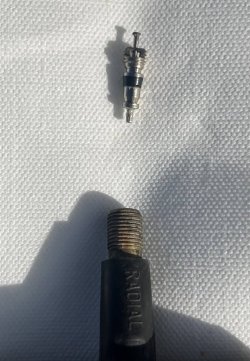
I understand the theory of centrifugal force opening a tyre valve, but does it really happen in practice? Surely all you'd need to prevent that happening is a valve spring of sufficient strength to keep the valve closed at any speed a motorcycle is capable of. It would be pretty rubbish design practice for valve manufacturers to ignore such a critical requirement.
I've done some silly speeds on motorcycles, well in excess of 200kph, but I don't know if the tyre valves were affected because I always use valve caps.
One of these days when I have nothing better to do, I'll pull the valve out of a tyre and measure the force required to lift the valve off its seat. Then remove the valve plunger part so I can weigh it. Those data, together with the diametric distance of the valve from the wheel centre will provide sufficient information to do the rotational dynamics number crunching to calculate the wheel RPM required for centrifugal force to overcome the combination of valve seat spring pressure and internal tyre air pressure. obviously wheel RPM is directly related to road speed.
The only thing stopping me is that I don't have a scale sensitive enough to weigh the little valve plunger or measure the spring pressure accurately enough. I reckon I need a jeweller's scale with a resolution of 0.01 gram. All I've got is a digital kitchen scale that has 1 gram increments.
Perhaps I should suggest it to my local high school as an experiment to be done in their physics practical sessions.