Voltage with Lithium battery

cape

Hero member
Location
Finland
Here I go again. I’ve been struggling with voltage issues on my Jota for some time now. I have Nippon Denso alternator, Shindengen FH020AA mosfet regulator rectifier and a Lithium battery. Most of the time voltage is OK, somewhere between 13,8-14,2V. But when the battery is fully charged, the battery monitoring system steps in and protects the battery from being overcharged. BMS seems to completely cut the charging power to the battery, and this causes trouble. It results in unstable voltage and nasty spikes. Note, I wrote: “BMS seems to”, and that is what I meant. I have no actual knowledge of what is going on.

Anyway, I have checked and rechecked every wire and component which have something to do with charging, all good. I have always thought that FH020AA reg-rec would be compatible with Lithium batteries and it’s charging power would be about 14,2V. That is the value I initially found somewhere in internet. I recently rechecked the value and found out that it is 14,5V, which is too much for a Lithium battery. Who knows what’s the actual case. So, I ended up buying a new RMStator Lithium compatible reg-rec, and I hope it will finally resolve all the voltage issues I’ve had. The charging power is stated to be 14,2V. I hope that is the actual case. The results remain to be seen, on season 2025.

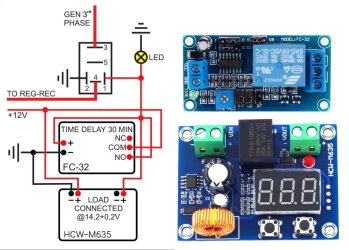
But if things don’t work out, I have a backup plan. It involves some extra components and new circuits. Basically, the idea is to cutoff one phase from alternator when the voltage gets too high. And then to reconnect it when the voltage is in acceptable level. And this needs to happen automatically. The attached picture shows the system. It is tested on bench and works as intended. But I hope I don’t need to go this road…
 

Attachments

  • overvoltage_protection.jpg
    overvoltage_protection.jpg
    128.2 KB · Views: 43
Here I go again. I’ve been struggling with voltage issues on my Jota for some time now. I have Nippon Denso alternator, Shindengen FH020AA mosfet regulator rectifier and a Lithium battery. Most of the time voltage is OK, somewhere between 13,8-14,2V. But when the battery is fully charged, the battery monitoring system steps in and protects the battery from being overcharged. BMS seems to completely cut the charging power to the battery, and this causes trouble. It results in unstable voltage and nasty spikes. Note, I wrote: “BMS seems to”, and that is what I meant. I have no actual knowledge of what is going on.

Anyway, I have checked and rechecked every wire and component which have something to do with charging, all good. I have always thought that FH020AA reg-rec would be compatible with Lithium batteries and it’s charging power would be about 14,2V. That is the value I initially found somewhere in internet. I recently rechecked the value and found out that it is 14,5V, which is too much for a Lithium battery. Who knows what’s the actual case. So, I ended up buying a new RMStator Lithium compatible reg-rec, and I hope it will finally resolve all the voltage issues I’ve had. The charging power is stated to be 14,2V. I hope that is the actual case. The results remain to be seen, on season 2025.

But if things don’t work out, I have a backup plan. It involves some extra components and new circuits. Basically, the idea is to cutoff one phase from alternator when the voltage gets too high. And then to reconnect it when the voltage is in acceptable level. And this needs to happen automatically. The attached picture shows the system. It is tested on bench and works as intended. But I hope I don’t need to go this road…
How does the time delay assist here? I would have thought the relay is controlled by the rising/falling voltage level. Your knowledge of electronics is far superior to mine, I'm trying to keep up.
 
I assume you mean a lithium ion battery, not a lithium battery as they are not rechargeable? The nominal charging voltage for a lithium ion 12v battery is 14.2 to 14.6 volts so your Shindengen regulator is OK. You don't want to exceed 14.8v ever.

Now on to your statement about unstable voltage and nasty spikes. How do you know this is happening and what issues is it causing? Is it an ignition problem, if so what ignition do you have? What test equipment are you using to see the voltage problems?I have ridden my 3CL with no battery in the bike at all and no issues whatsoever.

So you have a time delay relay connected to a battery load disconnect switch to prevent parasitic current loss. In my opinion, not needed.

All my Laverda's have gel cell batteries so I have no experience with lithium on a bike but am familiar with them.

What brand and model of battery are you using?

And back to my original question, how do you know you have a problem and what is it?
 
Last edited:
Interesting, Cape. After my new replacement SSB AGM failed completely recently (in 600km from new), I have fitted a little 430CCA LiFePo. Seemed fine with a brief start and run for a few seconds, but when i went out to start and run it for longer I noticed my Eclipse voltmeter light (which is a godsend) was intermittent green-red, which = overcharging, confirmed with multimeter at 15-16V+.

The weak part of these ND alternators I'm using is apparently the internal reg, and I've been expecting an issue since I fitted it many thousands of km ago. They are used on all manner of Kwaka, Suzuki and Triumph models. I've ordered an RMStator RM31000 reg (not cheap at A$210!) and the spiel is they are super reliable and will outlast the alternator - I hope so. As soon as I install it I'll check charge rate and hopefully it'll be within range to the LiFePo.

The day the AGM failed my green charge light had been glowing nicely all day. never noticed a prob until the bike stopped dead when I came into traffic and needed it to idle ... zero volts. Now I'm wondering whether the cart or the horse came firast. a. did a failed reg suddenly destroy the AGM or b. did the failed battery blow the reg? I have so little inherent knowledge of electrics that I have no idea. Another question c. is whether riding 100km with the source/exciter wire disconnected has damaged wither the (first) battery or the reg or both. From the dash, that 100kim just meant I had zero charge going in and was running on total loss.

Hopefully the charge rate with the new chip reg (it's tiny) is compatible with the LiFePo. I really want this stuff sorted so I can forget about it forever more!
 
OK, I’ll try to answer the questions.

The battery that I have is Exide ELTX12. It is a Li-Ion 12V motorcycle battery. Usually these batteries are LiFePo4 type, but for some reason Exide made it Li-Ion, I don’t know why.

Ignition system, that is Ignitech TCIP4.

I also have converted all the lights to LEDs, so the power consumption is much less than it is with original bulbs. But I don’t believe that is causing the problem.

What else? How do I know there is a problem? I have a digital voltage meter which clearly shows that the voltage becomes unstable at some point. I also have a Sparkbright Monsoon 8 voltage monitor and it start to show overvoltage by alternating red/green light. The set level is 15,2V, so there is an issue.

The symptoms? Nothing at all. I haven’t noticed anything. The bike is running just fine – doesn’t affect ignition, and all the lights are working + all the other appliances as well. But there is occasional overvoltage and a potential risk of something failing…

The charging power of FH020AA should do just fine, but obviously it doesn’t. That is why I bought the RMStator mosfet reg-rec.

Then the matter of my backup plan. It is a bit difficult to explain but I’ll try. As I said, the final solution would be messing with one of the alternator’s phases. It is not optimal or recommended, but if nothing else works, that would do it. So, one phase would go to reg-rec via a fife pin relay. The relay is operated by the two modules shown in the previously attached picture. HCW-M635 is an undervoltage protection module, but it can be used for overvoltage protection as well. What happens is that HCW-M635 is always on and monitors the voltage. It is a programmable unit and I have set it to 14,2+0,2V. So, when the voltage is below 14,4V, the module does not feed power to the load. When the voltage is 14,4V or more, the module feeds the power to the load. On the load side I have the relay for the phase. The power from HCW-M635 is used as an impulse power to the relay, so it pulls when the voltage is above the set level. And what happens; Voltage below 14,4V – relay doesn’t pull – phase is active – pins 3 and 4 in use. Voltage above 14,4V – relay pulls – phase is not active – pins 3 and 5 in use. This would result less charging power from alternator and voltage would start to decrease. Without a time delay module this would probably happen constantly, so it is there for a reason. At the time voltage is too high and HCW-M635 feeds power to the relay, also the time delay gets power. It is connected in such a way, that the phase relay stays active even if the voltage decreases below 14,4V. I have set the time delay to 30min, after that it “shuts itself down” and the alternator’s phase is active again. I hope that made sense.
 
Last edited:
Interesting problem. Unfortunately, my knowledge of electrics/electronics isn't going much beyond exchanging bulbs... Normally, the MOSFET reg/rec should cut out phases completely itself to my understanding if voltage goes beyond a certain level, which is the big advantage of these devices and the reason they do not get as hot as normal reg/recs (which would turn the overvoltage into heat while the MOSFET simply cuts the connection internally). Funny though it doesn't... Maybe the MOSFET isn't an original part but a cheap china copy and has a defect?!?
 
No, mosfet reg-rec is basically a shunt regulator, so it puts the excess voltage to the gnd. It is a series regulator rectifier you are thinking of. It cuts the alternator power.
 
Last edited:
And before anyone asks: "Have you tried a Lead Acid battery? ". Yes I have and could easily swap back to one and have zero problems, but I want to resolve the issue with Lithium battery and continue to use it.
 
I don't know enough about how the Shindengen FH020 control circuitry is configured. I can only suppose that when the battery BMS disconnects the alternator input, the FH020 loses it's reference voltage and operates as if the battery voltage is zero and so pushes the alternator output voltage high. Without the damping effect of the battery to absorb switching spikes, it may result in the symptoms you have experienced.
 
I searched information about BMS, how it works when the battery reaches its fully charged voltage and how R/R responses to it.

Here's how the two work together:

• R/R Output: The R/R outputs a regulated voltage (e.g., 14.2V) to the battery terminals.

• BMS Monitoring: The BMS continuously monitors the battery voltage.

• BMS Control: When the battery reaches its fully charged voltage, the BMS signals the battery to stop accepting charge. This can be done by:

• Actively cutting off the charging current.

• Increasing the battery's internal resistance to limit current flow.

• R/R Response: The R/R continues to output its regulated voltage, but the excess current is either dissipated as heat or absorbed by the battery, depending on the BMS's specific implementation.
 
OK, so if you did not have a voltage monitor on the bike, you would not be aware of any problems and be happily riding down the road.

I suspect you don't actually have any voltage problems at all. Put an analog voltmeter on the charging circuit and see what it says as it won't jump around due to electrical noise. What it says is more important than a digital meter.

So you have a battery that actively disconnects from the charging circuit once it thinks it is charged. It would be interesting to know how often it cycles in and out of the charging circuit. It could be multiple times a second? And once it disconnects from the charging circuit the bike will see little if any load other than the ignition so you have no battery to absorb electrical noise which by itself will not cause problems.

Discharge the battery so while testing it is charging all the time and keeps it in the circuit. Still electrical noise?

Put a lead acid battery in the bike and see what happens. I suspect all will now be OK.

Or throw the voltage monitor away and go riding. The noise is most likely spurious and triggering the voltage monitor. Without proper test equipment to look at the voltage wave form, you are chasing your tail.

By using a lithium ion battery that disconnects, LED bulbs which draw very little current, you have created a solution looking for a problem.
 
Last edited:
Or throw the voltage monitor away and go riding.
I won't be doing that. Twice my Eclipse voltmeter idiot light has been correct in diagnosing a problemo: no charge (turned out the source/read wire blade connector had come off and the latest, reg blown and overcharging. I'll be very surpriserd if I get an overcharging code after I fit the new reg ... due today.
 
If and when the BMS cuts the charging power to the battery, it is triggered at 15V and released at 14,4V. So the event apparently doesn't happen several times a second, but takes some time.
 
If and when the BMS cuts the charging power to the battery, it is triggered at 15V and released at 14,4V. So the event apparently doesn't happen several times a second, but takes some time.
You don't know that and you don't even know if you have a problem. Each time an ignition coil is turned on it takes current which could drop the voltage to 14.4V and the battery re-connects multiple times a second.

Please stop guessing and actually measure what is happening with proper test equipment. A cheap analog voltmeter will save a lot of time guessing what is going on. My bet is the over voltage is just spurious noise which will cause no problems.

And please put a lead acid battery in the bike and see what happens. Adding additional parts to try and correct a problem which may not even exist is a very dumb idea.

As for motorcycle voltage monitors, nothing agsinst them but not really necassery as they can cause riders to become obsessed with constantly checking it. It is the reason Triumph stopped putting oil pressure gages on their bikes in 1949 as some owners could not ever enjoy riding the bike due to the oil pressure changing as the motor got hot and RPM's changed. To them if it did not show 60psi at all times, something must be wrong.
 
Last edited:
And before anyone asks: "Have you tried a Lead Acid battery? ". Yes I have and could easily swap back to one and have zero problems, but I want to resolve the issue with Lithium battery and continue to use it.
And besides that, Monsoon 8 is a very accurate tool. When it indicates overvoltage, it will do so for some time.

Using a multimeter while riding would be a bit difficult. It may take several hundred kms before anything happens...

And I'm not adding anything to the bike for now. I hope the lithium ion compatible reg-rec is all I need. I just wrote that I have a backup plan, if nothing else works.
 
I thank Cape for doing this research work, he has a proven track record and certainly not dumb. Yes we could all go back to lead acid batteries (and points and drum brakes etc etc) but many riders have gone the high tech Lithium something battery route for various reasons, not least weight, and many people have been stranded when these wonder batteries suddenly die for apparently no reason. Here Cape has noted an anomaly and is looking for a way around it. If successful it could well be a saviour for many people on many different types and brands of bike. It looks to me like a high tech version of what camper vans use to charge their accessory battery via a relay that only connects it when the starting battery is over a certain volts.
 
Every old bike I ever bought was missing frame paint under its lead acid battery, from either boil over or leakage from tipping the bike over. Never using them again since mat batteries arrived.
 
I took a look at rm31000. It is extreamly small and would be a nice gadget. But is it really compatible with Laverda? It is stated to work with alternator field coil. Isn't Laverdas alternator a permanent magnet type?

Here is one site advertising it for $17,87. I do not know the shop. Might be a hoax.

If that is a genuine ad the price is insane - even on their website, RMStator quote USD$94. I couldn't be bothered with waiting plus freight from Canada so i paid A$210 (free shipping ... from a suburb 15km away ... wow!). At that price I'll buy spares! but will supposedly never need them. So highly likely to be a hoax.

I'm amazed at how small the RM31000 is ... hard to believe a tiny chip can do all that voltage regulation.

I have a Nippon Denso alternator from a Kawasaki GPX1000 on my twin (replaces the generator and regulator). Probably a different type than the Laverda.
 
Back
Top