Was Laverda’s triple design ahead of its time?

Garbrand

Full member
When I look at the current generation of motorbikes, I see a lot of three-cylinder models appearing on the scene. Apart from the fact that most modern motorbikes look like the Predator – which isn’t to my taste 😣– I sometimes wonder whether Laverda was actually ahead of its time with its three-cylinder design?
 
As much as I would have liked to experience the triple two stroke engine Laverda designed, perhaps if the money spent on that project had been invested in a water cooled, 4 valve triple four stroke engine we would now be discussing how much better the ‘modern’ Laverda triple engine is compared to the ‘Bloor’ Triumph engines…..
 
As much as I would have liked to experience the triple two stroke engine Laverda designed, perhaps if the money spent on that project had been invested in a water cooled, 4 valve triple four stroke engine we would now be discussing how much better the ‘modern’ Laverda triple engine is compared to the ‘Bloor’ Triumph engines…..
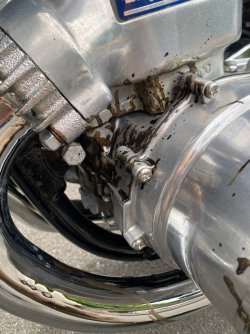
I am testing 😁 but it’s on the bench currently - oil leaks 🙄IMG_7543.jpeg
 
Like Triumph and BSA I think Laverda were just trying to add another cylinder to a twin originally but the finished article was definitely distinctive and a good looking motor. Most of the new cars with 3 cylinder car engines are boring as hell.
 
Like Triumph and BSA I think Laverda were just trying to add another cylinder to a twin originally but the finished article was definitely distinctive and a good looking motor. Most of the new cars with 3 cylinder car engines are boring as hell.

Obviously - but other than the Brits Laverda did use more bearings in the center of the crank with the twins …
🙂
 
Maybe it was ahead by a genius stroke of luck as well as the quality engineering. Moving away from the 120⁰ prototypes because of the fatigue issues, provided a unique motor with unique characteristics in 180⁰ triple .

Still to this day, it spools up faster than a four out of corners and that gives it one distinct performance advantage with the same or less horsepower than a four.

That stood it apart from the existing triples and more importantly the UJM's that were just around the corner ( im not referring to the cb750 but the Z's and GS's)
 
  • Like
Reactions: pf1
The large bike market was saturated with twins in the late 60's, with transverse fours beginning to emerge towards the end of the decade. These had their disadvantages such as engine width and weight, as well as more internal parts. Imho, a triple is a good compromise between the grunt of a twin and the revability of a four, possibly why Triumph/BSA also looked into triples to extend their range of aging twins.

It seems to me that Laverda had always been strapped for cash. A 4-stroke triple has a quarter less parts in the top end than a four, a very compelling argument when it comes to production accounting. The actual size of these components is of less importance, a small piston costs just as much to produce as a larger one, at least within the scope of motorcycle engines. Triples are generally also more compact than fours, so there's two major advantages of a triple already... ;)

DOHC was a bit of a novelty at the time, usually reserved for pukka racers. CB450 Honda was one of the very few affordable (in contrast to the MV fours) DOHC road bikes of the 60s, while OHC had become more or less the standard across the industry, except for the die-hard Brits (and Yanks) of course. The rest of the japanese industry was mainly still hooked on 2-strokes.

The 180° layout of the Laverda triple is indeed unique, apparently a solution to a problem that had cropped up early during development. The engine width/crank length when compared to the brit triples is most probably to blame, Tri/BSA did just fine with solid mounted 120° engines. Brits followed their long-stroke philosophy which allowed for closer bores and therefore considerably shorter cranks. Italian sport bikes OTOH were traditionally square or under-square which results in longer cranks. Italian engine designers have always set their focus on reliable valve trains resulting in further lengthening the Laverda crank by the addition of a timing sprocket. This also resulted in the classic shim-under-bucket arrangement that causes so much grief for backyard bodgers and drives maintenance costs. Alfo Romeo owners were quite used to it by then...

I don't consider the Laverda triples to be so much more refined or ahead of their immediate rivals, Breganze simply stuffed the well-known basics of comtemporary high-performance engines into an affordable, well working package. It's a bit of a pity they were constrained to using the existing 750 transmission, which was very definitely old-school by then. But, chain primary drives were still quite acceptable, even the Honda 4s had a primary chain (which was an absolute bastard to renew!). Fitting a transistor CDI ignition, dual hydraulic discs and purposely omitting the kickstarter were pretty much ground-breaking though, the 750 had already proved the kickstarter could be left out. The rest of the bike was actually pretty conservative, but put together in a handsome, appealing package with a unique, business-like stance. Just looking at it, one could see it wasn't built for posing.

The more affordable japanese designs offering increased power, speed and (sadly) reliability quickly overtook the Laverda and it took another 7-8 years for the 4-valve head to attain domination, with liquid cooling following quickly to fulfill ever-tightening emmissions regulations. It is a testimony to the Breganze design that it was capable to hold on as long as it did. Other air-cooled designs also held on for far longer than they had a business to, airhead Beemer, bevel Ducatis and Moto Guzzi come to mind. But, while the Laverda triple gradually grew more refined and powerful, the Beemer and Guzzis slowly lost more and more of their original sport genes, retiring as breathless slugs. A 1000 LeMans or MHR couldn't hold a candle to a 1000SFC... let alone the airhead which bowed out while offering a measly 59 hp.;)

piet
 
I don`t think it was ahead of it`s time ......... more a product of it`s time .

There was nothing technically advanced about the triple , nothing the world hadn`t seen before ....... As Piet mentioned , the most radical departure from the norm was probably the junking of a kickstart mechanism , and as on the twins , putting all your faith in an electric starter ......... That was a bit of an eye-opener at the time ........

As for the modern ( transverse ) triple layout , we have the Americans to thank for that ....... Kawasaki and BSA / Triumph triples were on sale in the USA years before the first Laverda triples became available .

Bert Hopwood and Doug Hele were both at Norton during the `fifties , when Joe Berliner was crying out for a stateside 750cc ( 45 cu inches was a popular capacity class ) version of the 650 twin ......... They built a 750 twin but the vibration was horrific when tested ..... ( later cured with an Isolastic sticking plaster ) ......

Hoppy and Helly decided a triple was worth trying if extra capacity was needed ....... When they both arrived at Triumph they had a triple , based on the existing Triumph twin , on the drawing board in 1963 , and a prototype up and running in January 1965 .
The BSA / Triumph triple went on sale in 1969 .

This was the route they were forced to take , because basically there was no boardroom desire , and therefore no money , for a new design .......

Hopwoods modular range ( including a three cylinder two-fifty ! ) had already been killed off by BSA management ..... " The twins are still selling well in the USA , so why should we worry ? " .........

Kawasaki had their two stroke triples up and running in 1968 , and like the BSA / Triumphs , they went on sale in 1969 , four years before the Laverda 3C .

Suzuki two stroke triples arrived soon after , in 1972 .

So was the Laverda triple design ahead of it`s time ? ........ As far as the triple cylinder layout is concerned then no ........ If anything it was late for the party , in terms of arriving in the showrooms .

Of course you could argue two stroke versus four stroke triple merits , or otherwise .......

Laverda triple design and development would have been taking place between `68 to `72 , some years behind the BSA / Triumph , but more or less in tandem with the relatively simple two stroke Kawasaki and Suzukis.

The Laverda has much in common with the BSA / Triumph ....... As well as being a development of an existing ( and outdated ) design , it was also born out of necessity ....... The need to succeed in America .

The BSA / Triumph triple was doomed due to lack of management investment and outdated manufacturing methods ...... it was the product of a development team having to make the best of the limited resources available to them .

The Laverda triple was a much more satisfactory development of an existing design than the BSA / Triumph could ever hope to be ...... and again as Piet said , DOHC was still a bit of a thing in the early `seventies , although the Z1 was there as well ........ but the 3C was ultimately doomed because Moto Laverda wouldn`t have had a hope in hell in order to produce enough of them in the numbers needed to be profitable , and lacked the buyers anyway , because they had no effective nationwide marketing network .......

One thing BSA / Triumph did have was a well established dealer network , with both East and West coast headquarters ....... It got them noticed and made them an effective presence in every city and large town ....... something Moto Laverda could never hope to match ........

One of the reasons Honda became so well established in the USA is that they took advantage of that BSA / Triumph dealer network ....... pretty much taking it over completely when those dealers eventually had no more BSA`s or Triumph`s to sell any more ......


So getting back to the original question ..... Was Laverda`s triple design ahead of it`s time ? ........ No , of course it bloody wasn`t ........... ;) ................
 
Last edited:
Laverda may have sold many more triples if the Laverda factory had not only listened to feedback from buyers and riders of the early models, but also followed their recommendations.
(1) Get rid of that massive lump hanging off the right-side end of the crankshaft; that design was antiquated and did not belong on a modern (70s)motorcycle.
(2) The labor-intensive shim under the bucket camshaft valve clearance was/is a total PIA, and back in those early days when Laverda shops, haha, would actually offer it as a service item, well, let's simply say it would drain your wallet. I was thankful that in Perth in the 70s the Laverda shop, thanks Bruce, would do a no-charge shim exchange for punters doing their own work; gone are those days.
'Ahead of its time design', I don't think so. A Kawasaki Z1 900: you could adjust the 8 cam/valve clearances in less than an hour; on the Laverda triple, checking and adjusting the 6 cam/ valve clearances, well, let's just say it takes an entire afternoon, a PIA.
Dave, the bucket and shim was used on many car and bikes. If properly designed, you are not having to check and adjust the shims so it does not become a PIA, as it is something you never need to do.

I put over 200,000 miles on a BMW K75, a 120 degree triple with buckets and shims just like a Laverda. During those 200.000 miles, the valves only needed to be adjusted three times. They had much better valve seats and valves than Laverda used. I also have a BMW R1200RT that is not bucket and shim and in 154,000 miles the valves were adjusted twice.

The 180 degree triples are certainly an old obsolete bike, but wow are they fun to ride! The exhaust note and the feel of the motor can not be duplicated by any other bike.
 
Laverda may have sold many more triples if the Laverda factory had not only listened to feedback from buyers and riders of the early models, but also followed their recommendations.
(1) Get rid of that massive lump hanging off the right-side end of the crankshaft; that design was antiquated and did not belong on a modern (70s)motorcycle.
(2) The labor-intensive shim under the bucket camshaft valve clearance was/is a total PIA, and back in those early days when Laverda shops, haha, would actually offer it as a service item, well, let's simply say it would drain your wallet. I was thankful that in Perth in the 70s the Laverda shop, thanks Bruce, would do a no-charge shim exchange for punters doing their own work; gone are those days.
'Ahead of its time design', I don't think so. A Kawasaki Z1 900: you could adjust the 8 cam/valve clearances in less than an hour; on the Laverda triple, checking and adjusting the 6 cam/ valve clearances, well, let's just say it takes an entire afternoon, a PIA.
Most of the owner feedback would have been centred on the phrase "We need more power!!" :rolleyes:

Contemporary competitors all had a lumpy alternator hanging off one side at the time, state-of-the-art so to say. The Laverda triple was still narrower than many fours at the time, despite the lumpy alternator. Piggy-back alternators only appeared later on the common multis. Benelli Sei was surely one of the first, that engine would have turned out ridiculously wide had the alternator been mounted at the crank end. Oh yes, MV had that 10kg lump of starter-cum-generator mounted under the engine...

Shim-under-bucket was also state of the art, used almost universally in high-performance applications and offering exceptional reliability. In the case of Laverda, it was let down to a degree by metallurgy, the design should have incorporated hardened valve seats from the beginning, especially as lead-free fuels were already looming on the horizon. Many a Kawasaki Z or Suzuki GS owner paid for the simpler maintenance with a trashed valve train after the shim was spat out through over-revving/valve bounce, their crude points ignition offered no rev limiter that may have prevented this.

Zed and 3C are a handy comparison actually. Try re-cutting a Z valve seat, 3C seat has all the properties of seasoned Parmigiano in comparison.

Pros and cons...

piet
 
The Triumph/BSA triples could also be made to go bloody quick in the right hands and won Production TTs etc thus cementing their reputation long before Laverda triples had a brief run of success in national production racing.
However, IMHO I don’t think any of the other triples of that era matched the Laverda triples for looks.
 
In my opinion, the main problem with the three-cylinder engine was its excessive increase in weight. That is also what Cico told me back in 1981, when he was converting my SF3 into an SFC replica: "They’ve ended up with a lump of iron here—you can’t win any more races with this." To me, it remains the most beautiful "lump of iron" in the world.
Johann
 
The 180 degree triples are certainly an old obsolete bike, but wow are they fun to ride! The exhaust note and the feel of the motor can not be duplicated by any other bike.
Bruce, you are absolutely right; that's why I have owned Laverda triples since 1977, and I've had my 78 Jota for 44 years.
Swinging your leg over a Laverda triple and going for a ride, whether it's a 'fang' up the mountains or a tour to distant destinations, is the best mental health therapy there is, definitely needed, and it's ongoing.😁
 

Attachments

  • IMG_1497.JPG
    IMG_1497.JPG
    77.5 KB · Views: 22
Bruce, you are absolutely right; that's why I have owned Laverda triples since 1977, and I've had my 78 Jota for 44 years.
Swinging your leg over a Laverda triple and going for a ride, whether it's a 'fang' up the mountains or a tour to distant destinations, is the best mental health therapy there is, definitely needed, and it's ongoing.😁
Dave we are all jealous of where you live and the road you can ride your triple on.

For those that don't know, Dave lives in the Cochella valley that has an incredible road in the mountains west of him. I mean a really nice road for a motorcycle that you can ride many times and it never gets old. It is very twisty and you climb 5000 feet in 40 miles.
 
In my opinion, the main problem with the three-cylinder engine was its excessive increase in weight
My mate Motodd Rob did it right and pulled the 1200 triple from the stock Laverda frame setup and built himself a magnificent modern triple. Although you cannot drop much weight from the triple motor itself, the Motodd (cudos and thanks to Phil) is considerably lighter than a stock Laverda 1200.
Then Rob, truly a master craftsman in anything he builds, lays a lot of carbon fiber on the Motodd, GSXR wheels, lightweight discs and 4 pots, and trims down and replaces everything that can shed weight and still has a street-legal bike.
On a Sunday morning ride, you will not see another one like it. I am looking forward to riding it again; it has been a while- too long.
 
I think Red's crank work tosses about 6kg into the swarf bin - that's a guess, not sure of the actual figure.
6kg... pretty ambitious. ;) I managed to remove 3 with my modest means, not much more in it but makes a world of difference! Reckon Reds' alternator conversion sheds close to another 1/2 kg over the original Bosch in the MkI engines.

I currently have a lightened triple crank on the bench that actually has had too much removed from the wrong places! Balanced for stock rods, the owner wanted to have Carillos fitted. Due to their greater big-end weight distribution, there is now not enough metal left on the webs to compensate! Not willing to faff around with tungsten plugs etc, so stockers going back in.

Imho, there are limits to what is desirable in a road bike. That 3kg reduction allows my 3C to rev like a 2-stroke, it's as eager as a ferret in every gear. If I don't restain myself a bit, I'm constantly standing in front of the magistrate with one foot... fantastic on the racetrack though. Due to the CR 'box, it's also become a bit of a pain to ride in the mountains, steep switchbacks often require a lot of clutch slipping in a first gear that can spool to over 130km/h.:eek:

Reducing weight from the chassis is far more productive for a road bike, the GSXR wheels lose weight where it is most noticable, without compromising anything.

piet
 
Back
Top