I don`t think it was ahead of it`s time ......... more a product of it`s time .
There was nothing technically advanced about the triple , nothing the world hadn`t seen before ....... As Piet mentioned , the most radical departure from the norm was probably the junking of a kickstart mechanism , and as on the twins , putting all your faith in an electric starter ......... That was a bit of an eye-opener at the time ........
As for the modern ( transverse ) triple layout , we have the Americans to thank for that ....... Kawasaki and BSA / Triumph triples were on sale in the USA years before the first Laverda triples became available .
Bert Hopwood and Doug Hele were both at Norton during the `fifties , when Joe Berliner was crying out for a stateside 750cc ( 45 cu inches was a popular capacity class ) version of the 650 twin ......... They built a 750 twin but the vibration was horrific when tested ..... ( later cured with an Isolastic sticking plaster ) ......
Hoppy and Helly decided a triple was worth trying if extra capacity was needed ....... When they both arrived at Triumph they had a triple , based on the existing Triumph twin , on the drawing board in 1963 , and a prototype up and running in January 1965 .
The BSA / Triumph triple went on sale in 1969 .
This was the route they were forced to take , because basically there was no boardroom desire , and therefore no money , for a new design .......
Hopwoods modular range ( including a three cylinder two-fifty ! ) had already been killed off by BSA management ..... " The twins are still selling well in the USA , so why should we worry ? " .........
Kawasaki had their two stroke triples up and running in 1968 , and like the BSA / Triumphs , they went on sale in 1969 , four years before the Laverda 3C .
Suzuki two stroke triples arrived soon after , in 1972 .
So was the Laverda triple design ahead of it`s time ? ........ As far as the triple cylinder layout is concerned then no ........ If anything it was late for the party , in terms of arriving in the showrooms .
Of course you could argue two stroke versus four stroke triple merits , or otherwise .......
Laverda triple design and development would have been taking place between `68 to `72 , some years behind the BSA / Triumph , but more or less in tandem with the relatively simple two stroke Kawasaki and Suzukis.
The Laverda has much in common with the BSA / Triumph ....... As well as being a development of an existing ( and outdated ) design , it was also born out of necessity ....... The need to succeed in America .
The BSA / Triumph triple was doomed due to lack of management investment and outdated manufacturing methods ...... it was the product of a development team having to make the best of the limited resources available to them .
The Laverda triple was a much more satisfactory development of an existing design than the BSA / Triumph could ever hope to be ...... and again as Piet said , DOHC was still a bit of a thing in the early `seventies , although the Z1 was there as well ........ but the 3C was ultimately doomed because Moto Laverda wouldn`t have had a hope in hell in order to produce enough of them in the numbers needed to be profitable , and lacked the buyers anyway , because they had no effective nationwide marketing network .......
One thing BSA / Triumph did have was a well established dealer network , with both East and West coast headquarters ....... It got them noticed and made them an effective presence in every city and large town ....... something Moto Laverda could never hope to match ........
One of the reasons Honda became so well established in the USA is that they took advantage of that BSA / Triumph dealer network ....... pretty much taking it over completely when those dealers eventually had no more BSA`s or Triumph`s to sell any more ......
So getting back to the original question ..... Was Laverda`s triple design ahead of it`s time ? ........ No , of course it bloody wasn`t ...........

................


 – I sometimes wonder whether Laverda was actually ahead of its time with its three-cylinder design?


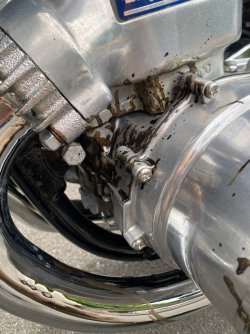
 but it’s on the bench currently - oil leaks