What did you do to or for or with your Laverda today?

I've set the float heights, 18 mm +_ 0.5 as per the book, measured from the bottom of the floats to the sealing face of float bowl to carb body.
Am I correct?
Both sides of each float set checked.
Accelerator pumps set to 4 ml. per 20 pump strokes.

Spilt a bit of fuel and smelt far too much fuel.
Now to set the three little beauties up on the bike.

Please let me know if I have any details wrong.

Thanks to Ducati Paddy for good efficient spares supply, parts and advice.
In your float height rig it looks at first glance as if the carburettor is aligned exactly horizontally. Installed on the bike, however, it has an angle of approx. 30°. I think this matters, but would rather listen to the experts.
 
In your float height rig it looks at first glance as if the carburettor is aligned exactly horizontally. Installed on the bike, however, it has an angle of approx. 30°. I think this matters, but would rather listen to the experts.
Float height is 18mm with the float bowl gasket face horizontal. The inclination on the bike is taken into account.
Maybe why the VHB float height is 24mm, they're mounted horizontally?

Paul
 
In your float height rig it looks at first glance as if the carburettor is aligned exactly horizontally. Installed on the bike, however, it has an angle of approx. 30°. I think this matters, but would rather listen to the experts.
I did wonder at this.
But as the official Dellorto booklet says 18mm plus or minus 0.5mm.
I took the attitude that the inclination will affect at what point the fuel acts on the floats
but the distance as given by Dellorto should be the one to use as this should not change.
All three carbs had the floats set at between 19 to 20 mm.
It ran fine but the idle screws were further out than book settings so again I'm guessing that was to make up for the lower level in the float bowl.
I've set the idle screws to 1.5 turns out of fully in.
Just as my starting point.
All jet sizes are as per original book and I've added an air filter which was not fitted at time of purchase.
Book shows carb float height being measured with carb with the venturi vertical.
 

Attachments

I'm sure you know where to get the bolts you need for the trim, but just in case, see link below.

Thank you.

I checked out buying those screws through this site ........ the shipping would be more than the screws!
I will look at North American BMW sites. Hopefully the part number is the same. Thank you for the link though. The closest I have found here in Canada is a Kawasaki screw that is close ........ but only found one and on order they are back-ordered indefinitely!

Jim
They're easy enough to make. Just take a screw of the necessary diameter and grind a couple of flats on the head. I did that to fix the chrome trim on my 750 S saddle. You need to be inventive with these old machines.

Or buy a new one.

Paul
 
They're easy enough to make. Just take a screw of the necessary diameter and grind a couple of flats on the head. I did that to fix the chrome trim on my 750 S saddle. You need to be inventive with these old machines.

Or buy a new one.

Paul

That is what I have done ........ I found 2 of the Kawasaki ones and ground down another half dozen of full sized screws.
I was just curious as to what it would cost to buy proper ones. Even shipping in Canada is just plain silly.

Jim
 
Float height is 18mm with the float bowl gasket face horizontal. The inclination on the bike is taken into account.
Maybe why the VHB float height is 24mm, they're mounted horizontally?

Paul
No.

With the gasket surface horizontal, the float is already resting on the spring-loaded valve and depressing the spring an un-known amount. Some valves may stand up to the float weight, most don't, especially those in Mikunis (another matter...)

Float height is checked with the carb held so that the float just closes the valve, with no weight on the valve itself. Doing this any other way will result in uneven heights across the board with the engine running. The differences will be minute, but may well influence idle behaviour and could be downright dangerous at WOT.

Doesn't matter at all in the case of VHBs, these do not have sprung valves.

piet
To be more precise, I tilt the carb until the float valve contacts it's seat but the spring doesn't compress, so neither quite horizontal, nor vertical. I measure from there.
Just common sense.

Paul
 
No.

With the gasket surface horizontal, the float is already resting on the spring-loaded valve and depressing the spring an un-known amount. Some valves may stand up to the float weight, most don't, especially those in Mikunis (another matter...)

Float height is checked with the carb held so that the float just closes the valve, with no weight on the valve itself. Doing this any other way will result in uneven heights across the board with the engine running. The differences will be minute, but may well influence idle behaviour and could be downright dangerous at WOT.

Doesn't matter at all in the case of VHBs, these do not have sprung valves.

piet
I've had to read Piet's text about four times now.
I was confident I had my carbs pretty much spot on.

Now I'm not so sure.

So with my carbs held vertically, and the float bowl sealing surface horizontal, but facing down.
Therefore, the carbs are orientated as would be on the the bike, (all be it, as if going up a hill).

I lifted the floats until the flow of petrol stops falling from the float valve.
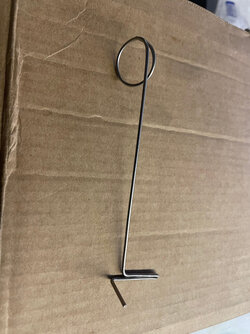
I use a light lifting tool of my own manufacture, so that the flow stops as the tool touches the sealing surface.
I'll take a picture of the tool I use tomorrow when back at work.
My theory is/was, that the only pressure on the valve needle is pressure that would be natural under normal (static, as in, not bouncing up and down on a road) running conditions.
When testing there is no float weight on the valve as the float weight is acting down away from the valve needle.
Only my lifting action is putting pressure on the needle and its spring plunger.

Have I got it wrong?
Sounds ok.
I use a bit of alloy plate with a cut away at 18mm, makes it easy to get right.

Paul
 
Float height has nothing to do with carb orientation on the bike, it is a standard set by the carb manufacturer at which the fueling will be delivered as specified by the engine manufacturer. AfaIk, all Dellorto PHB/PHF/PHM carbs with swivelling floats are specified with the same float heights. Actual fuel levels, on which jet sizes are based, are dependant on float height setting as well as float weight. Deviating from the specified float height setting and float weight will throw all jetting specs straight out the window.

The movement of fuel in the float bowl over rough roads is a given, not much one can do about that. Baffles in the bowl might help to a certain degree, but fuel level will always remain compromised by the vehicles motion. Compared to FI set-ups, carbs are rather hit-or-miss affairs that are usually still quite acceptable. The one single area the carb needs to be as spot on as possible is at WOT under max load. Burning a valve or piston through lean mixture can happen within seconds under adverse conditions. Rich mixture isn't quite that dangerous, just that you'll always be at the rear of the pack chasing the others.


When testing there is no float weight on the valve as the float weight is acting down away from the valve needle.
Only my lifting action is putting pressure on the needle and its spring plunger.

Have I got it wrong?
As long as you're not compressing the spring in the valve, you should be OK.

In my experience, you cannot feel when the valve closes until the spring is fully compressed. The valve body is largely obscured from view, judging when it stops moving is just as difficult. Using fuel flow to determine the closing point is a messy and unhealthy exercise and still difficult to get right. As the float only weighs 10 gr., letting it rest against the valve when hanging near vertical is imho the most precise method with the least possibility of the spring being compressed. Peering over the float edges and the scale of a steel ruler set on the gasket face at the same time requires a little practice. Of course, both floats in each carb need to be adjusted to the required height, they cannot be relied upon to be equal.

piet
 
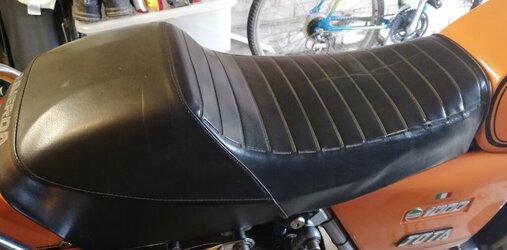
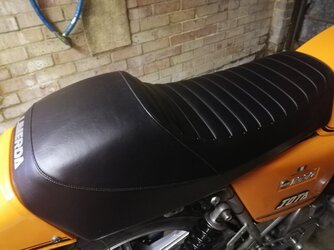
If it's any help, I had my Jota seat restored in Dec 2020 by:

Tony O'Connor
Eldorado Motorcycle Seat Restoration
1 Allen Ave. Mt Barker SA 5251
AUSTRALIA
Telephone 0400 707 767
International +61 400707767

motorcycleseats@bigpond.com.au


The cost was about 850 Aussie Dollars including return shipping, plus the original shipping to Australia from the UK and the import duty when it came back.
The service was fantastic and quick, notwithstanding Covid shutdowns and Christmas-post impact. The seat is as good as new. See the before and after shots below.
 

Attachments

  • IMG_20201116_113008.jpg
    IMG_20201116_113008.jpg
    77 KB · Views: 15
  • IMG_20210212_121013.jpg
    IMG_20210212_121013.jpg
    97.8 KB · Views: 15
Float height has nothing to do with carb orientation on the bike, it is a standard set by the carb manufacturer at which the fueling will be delivered as specified by the engine manufacturer. AfaIk, all Dellorto PHB/PHF/PHM carbs with swivelling floats are specified with the same float heights. Actual fuel levels, on which jet sizes are based, are dependant on float height setting as well as float weight. Deviating from the specified float height setting and float weight will throw all jetting specs straight out the window.

The movement of fuel in the float bowl over rough roads is a given, not much one can do about that. Baffles in the bowl might help to a certain degree, but fuel level will always remain compromised by the vehicles motion. Compared to FI set-ups, carbs are rather hit-or-miss affairs that are usually still quite acceptable. The one single area the carb needs to be as spot on as possible is at WOT under max load. Burning a valve or piston through lean mixture can happen within seconds under adverse conditions. Rich mixture isn't quite that dangerous, just that you'll always be at the rear of the pack chasing the others.


As long as you're not compressing the spring in the valve, you should be OK.

In my experience, you cannot feel when the valve closes until the spring is fully compressed. The valve body is largely obscured from view, judging when it stops moving is just as difficult. Using fuel flow to determine the closing point is a messy and unhealthy exercise and still difficult to get right. As the float only weighs 10 gr., letting it rest against the valve when hanging near vertical is imho the most precise method with the least possibility of the spring being compressed. Peering over the float edges and the scale of a steel ruler set on the gasket face at the same time requires a little practice. Of course, both floats in each carb need to be adjusted to the required height, they cannot be relied upon to be equal.

piet
Thank you Piet,
Your points are noted.
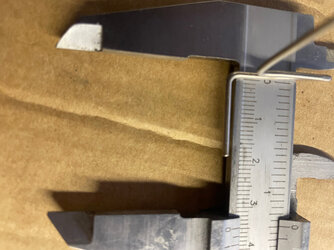
See attached photo of my float lifting tool.
It's a 'prototype' as my 'professional' tool is at home in the garage.
As to the dangers of fuel, yes you are correct, not nice but I'm not doing it for a living and took precautions.
PPE ,ventilation etc. etc.
As for the plunger issue, all needles were checked for function.
I chose to do it this way as then I know the valves are actually functioning correctly.
Previously I've used new components and still found them to lack function so endeavour to check everything.
No point getting the measurement spot on only to find the fuel continues to leak past the tip.Both floats were measured in each carb and had been cleaned and weighed before assembly.
Float frame dimensions were checked so needle and plunger can work as designed.
 

Attachments

  • IMG_0116.jpeg
    IMG_0116.jpeg
    120.8 KB · Views: 32
  • IMG_0117.jpeg
    IMG_0117.jpeg
    170.4 KB · Views: 31
Are you asking me what I did today on the Lav? Are you asking me? Not a gool durn thing. Too durn cold in that there garage.
I am glad to see other people getting things done and only a little jealous and a lot impatient.
 
Polishing some fork legs today. Only -2 out so good time for outdoor work. Weird how after polishing it gets bigger ......!!!!!

Jim

EbakD4TR0EYqDPIJSx0hG9UirUQJYOzGOdmvtz39ntGaAruTujaw6MB9P5ds7bj8UThb__qvmFMOAfmSVwm43lmAvgWKfgcBrJEYJosuf2KE25d3LpyioZj6uqX0fWKD0LtgMa8qxwicE8qxSrHevOIFS14BR6kaimB2STzLTaP0zCmk-e7qMz4dfWu1ZXMOQbmu8oW5uQKFuBhDhjrw5OSXoqY0uox3k3b0lYBO90zpo8P8M2A-PE_COZWwlOG8Tj34NtCRaP9U85J1fvl40AYbOFPQLqoUazEl2BuKbphYsx6wRYECweYcjuV3JSlh917u1IXifPoLVKdrWXtTbiI87Bc1Cu6qT7AzKy0LLMOUudsHTNQTMHO7A1QgLpVFNt2kkEk3Gwwz2dOFSje_q0qQ4xgLcEcxrMetXBdwb3B4hD7Rcsy1nvMOLtJvlUWgy-AMuEI5Ijasw3YDKZI6iya1SyY7UAIstCOK-2tPwByLVSCZnc498LyZbXZYcmyRena6dcG8jW2WKaXi1jtHcNGG2SLjoOj8B0sxQbSdHOVjX-XPbSlkL6sjElf-Cqh76mLRH92PvE_pv0prrdWOTT9zZO_k7LIiXkaBwGGEglmvBe7pSDZ62J8AtSQG-sRCBs_iW1_NVdnKygJu-vd7JiO52updvfJNq23cmn-FrQ3t76NZSBn_RhCmaWydk_iFy_c8xKwagsEdRtSZd5lUb-iYMTrL7Gy3Vp4vqjXMlJ8cxyOXT3fv38UXYnfBH3C6eqNi6RQ-SZwm9K4oWqZiYHqolXbUrU2hiEN1sBGgQgQvzYjFawR9UQLfxJlcOSgjxIsn1QJSDDFrBmInyBaq1EikZ7SqPtG7jWVxm-WmjsoCSGvMxrxMdUi5Th7KF8X2T7dS8W6eix7-pJFAFbieZcpOYUO9TTCte3bTjPGq0VvZmw=w1097-h617-s-no
 
I had some parts vapor honed and they came out great. The VH guy said he could do other parts, such as COMPLETE wheel asseblies. I have been thinking of taking them over and see what he says after seeing them. He seemed confidant. I am a bit concerned about the bearing, probably have to pull them.
 
I had some parts vapor honed and they came out great. The VH guy said he could do other parts, such as COMPLETE wheel asseblies. I have been thinking of taking them over and see what he says after seeing them. He seemed confidant. I am a bit concerned about the bearing, probably have to pull them.

If you plan on replacing them then leave the bearings in so the bearing seats are not altered ....... otherwise you will be replacing them afterwards anyways.

Jim
 
Back
Top