
How can one be sure?That does look back to front I think. If it's not then mine is

You are using an out of date browser. It may not display this or other websites correctly.
You should upgrade or use an alternative browser.
You should upgrade or use an alternative browser.
What did you do to or for or with your Laverda today?
- Thread starter CLEMTOG
- Start date


Tippie
Hero member
- Location
- Dr?bak, Norway
Or a front numberplate holderMy 3c front guard has 2 small holes across one end, I guess it's had a rubber mudflap bolted on sometime decades back. That's my guess at what end goes where.
Yes, for some odd reason, I forgot about front plates used to run across the guard right at the front. I dismissed that idea as the only front plate I had seen in decades were museum name plates that ran down the backbone of the guard. I am old enough to have owned a bike with a front plate, they removed them off bikes by law as dangerous, doesn't stop them calling for them to come back, so Speed Cameras will work on bikes, so funny that.
From Google
Front number plates for motorcycles were no longer legally required in Australia as of August 1975. While motorcycles registered before September 1, 2001, could still have front plates, it was no longer mandatory. Motorcycles registered after that date were only required to have a number plate at the rear.
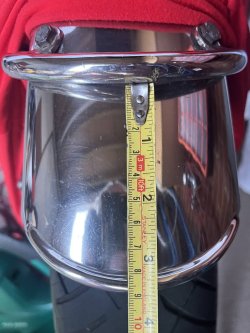
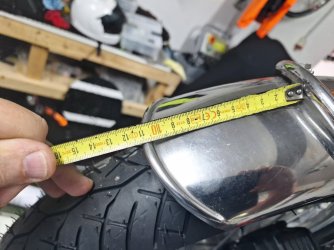
Maybe an optical illusion, in any case, I measured the length of the guard from the stay to the end point. The longer section is to the rear, ie the one closer to the engine, so in my mind it's installed correctly.How can one be sure?

piranha-bro2
Hero member
- Location
- Melbourne
If it's longer at the rear, you're in the clear!

Perry
Hero member
- Location
- West Dorset UK
Yes sorry that sounds correct. Optical illusion it must beMaybe an optical illusion, in any case, I measured the length of the guard from the stay to the end point. The longer section is to the rear, ie the one closer to the engine, so in my mind it's installed correctly.


The Sock
Hero member
- Location
- London, England
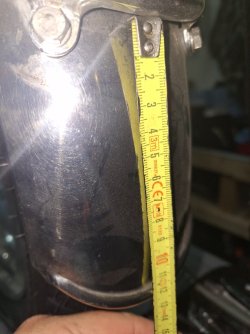
These would help check, Russ.Maybe an optical illusion, in any case, I measured the length of the guard from the stay to the end point. The longer section is to the rear, ie the one closer to the engine, so in my mind it's installed correctly.
Taken of mine, which I know to be original.
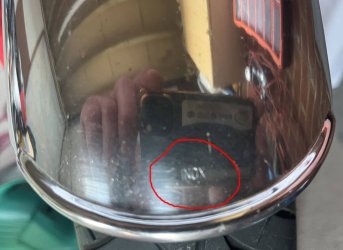

Well it seems I can sleep easy nowInox isn't stamped on all the guards.
Paul
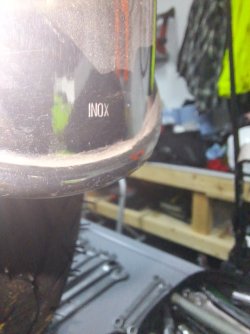
 , INOX stamp close to the engine.
Attachments
The Sock
Hero member
- Location
- London, England
If you turn the guard, after unbolting it from the hoop, the length at the front will be shortened.Well it seems I can sleep easy now
Hello Mr Sock, so you think the hoop is back to front?If you turn the guard, after unbolting it from the hoop, the length at the front will be shortened.
The Sock
Hero member
- Location
- London, England
No, the hoop is on the right way, but the mudguard itself appears not to be, Russ.Hello Mr Sock, so you think the hoop is back to front?

jko_78
Full member
- Location
- The ever windy Northwest of Europe
You may have jinxed it, as due to a train strike I wanted to drive it work yesterday and it wouldn't start....Be careful it doesn't kill the ignition if you don't follow the driving directions.

Off to have a better look today. As I mentioned earlier, wiring is rather old so you never know where you may have loosend a terminal or bent a wire. (starting with checking if there are sparks first)
jko_78
Full member
- Location
- The ever windy Northwest of Europe
So... had some really weak yellow-ish sparks, swapped the spark plugs with an old (known good) set from my BMW (out of the head, plug metal grounded on the engine) and the same weak looking spark. With some fiddling got the bike to somewhat run, sounded like the choke was stuck (wayy rich), smelled of fuel and would not idle.
Just in case had a look at the choke, cables, etc, removed float bowls (spelling?) and cleaned it all up, no difference. There was a dead insect in there, how on earth did that get there with all the filters...??? As I put the Zumo adapter between the upper frame rails & routed all the wiring there, maybe I had fouled something, but it all looked good.
So undid my change before which it worked, removed the adapter from the Zumo from the coil, and away it fired as if nothing happened. Apparently even having just the adapter (empty bracket, no Zumo was in there) on the switched wire of the coil causes enough loss for a good spark?
Did a little test drive, back to as good as it was. Interestingly on my BMW I have the same setup but there it works without problems. Not sure if the Laverda parts are just old (coils, wiring) or the BMW works different. Or it still has degraded sparks but they are less noticable. IIRC the BMW has the same setup coilwise.
It did catch my eye there are NGK 10's in there, seems a bit cold for a GT and more for a race bike? Bike runs and works great otherwise, plugs weren't dirty or fouled.
Maybe a remnant from the sidecar days, full throttle in 3rd or 4th gear against headwind storms, or during engine work (engine has been opened at lease twice) the compression was raised, I'll have a chat with my dad about that.
Anyway, today was a day off, even though trains are running tomorrow I might get on the Laverda anyway. I did learn a lot about the bike, which is always a good thing.
Yes, you can all laugh at my idiocy now
Last edited:
Then the INOX stamp would be at the frontNo, the hoop is on the right way, but the mudguard itself appears not to be, Russ.
 , is that allowed?
Tippie
Hero member
- Location
- Dr?bak, Norway
A good idea to just have the coils on their own circuit and fuse, so that nothing else will steal power or short and have the bike stop because of a blown fuse. Take power for the Zumo from another fused circuit. Also the original ceramic fuses box is a known voltage thief, so measure volts at the coils, and either side of the fuse. I have a mini relay for the ignition switch so that the contacts in there have just milliamps through them. NGK10 is extremely cold, but definitely not dangerous, I raced with 9 and lots of people use 8 on the road unless in a place where you ride really fast.
jko_78
Full member
- Location
- The ever windy Northwest of Europe
Hadn't thought of it that way, but it does make sense to separate essential things from non-essentials. I've got the Zumo power supply connected to the battery directly now, there's a small fuse in the wire of the power supply. I've measured any standby power use but it's not even registering on my (admittedly cheap) multimeter so it seems I tried to fix a non-existing problem in the first place.... I guess the saying "don't apply solutions until you've identified the problem" holds true 
I did find out my dad has already bypassed the bigger of the 2 fuses in the original box with a newer push-in type (those modern transparant ones, with a curved visible wire). I've used some of those boxes on my camper van build, might fit one here too and have some separation.
Relay is a good idea too, I've fitted one on the water tap in my camper as the contacts would burn out from the pump's power...
Since it seems to do fine on the 10s I'll just leave them in. Although I'm neither a racer nor a really fast rider, so in that regard they're probably not needed but knowing my dad a bit, they are probably there for a reason.
piranha-bro2
Hero member
- Location
- Melbourne
Never seen a twin running on 10s. But if they're working, no big deal. Definitely agree with Lee about isolating your circuit for coils. I also run a relay, so the ignition switch simply connects a heavy power supply wire to my fuse box and then direct wiring to various components. Earthing is also important - often disregarded. Give everything as much juice as you can.