what kills con rods?

Paul LeClair said:
I ALWAYS shut the petcocks off, even just at a fuel stop.....

That's the single most sound piece of advice for anyone that owns a bike or anything for that matter with a FUEL TAP,

if you don't practice this then START
 
Paul LeClair said:
on Andrew's 1200, mentioned earlier in the thread, before it went to Aus to Andrew I serviced it here in Calgary after picking it up from Heinz Neuman, the former owner of Elite Motorcycles, the former Laverda dealer in Calgary. I know the bikes original owner, Will, who is a maintenance nut, then Heinz took the bike back in on trade and it was so nice he kept it for his personal bike. It actually only had roughly 20,000 kms on it from new, when it left me it had a new timing chain, carbs rebuilt and perfectly balanced, ignition timed correctly, brand new fuel petcocks in the tank, etc, yet with only about 800 kms of Andrew riding it one of the rods went through the cases. Andrew described it as happening just cruising along, maybe 4,000 rpm ish.....

it was after repairing Andrew's Series 2 engine which involved sourcing a replacement set of cases that I decided on enforcing the Carrillo requirement as part of a standard rebuild for all Series 2 and 120 engines
Wolfgang explained than that those cases are getting very difficult to source


One of the features I like about ignitech ignitions is that you can program how many revolutions you want the engine to do on the starter before it starts to feed in the sparks. That should avoid any possibility of firing up one cylinder against another that is hydraulically locked.
 
So, according to the general consensus, I should park my > 300,000 KM RGS in case a rod decides to get out of bed :o
 
I do regret not going Carrellos when Red did mine,I was told,but I was at the end of years of costly fucking about with mine.I now just get on with it.Ride like I always ride,it got some good caning on the open stuff on The Snowy Run,holding 6k in top for extended periods chasing Marty and co.Shit happens and there built to be ridden as the manufacturer intended.While on a ride it does not enter my mind,to busy enjoying myself.
 
Terry Dymond said:
So, according to the general consensus, I should park my > 300,000 KM RGS in case a rod decides to get out of bed :o

Don't park it up Terry ............... we're using yours as a test bed.
Note: If one of those rods jumps out of bed tommorow, it's not my fault.
 
No intention of parking old yella, got a ride booked with Ian on Sunday, but it's a secret, don't tell anyone  ;)
 
Cosi said:
That's the single most sound piece of advice for anyone that owns a bike or anything for that matter with a FUEL TAP,

if you don't practice this then START


Paul and Cosi have given what may be the most important tip to all us Laverda owners - more so to me in light of my own experience. Do yourselves a favour and turn of the fuel taps every time you stop the engine.  Until this happens to you, it might not seem too important..

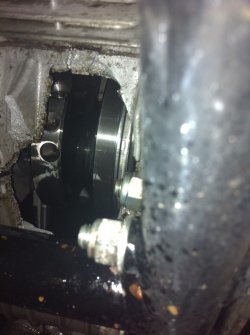
Picture of the Series 2 crankcases taken on the side of the road after the big silence...

I was very lucky to be able to source replacement cases for the Series 2 1200 through Wolfgang within 24 hours.  It was an expensive exercise in all, the bike had been running fine right up to the rod decided to let go, but to be able to find spare cases was the main issue.  Until faced with the dilemma of finding Series 2 new cases, you don't realise how hard it is getting to find some of these parts - I really was most fortunate to find a set..  others had said to expect to be searching for a year or two, but someone was looking after me.

I would suggest it to be good insurance to replace the standard rods with Carillo's any time that you have the engine apart or feel like giving yourself an early Christmas present - low mileage on the clock is no indicator of what may have happened prior to your ownership of a bike.  As Paul said, he checked everything by the book with the bike before it left Calgary for Sydney and there was no indication of a problem with the crank or any other part of the bike.  Paul re-commissioned the bike completely - he must have known he was going to get a Mirage of his own and wanted a practice run!

The rebuilt motor from Red has been great to ride - new Ross pistons were also fitted in lieu of standard with compression raised to 10.1:1 or thereabouts, capacity up to around 1136cc.  The bike is now back at Red's having some more improvements done in a few other areas. 


Andrew - and yes, all my mates do call me Yogi.. :D :D :D
 

Attachments

  • Munched crankcases on 1200.jpg
    Munched crankcases on 1200.jpg
    193.7 KB · Views: 52
Terry Dymond said:
So, according to the general consensus, I should park my > 300,000 KM RGS in case a rod decides to get out of bed :o

It's a matter of risk analysis Terry .My perception is small chance of something diablolical happening. Rough figures of the population of bikes out there how many throw a rod  as a percentage ?

I have heard on the dark side of modern generation MV Agusta F4 throwing a #2 rod out of the sack. Am I going to pull my 4000 mile motor and strip it . LF I am  :LOL:

joe
 
Cosi said:
That's the single most sound piece of advice for anyone that owns a bike or anything for that matter with a FUEL TAP,

if you don't practice this then START

Thing is, Cosi .. I always forget to turn 'em back on again ..... (angryfire)
 
  I often had a problem with owners wanting to race both the twins and triples - they'd happily spend a fortune on cams,pistons,head jobs etc, but most didn't consider that racing with rods that had done millions of cycles would be a bit silly. The cost of the Carillos was prohibitive to some , so I offered the solution of polishing the beams of the rods and having them shot peened. This was not as 100%, of course, as having new carillos, but allowed a lot of people to go racing that otherwise wouldn't have done. I can't recall anyone throwing a peened rod, but maybe they have by now! - Regards - Phil
 
But are Laverdas any better or worse than any other comparable bikes of the era, and if worse why? My little XL 125 had the wot sits revved off it back in the day, seized bearings in the gearbox, dropped a valve which smashed through the piston, broke rings when I geared it down to try and go faster, did the main bearings as well as the big end which hammered away for a while.The only thing it didn't do was brake a rod! I remember a bike mag article back in the day analysing a CB 900 rod break....inherent bad design where it bolted up with a stress raiser there. Is there any reason  a Lav rod should be worse than any other...anything to do with the Triple engine or firing cycle?Step up you engineers!
 
Dellortoman said:
One of the features I like about ignitech ignitions is that you can program how many revolutions you want the engine to do on the starter before it starts to feed in the sparks. That should avoid any possibility of firing up one cylinder against another that is hydraulically locked.

makes no difference, the starter motor itself has the power to bend a conrod if the cylinder is fueled up, engine does not need to start for it to happen
two owners told me that their engines did not fire when they got the "clunk" that bent the conrod

Mark S, long time Laverda Jota owner, bought a fairly nice one owner Corsa, had it for 3 weeks and left the fuel taps on overnight, went to start it and it went "clunk", did not fire, he realized that it may have fueled up so removed the spark plugs and spun the motor over and fuel poured out of one cylinder, installed the plugs and started the bike and the vibration could be felt straight away, turned it off, beat himself up while he called us, bought the engine over the next week and after stripping the engine we confirmed that the middle conrod was bent

years ago on one of the rigs I was on the Driller went to start the engine in the morning, was a 8V53 2 stroke GM diesel, it had dribbled through an Injector overnight and filled one cylinder, very big "clunk", after stripping the engine one conrod badly bent
is not just Laverda engines that can get damaged from this issue and does not even need to be a petrol engine as this story shows

or you can be lucky as 81 Lav was and just knock that cylinder out of phase, we pulled Bruce's crank from his 81 Jota and No 1 cylinder was 12 degrees out of phase but the conrod was straight still, figured something was wrong after we found 3 liters of oil and 2 liters of fuel in the engine when doing an oil change

 
tom3c75 said:
Surely Carillos would be equally susceptible the hydraulic lock problems that affect Laverda conrods?

that is correct, Carrillo conrods will also suffer, difference is that as they are forged and use a higher material grade they generally will not break like the Laverda conrods will
photo below of a Carrillo conrod that suffered an "event", was not caused by hydraulic lock but is a good example showing that the Carrillo will deform quite a lot before breaking
if that crank had been running standard conrods it would have broken that rod and ventilated the engine cases and being from an 81 Jota, would be another set of cases gone

 
redax5 said:
that is correct, Carrillo conrods will also suffer, difference is that as they are forged and use a higher material grade they generally will not break like the Laverda conrods will

Only fair to confirm the stock rods are also forgings.

Carillos and similar are definitely stronger, but also lots more expensive to produce, and usually heavier than most stock rods.  But, as they are usually manufactured in small batches for any given application, precision is greatly superior to mass-produced items.  Rods from a single batch are just about identical with little or no deviation in total weight or weight distribution, which is in stark contrast to mass-produced rods.  I found that out when I built the first crank for my 3C.  Took a whole box full of RGS rods to find 3 that were near-enough identical without needing to go to the grinding wheel.

Would be interesting to see how long a Carillo lasts once only slightly damaged, as probably the stock rods are that eventually do let go.  The pictured Carillo won't allow any further revs from that particular engine... is a hole punched by a Carillo nicer than one punched by a stock rod? :D

piet
 
Well, I stand corrected. But I'm surprised that the starter alone has enough grunt to damage a hydraulically locked engine. My assumption was that the engine would have to fire on another cylinder to do any damage.

There's no way the starter motor itself would be able to muster enough torque to bend a rod. It would just stall.  My guess is that the damage would be a result of the rotating crank coming to a sudden stop. The crank is bloody heavy and would have a lot of stored energy when rotating, even at cranking revs. It would be a bit like hitting the rod lengthways with a lump hammer.

I turn my fuel taps off too since Paul recounted his hydraulic lock story a few years ago. I do it on all my bikes with manual taps so I'm getting better at remembering to turn it back on  :-[

Cam
 
Back
Top