what kills con rods?

The Dellies do have a vent, but its miles above the inlet stub level.  Carbs can breathe alright, no argument there, its just that they when they overflow its right into the engine. 
Vacuum cut off fuel taps were introduced a part of the ever growing H+S culture, to stop carbs pouring petrol out if a bike crashed onto its side.


I have a question about the practice of shutting the fuel taps a few meters before
parking up.  I am not trying to be a smart ass...maybe I am missing something.
But isn't the fuel in the tank the same age as the fuel in the float bowl?  When you
re-open the tap on the next start up, the fuel entering will be the same age as the
last fuel burned?  Just a thought....

Keith
 
The smaller volume in the float bowls evaporates more quickly than the several litres in the tank, leaving a gummy residue behind.
I also saw in several carbs I have worked on this year that the rubber seals inside the float bowls are attacked, turning them to goo as well.
The fuel tank is more sealed than the fuel in the float bowls too. It can still go off, but it would take longer to do so.
One issue with empty float bowls is that as the floats have dropped and left the float valves fully open it is possible that the stick open once fuel re-enters.
But a deft tap on the float bowls sorts that out.
 
jdugen said:
The Dellies do have a vent, but its miles above the inlet stub level.  Carbs can breathe alright, no argument there, its just that they when they overflow its right into the engine. 
Vacuum cut off fuel taps were introduced a part of the ever growing H+S culture, to stop carbs pouring petrol out if a bike crashed onto its side.

No, I think they were introduced to make bikes easier for dimwits.
Paul
 
Grant said:
The smaller volume in the float bowls evaporates more quickly than the several litres in the tank, leaving a gummy residue behind.
I also saw in several carbs I have worked on this year that the rubber seals inside the float bowls are attacked, turning them to goo as well.
The fuel tank is more sealed than the fuel in the float bowls too. It can still go off, but it would take longer to do so.
One issue with empty float bowls is that as the floats have dropped and left the float valves fully open it is possible that the stick open once fuel re-enters.
But a deft tap on the float bowls sorts that out.

I use an upper cylinder lubricant (UCL) in most of my old machines including the Laverda. The new fuels are tough on old design rubber seals and float valves on the old Dells...I have not (knock on wood) have to replenish any seals or gaskets on the Dells in five years.

Don't know if you have Marvel Mystery Oil over there...works well in the fuel. Don't add it to the engine oil with a wet clutch bike.

Any good UCL should help the carbs stay fresh once parked.

DSCN7255.jpg
 
SandPebbles said:
I have a question about the practice of shutting the fuel taps a few meters before
parking up.  I am not trying to be a smart ass...maybe I am missing something.
But isn't the fuel in the tank the same age as the fuel in the float bowl?  When you
re-open the tap on the next start up, the fuel entering will be the same age as the
last fuel burned?  Just a thought....

Keith

Nout to do with age of fuel. Is an attempt to stop fuel flowing into the combustion chamber and causing hydraulic lock, or as in my case filling the crankcase with fuel and fucking the crankshaft bearings and big end bearings.
 
jdugen said:
I've been having this 'discussion' over on the 'other' forum.  (Where the idea of conrod damage from fuel lock was pooh poohed.....)

having seen in person a Detroit Diesel bend a Conrod just on the starter motor alone I have no doubt that a Laverda engine is also capable of doing it as confirmed by 2 different owners.
my take on it is that the offending cylinder is probably at BDC on the compression stroke when you hit the starter and that there is a fair pool of fuel on top of the cylinder but very much doubt that the cylinder is full.
With the momentum that the starter generates in that short period of time to spin the crank so that piston is now at TDC is sufficient to bend the conrod.

 
jdugen said:
I've been having this 'discussion' over on the 'other' forum.  (Where the idea of conrod damage from fuel lock was pooh poohed.....)
My recently acquired Jota was merrily dumping its fuel straight into the barrels, new float needles immediately ordered, but....
Surely the problem is the lack of overflow venting on the Del Orto's?  Inspecting my set, there is nowhere for the float chambers to drain other than the cylinders.  Mine now have a judicious 5mm hole drilled into the float bowls just above ideal fuel level.  Serves two purposes, allows exact setting of fuel level in the floatbowl, and any overflow goes out down the pipes to the floor.  (Just as every Jap carb has had since they were first designed).  (Doncha just love Italian engineering).
The pre 2000 year Husky 4 strole dirtbikes that came with Delordos had there overflow so it flooded the chamber and made them a shit to start after a fall,the post 2000 models had a float chamber with the overflow to outside the motor.Its been done before but for different reasons.
Brett had a flooding issue on the Snowy Run,one of his really long breather hoses melted closed on the exhaust under the motor,he had copyed the long hoses on his SFC triple.
 
jdugen said:
The Dellies do have a vent, but its miles above the inlet stub level.  Carbs can breathe alright, no argument there, its just that they when they overflow its right into the engine. 

The vent is there to link the fuel bowl to atmosphere not to drain excess fuel. Bernoulli?s principle explains the lower pressure exerted sideways through a venturi but it needs the true atmospheric pressure in the bowl to push the fuel up through the jets. Yep, carbs don?t suck, they blow.  ;)

To add to Red?s comment about a starter motor bending a rod, it only takes the volume of the chamber at TDC to create a lock. Measure squish and you will see there isn?t a lot of volume needed. In addition to the starter motor the piston has gathered momentum as it has risen on the compression stroke so not only do you have the starter motor but all the inertia of the rotating mass as well. Put a hammer on a nail and try and push, then give it some momentum. The difference is startling.

I mainly run Guzzis. The advantage of them in this case is the carbs are virtually level. They don?t naturally drain into the inlet manifold. Lavs have that natural flow forward.

Rods are under opposing forces all the time. Compression on compression, power  and exhaust strokes and tension on intake. It is a push pull affair. They are under high compression just before TDC on the compression stroke. At revs timing can be in the 30+ degree area. This means that the piston is roughly 93% up from BDC but only 83% on its rotational journey. The rod is under an extreme load but not in line with it. It needs to be able to endure the side loading too. If the timing is too advanced and the flame front is expanding too soon then the loads are increased. This is often the case as advanced timing gives less power loss than retarded timing. Pinking/pinging is only noticeable when the timing is way too advanced, not just slightly.

My take on it and ignoring the obvious manufacturing flaw issue.

Cheers

Rod
 
The venting on the Dell Ortos is more than ample.  It's the oblique mounting angle that allows the overflow to spill in the cylinders, single and only reason to shut off the petrol taps in case of dodgy float valves as soon as the engine stops.

The later carbs, as fitted to the 120s, had 2 vents, connected to the ouside with small stubs and hoses to prevent water entering them.  The earlier carbs had a single, crudely shrouded vent that allowed all manner of moisture to find its way to the float bowl.

Because of the large size of the carb vent proportional to the fuel surface area in the float bowl, the volatile parts of the fuel contained there will evaporate quicker than those inside the tank, making it sometimes impossible to start the engine with what is left in the float bowls.  But, as Lothar has stated, it takes but a few seconds for fresh fuel to re-fill the bowls, if there's enough space because you were clever and turned off the taps 1/4 mile before stopping at your garage/shed, etc.

Several fuel enhancers on the market here as well, both to up the octane-rate slightly, add a couple of lead-replacement additives and to allow the fuel to "hook up" with any water that may have developed at the bottom of the tank.  Most seem to do what it says on the tin..

Quite agree the stock starter motor and a healthy battery will easily bend a rod if they get the chance.  The leverage acting on the rod from the big end is enormous, at a certain rod angle, a combustion chamber 1/2 filled with liquid fuel won't make much of an impression on the starter. :D  Might show as a slight hesitation when spinning up, but even if you do notice it, the damage will be done.

piet
 
There seems to be a little confusion entering the conversation between venting the float bowls and an overflow drain.  Inside most Mikuni and Kei Hins the float bowl will have a hollow tube from bottom to a midway point, usually just above correct fuel level.  Any flooding has a safe escape route, and remember, latest carb mounting practice has them at 45 degrees or more of downdraft.  Any flooding would cascade straight into the inlet port.  Correct fuel level on the Lavs has the fuel pretty close to overflow once mounted at the angle they sit at.  A bit of grit and a nicely flooded cylinder is the result, mine will just waste the precious stuff onto my boots.
 
After reading this entertaining and informative thread I will do the following:

1) Only ride each Laverda I have about 1000km per year.
2) Turn off my fuel taps every time the wheels stop turning - as usual.
3) Drain the float bowls every time I go overseas - as usual.
4) Use upper cylinder lubricant.
5) If a rod lets loose I will install Carrillo's and sneak around to Maurice's to steal a set of numberless crankcases while he is touring Europe next time.  :o

Gotta love this forum for great information and debate.

Cheers

DoC!
 
I've been having this 'discussion' over on the 'other' forum.  (Where the idea of conrod damage from fuel lock was pooh poohed.....)

I don't think the idea of conrod damage was "pooh-poohed" - it was a discussion over whether or not it was best to put extra vents in your carbs or turn the fuel taps off - both will negate the chance of bending the rods - you just seemed more paranoid about it than anyone else  - Regards - Phil
 
As with everything, there is a reason I am 'concerned' about carb flooding.  Not only can a flooded cylinder bend rods, the one I worked on actually blew the sparkplug out too........!!
 
Why is it when stuff seems to get lighter and is made from exquisite alloys, that the only named replacement for our original Laverda rods are not lighter but heavier! Can't Boba knock up a few from carbon fibre? Or take a few 3d copies? Speaking as one who had a crank fully redone  a few years ago and balanced, presumably there would be more holes drilled to balance with different rods?
 
nick7 said:
Why is it when stuff seems to get lighter and is made from exquisite alloys, that the only named replacement for our original Laverda rods are not lighter but heavier! Can't Boba knock up a few from carbon fibre? Or take a few 3d copies? Speaking as one who had a crank fully redone  a few years ago and balanced, presumably there would be more holes drilled to balance with different rods?

seems to be some confusion here on the weight of a Carrillo conrod when compared to a standard Laverda conrod

Nick7,
you have a Series 1 engine so rest assured that your new Carrillo conrods are lighter than the standard Laverda conrod.
Carrillo triple conrods weigh ~380 grams and have a variation of around +/- 1 gram, their reciprocating weight is ~118.5 grams +/- 1 gram.
Standard Laverda Series 1 conrod weighs 395 grams, has a variation that is hard to measure as they are all over the place but say in the range of +/- 20 grams, reciprocating weight is 146 grams and again can vary by 10-20 grams between conrods on the same crank easily.

it is true that a Carrillo conrod weighs more than a Laverda 120 conrod, again the Carrillo is at ~380 grams +/- 1 gram, standard 120 conrod weighs in at 340 grams +/- 5 grams approx, reciprocating weight on a standard 120 conrod is ~110 grams against the Carrillo 118.5 grams.

Let's compare the 750 conrods and this comparison is for the full size 750 conrod, not the SFC 750 version.
Carrillo weigh in at ~428 grams with reciprocating weight of 121 grams and again with a variation of +/- 1 gram
Standard conrod weighs in at 493 grams with reciprocating weight of 176 grams with variation of 20 grams either way

Laverda 500 standard conrods also weigh less than the Carrillo conrods but when you weigh them you find the reciprocating weight on the Carrillo is less then the standard 500 conrod and that is the part that matters, not the overall weight of the conrod.
As I am in Cairns at the moment doing my Well Control certification I don't have the 500 figures with me but I do remember the above is correct as Piero Laverda queried me on the Carrillo weights when I sent him his conrods.

Balance factors, interesting subject, my comment on balance factor is how is it possible to do anything but the very basic of balancing on any crank when you have a variation between conrods on the same crank of +/- 20 grams ?
Correct answer is that it is not really possible.

So when Phil, Piet, Keith or myself build someone a crank, any Laverda crank, does not matter for which model and we use a nice set of Carrillo conrods that weigh within 1 gram of each other with correctly honed big ends than I have no doubt that this new built crank is going to be more in balance and spin way smoother than any Laverda crank that ever left the factory with the exception of the 750 SFC race prepared crank.

as for the balance factor itself, as shown above, Carrillo conrods depending on the model are either heavier or lighter on the reciprocating end which is the part that matters but we are talking grams here. Yes, the balance factor is going to change by a few percentage points +/- and this is going to raise or lower the "sweet spot" where the engine is spinning in harmony but again, we are probably talking a rev range here of 250 rpm +/- so who in this group of Laverda owners have a calibrated arse that can tell the difference as to where the "sweet spot" is.

None of us have.

Only difference you are going to feel is that your new engine is so much smoother and running so much better now than it was before you sent the engine away for a rebuild that everything else is irrelevant.
Just ride the sucker and enjoy the Laverda love.

HTH
Red


Wow lots of info there! I don't have carillos as it happens, and don't think I will take down a lovely running motor to fit them. If it got any smoother I would just bend more valves!Not sure I understand the reciprocating weight ? I know looks have nowt to do with it, but I don't like the weird look of the carillos....Keith mentioned he might commission some others though can't remember the name or timescale for that. Btw, anybody know of a source for an effective crank locking tool to facilitate 36 mm nut removal from alternator side as need to get to yon misbehaving starter clutch.
 
nick7 said:
Btw, anybody know of a source for an effective crank locking tool to facilitate 36 mm nut removal from alternator side as need to get to yon misbehaving starter clutch.
Nick, the best thing I ever found was a Bultaco flywheel holder, but they're a little hard to come by these days. What looks like an acceptable replacement is this sort of thing http://www.machinemart.co.uk/images/library/product/large/04/040814879.jpg, readily available from any number of eBay/Amazon sources.
A rattle gun also helps enormously. Don't forget the nut is left hand thread, though! And if you're looking for an extra-extra-deep 36mm socket for the other lefthanded nut behind the flywheel stator, Wolfgang recommends one from Gray Pneumatic, part number 2036XMD. Also available from any number of internet sources. I have one, works great.

Ken
 
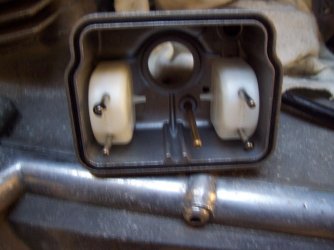
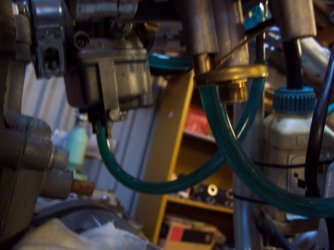
Just been inspecting the carbs on a SF750 I've imported - they are brand new PHF36's - the float mechanism is totally different and, this will please jdugen, there is an extra breather in the float bowl, along with a drain plug to save removing the bowl. The original breather has an elbow on it now to run tubing from it to atmosphere.  There is also a shield round the main jet area and the pilot jet is now an extended version. Not sure why yet as the plunger is well clear of its seat and the choke jet is  clear, but the bike doesn't rev its head off when the  (flip-up) chokes are activated. Sorry about blurry shots! - Regards - Phil
 

Attachments

  • New phf f-bowls.jpg
    New phf f-bowls.jpg
    103.6 KB · Views: 62
  • new phf.jpg
    new phf.jpg
    94.9 KB · Views: 66
Back
Top