
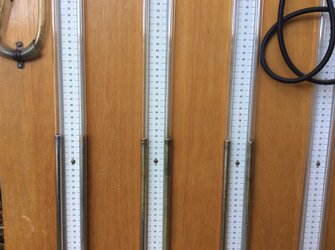
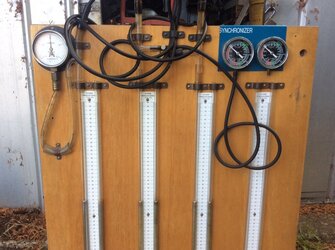
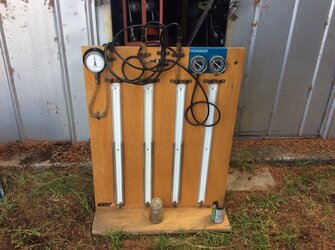
Cam and Vince, 'tis true, my ( our ) era was workable, not so much now. Swapped some gorgeous very vintage brass and mahogany electrical test apparatus for a few/many pounds of mercury, with typed sheet on how to chemically scrub the contaminated mercury you see in the jar at bottom of manometer, as the poms say, lovely piece of kit this setup, ex mechanical engineering test frame, college management could not shut down down fast enough. More to the story, another topic another time. j.

You are using an out of date browser. It may not display this or other websites correctly.
You should upgrade or use an alternative browser.
You should upgrade or use an alternative browser.
when you are your own dreaded previous owner
- Thread starter Paul LeClair
- Start date

Dellortoman
Hero member
- Location
- Tasmania, Australia
That's a lovely old bit of gear John. Probably the most accurate bit of kit you could have for carby balancing.
Talk of mercury manometers reminds me of a plumber that I once had the misfortune to be associated with. I sometimes wondered how he made it through his apprenticeship. He was always doing brain-dead stuff. At least he wasn't one of my guys. He was the client's maintenance plumber on a large building project that I was the construction project manager for.
One day he decided to use a mercury manometer to measure the flow of water through a STAD valve (a calibrated valve with pressure tappings to measure flow rate). I don't think he had a clue what he was doing because he buggered up the sequence of valve openings and all the mercury got sucked out of the manometer and disappeared into the pipework. He should never have been fucking about with it anyway because that part of the project was still under construction and hadn't been officially handed over to the client.
I went with one of my much cleverer plumbers to figure out which low point in the piping system the mercury would most likely have settled, then we had to shut down the system while my plumber dismantled the pipework to recover the mercury. After putting it back into the manometer, we figured he got 90% of it back. We couldn't find the other 10%. It's probably still scattered in small droplets in various parts of the water piping system. The worrying thing is that it's a potable (drinking) water supply.
I comfort myself in the knowledge that mercury doesn't dissolve in water, so the remaining little bits will most likely stay put in whatever little piping nooks they've settled into, and not bother anybody until the plant is eventually decommissioned well after I'm pushing up daisies.
The first time I ever saw Mercury I was probably 7 years old and one of the local kids found these odd tiny shiny round balls of STUFF in the earth buried next to the house water meter approx 3mm in diameter. We found it odd the way it would not allow you to touch it with your fingers, it would roll away. Why it was there always intrigued me.

1200ts
Hero member
- Location
- USA - Riverside CA
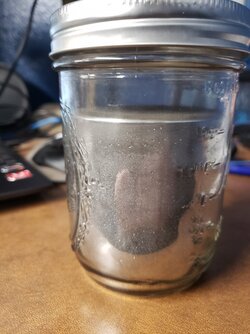
I also still use mercury to synchronize carbs. No problem getting it here in the USA. I bought 350 milliliters of it for $10 a couple years ago. And yes $10 was a very good price!Cam and Vince, 'tis true, my ( our ) era was workable, not so much now. Swapped some gorgeous very vintage brass and mahogany electrical test apparatus for a few/many pounds of mercury, with typed sheet on how to chemically scrub the contaminated mercury you see in the jar at bottom of manometer, as the poms say, lovely piece of kit this setup, ex mechanical engineering test frame, college management could not shut down down fast enough. More to the story, another topic another time. j.

Andy J
Hero member
- Location
- Isle of Man
I too used to play with the stuff as a kid, it dripped out of the cracked glass in what had been my grandfather’s barometer but hung above the stairs in our house. As you say fascinating element. However, since I discovered I have above what used to be considered a safe level of mercury in my blood I try to steer well clear of anything I know contains the stuff.
The brand new Suzuki GT750K i bought 1973, September, warning label on the fork leg slider, "these brakes may not work in the wet" and they did not! If you kept squeezing the master cylinder harder and harder, all of a sudden you broke the surface tension on the twin disks and the front end would lock instantly, or just enough if quick of brake hand to release, before the whole front end washed out, bit of a homage to the GT750J drum front brake...nothing nothing then Grab!... turned apprentice boys into men in the day... a wry smile here.Remember those safety instructions Hondas had on their fuel tanks. Jay Leno's quote he reckons they should add these days, Please don't drink the battery acid.
Bruce those bloody pesky Hustler RD250 were a bike hard to beat in the day, first choice for apprentice boys out here. j
Ditto, had my manometer hooked up to owners triple, he "assisted", me to him...do not rev the motor while we balance the carbs, all set, so he redlines the motor to see if it settles on idle, motor sort of ran well on the mercury ingested into the carbies, well maybe not well would be best description as i watched how much mercury i had lost in that moment of carelessness.That's a lovely old bit of gear John. Probably the most accurate bit of kit you could have for carby balancing.
Talk of mercury manometers reminds me of a plumber that I once had the misfortune to be associated with. I sometimes wondered how he made it through his apprenticeship. He was always doing brain-dead stuff. At least he wasn't one of my guys. He was the client's maintenance plumber on a large building project that I was the construction project manager for.
One day he decided to use a mercury manometer to measure the flow of water through a STAD valve (a calibrated valve with pressure tappings to measure flow rate). I don't think he had a clue what he was doing because he buggered up the sequence of valve openings and all the mercury got sucked out of the manometer and disappeared into the pipework. He should never have been fucking about with it anyway because that part of the project was still under construction and hadn't been officially handed over to the client.
I went with one of my much cleverer plumbers to figure out which low point in the piping system the mercury would most likely have settled, then we had to shut down the system while my plumber dismantled the pipework to recover the mercury. After putting it back into the manometer, we figured he got 90% of it back. We couldn't find the other 10%. It's probably still scattered in small droplets in various parts of the water piping system. The worrying thing is that it's a potable (drinking) water supply.
I comfort myself in the knowledge that mercury doesn't dissolve in water, so the remaining little bits will most likely stay put in whatever little piping nooks they've settled into, and not bother anybody until the plant is eventually decommissioned well after I'm pushing up daisies.
The mass of the mercury helps flatten the negative pressure pulses, you still can see the flutter, though average it out by eye. You can really see the non linear rate of change as you increase the revs and the manometer registers the negative pressure differences for each cylinder, suspect not just the non linear cam action of the intercarby couplings, cylinder fuel load, cam lobe differences et al. j

Eurocycleguy
Hero member
- Location
- Chicagoland-USA
I still have a set of mercury carb stixs. But I have lost the plastic hose barbs that the tubes connect on to. I have to see if I can adapt to the hose barbs of the balance tube on the GT.
Dellortoman
Hero member
- Location
- Tasmania, Australia
The early Kawasaki H1 (Mk III) 500 drum brakes were the same. A character building experience to ride in the rain. The brakes were OK at highway speed when you could get a bit of heat into them to dry them out, but commuting in the city you were likely to lock the front wheel at every set of traffic lights.bit of a homage to the GT750J drum front brake...nothing nothing then Grab!... turned apprentice boys into men in the day... a wry smile here.
I commuted to University for 6 months on a 1969 H1 (it wasn't mine, it belonged to a mate who lost his licence). I loved that crazy bike, but I never used the front brake to slow down in city traffic on a wet day. I only ever used the back brake under those conditions. It was only safe to apply the front brake once you had already stopped.

GregT
Hero member
- Location
- Christchurch NZ
Unusual in my experience of HI's. Mine finished up like that - but it had a very high temp lining in it which grabbed when cold but was brilliant hot.
We ran a lot of half hour proddy races around that time and I'd got really tired of having no brake after 10 minutes.
It was a Raybestos lining used on the passenger trolley at the Deep Cove tunneling project. I was told the parlour trick for visitors was to let the trolley achieve terminal velocity and only brake when the end lights got scarily close. They did a set of linings a week I was told.

- Location
- Calgary, Alberta, Canada
I have been using a solid rod CarbTune Pro https://www.carbtune.com/ for carb balancing for a few years now.
Sounds odd, but I find them to be more accurate when hung upside down.
I remember playing with mercury as a kid........
Sounds odd, but I find them to be more accurate when hung upside down.
I remember playing with mercury as a kid........
- Location
- Calgary, Alberta, Canada
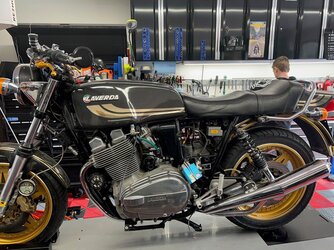
electrickery is not my friend, nor my forte. The 84 RGS Executive and the 82 1200 Mirage are both fettled and ready for spring. I have just rolled the 79 1200 on to my work bench, with great trepidation. Last July all the electrons fled the wiring harness and the bike is dead on the key switch. New Odyssey PC680 battery, still no joy. Fiddled a bit with diagnosis last summer, then set the bike aside.
bike wiring is far from original. The original ignition system and charging system were replaced with IIS a long time ago. Fuse box replaced with modern. Regulator/rectifier non stock, etc.. Plus, 'back in the day" when I did this stuff, my wiring and connection "skills" were even less advanced than now, so I have some of my own less than ideal work to correct.
Contemplating a complete custom wiring harness.... I do have a unicorn original old stock wiring harness, but it would have to be fairly significantly cut up and modified to use it for my setup. I wonder if there is anyone to make a custom harness of high quality from scratch for my needs? Anyone know?
Going to cross my fingers and start with the ignition switch, hopefully it might be that simple......
Attachments


Tippie
Hero member
- Location
- Dr?bak, Norway
Your elect skills are far better than you admit Paul, you have shown us. Just trace from the battery forward bit by bit.

breganzane
Hero member
- Location
- NSW Australia
That's such a horn looking bike!
As for the electrons, don't reinvent the wheel, rectify and repair as required. As Tippie says start at the battery and work your way forward looking for issues. Identify all the modifications, examine them even more closely and remake them using your latter-day improved skills as appropriate. Pay attenetion to the charging system wiring and connectors, and obviously the switchblocks and connectors. Can't see if they're still original, but switchblocks might be one thing that is worth simply replacing with some new modern ones given you're not too concerned with originality.
When I rebuilt my 79 Jota I figured I'd need a complete wiring harness but I found that 95% of it was perfect and I just stripped it down, re-made a few of the connectors with new ones, added a proper cabled earth into the headlight and re-sheathed it in 20mm PVC tubing I slit open and then glued back up with loctite 406. It came out looking 'almost factory' and has not given a moment's problem since.
Dellortoman
Hero member
- Location
- Tasmania, Australia
Don't underestimate yourself Paul. Your wiring knowledge and skill have improved in leaps and bounds over the last couple of years. Perhaps it's just your confidence that's lacking.electrickery is not my friend, nor my forte.
I certainly don't think it's beyond your capability to diagnose the problem. Grab your multimeter and dive in. You won't do any harm, and with a bit of patience, taking it one logical step at a time, the fault will reveal itself.
- Location
- Calgary, Alberta, Canada
thanks for the votes of confidence. I won't get back to the bike until the weekend, I am in Court all week and have been dragging my butt each evening after long days concentrating and arguing before a Justice. I still really enjoy performing in Court, just do not necessarily have the stamina of twenty or thirty years ago.
my lack of electrical confidence has resulted in the bike sitting dead since last July, but now it is front and center on the bike lift it is going to get diagnosed and fixed. "While I am at it... the carb fuel hoses are petrified, various rubber bits have deteriorated again, and I can see other things needing attention since the last time I rebuilt the bike. The odometer (kms) is about to turn over back to zero for the second time since I have owned the bike, time for some freshening again. This bike has been my favourite for 25 years now.

I expect I will be back with electrical questions and hopefully progress updates.
my lack of electrical confidence has resulted in the bike sitting dead since last July, but now it is front and center on the bike lift it is going to get diagnosed and fixed. "While I am at it... the carb fuel hoses are petrified, various rubber bits have deteriorated again, and I can see other things needing attention since the last time I rebuilt the bike. The odometer (kms) is about to turn over back to zero for the second time since I have owned the bike, time for some freshening again. This bike has been my favourite for 25 years now.
I expect I will be back with electrical questions and hopefully progress updates.