when you are your own dreaded previous owner

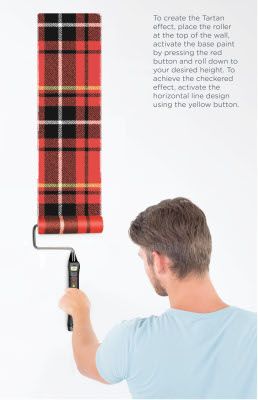
After 40 years, I'm still searching the tool stores for a left-handed hammer... I was told they are next to the tins of stripey paint, but I can't find those either.
(Aggrieved sigh…) it’s behind the round tooit on the shelf above the top one! 🤣

My mate in the air force would check the new guy’s knowledge base by giving him a small trolley with a squeaky wheel and telling him to get a C130 😁
 
My dad was an electrical engineer, but he rarely did any electrickery at home, other than fitting the occasional power point or new plug on an appliance cable. He wasn't much interested in cars or bikes. He wasn't opposed to manual labour though, and did heaps of home building and maintenance projects. So he had a reasonable collection of woodworking, concreting and other builder's tools. All hand tools though, as power tools were a rarity when I was a kid.

My brother and I would often make stuff using dad's tools. It was a source of annoyance to him cleaning up the mess we'd make in his workshop, or re-sharpening the plane blade after one of us had tried to plane a bit of wood that had a nail in it. He never discouraged us from making stuff though. I learned a lot of woodworking skills when I was a kid, including how to look after and re-sharpen the plane and chisels myself. I never did learn to clean up at the end of a job though. My own workshop is a huge mess as I write this. But it started me on a journey of using my own hands to make and fix stuff.
His metalworking tools were pretty much just a hacksaw and a few files, but that was enough to get started on the metalworking journey too. We made some lethal steel arrowheads. He didn't forbid us from making any stuff like that, but he somehow imbued us with the sense to not to shoot each other with them.

In later life when I became an engineer myself, knowing how to make stuff was a huge advantage when designing things for others to make. Some of the engineers I worked with were pretty much just academics and didn't know one end of a screwdriver from the other. They were rubbish at actually being engineers, so would put their efforts into climbing the company hierarchy into senior management positions. I often had guys like that as my boss.
 
I have not pranked them, I don’t want to discourage them, truly a gift to have them still interested in hanging out with their grandfather in the garage, working on boat motors, carbs, welding and cutting projects, wiring trailers and motorcycles, building engines, lapping in valves, making things, taking things apart, learning useful tool skills, etc..
Paul, I am sure you will but make sure they learn how to drive a manual (stick) shift transmission I am amazed at the number of young people who have no clue as to how to drive a manual trans vehicle or change a wheel.
I just sold (3 days ago) my old Toyota Camry 3. O l V6 that had a 5-speed stick shift, a few young blokes came by for a test ride but I had to refuse them because they did not know how to drive a car with a clutch pedal:unsure:o_O they should hang their heads in shame.
Dunno Dave, way of the modern world, why would they know how to operate older technology, some may learn, others will know how many cup holders and what in car data is available on what large screen, an engine is a complete mystery.

Speaking for myself, while it was not easy or always available guidance, whole lot of learning was all around, old radios for parts, old cars/bikes to render inoperable while we learned to make them operable or keep walking everywhere, motivation i suppose is the essence of being independent from sellers and used vehicle sales predators. Opportunity is a factor also.

Not least the significant factor of little or no money, for the lack of money tree we had the learning tree, many the root and branch it had. As Paul points out, give them the chance and they are every bit as we were, little or no difference, i went to the local library in the 60's, the modern young ones use the WWW, same really. Think back all the "advice" i was given when 19 yo, these old folk have no idea, is my thoughts.... there is no easy road to learning, hard road of real world experience is the road for young folk, advice has its use, later, too late more the case... j.
 
Why learn how to drive a manual shift? Electric cars don’t have transmissions! And most new cars sold are automatic transmissions also.

The same way I never learned how to harness a horse to a carriage or diagnose a sick horse, in a decade or two there will be no need to know how to troubleshoot an ICE engine either. Better that kids today learn how to work with asynchronous motors, high voltage and digital control systems: technology that they will be using all THEIR lives.
 
Last edited:
I got my license in a stick, VW Beetle. I really cannot remember the last time I drove one, it's been decades. Probably the HQ Ute with the 3 on the tree that got a floor change conversion and then it got the M21 XU1 4 speed added. Rust destroyed it eventually. I watched a TV show a while back about driving Model Ts, bloody hell that looks like brain surgery with other crazy gear selection.
 
Why learn how to drive a manual shift? Electric cars don’t have transmissions! And most new cars sold are automatic transmissions also.

The same way I never learned how to harness a horse to a carriage or diagnose a sick horse, in a decade or two there will be no need to know how to troubleshoot an ICE engine either. Better that kids today learn how to work with asynchronous motors, high voltage and digital control systems: technology that they will be using all THEIR lives.
Absolutely agree.
Although...
When my kids had horses I DID learn some horse basics, like carving abscesses from hooves and checking teeth.
And both my kids learnt to drive in manuals, and now prefer them, even if it's just to laugh at their friends who can't ;)
 
Why learn how to drive a manual shift? Electric cars don’t have transmissions! And most new cars sold are automatic transmissions also.

The same way I never learned how to harness a horse to a carriage or diagnose a sick horse, in a decade or two there will be no need to know how to troubleshoot an ICE engine either. Better that kids today learn how to work with asynchronous motors, high voltage and digital control systems: technology that they will be using all THEIR lives.

Rather silly thing to say. Why not teach them both? Understanding the past makes you comprehend the future better.

Imagine them being a specialist on rocket motors who drives a 1966 Land Rover on their spare time.

Oh never mind ....... just let them become a Nebish and blend in with the 20 billion other Nebishes.

Jim
 
As long as your kids are happy successful Nebishes, what more can you ask for? No problem with them learning to drive a stick, they may rent one when they travel, but why learn all the intricacies of ICEs? If they take up the car/bike hobby they will pick it up on their own.
Millions of kids are busy modifying and hopping up machinery today anyway, they’re just hotrodding gaming computers, not cars! Lots of aftermarket parts being researched, custom chassis being built and motors being supercharged/overclocked. The spirit is alive and well in the younger generations. And just like earlier generations, they too think that will impress the girls!
 
As long as your kids are happy successful Nebishes,

nebbish

nĕb′ĭsh

noun​

  1. A person regarded as weak-willed or timid.
  2. A person who is ineffectual, timid, and often luckless; a person of no significance.
  3. One who is fearful and timid, especially in making decisions and plans, in discussions, debates, arguments, and confrontations, and in taking responsibility.
I would drown them if they became Nebishes.

Jim
 
started power/ignition troubleshooting. I have been putting this off since last July.....

headlight off, ignition switch out, new battery connected. I found a 1200 wiring diagram here in LaverdaForum library, my thanks to the poster.

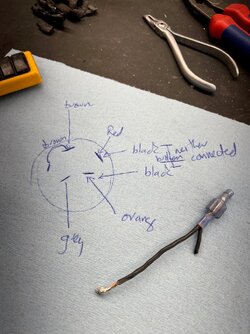
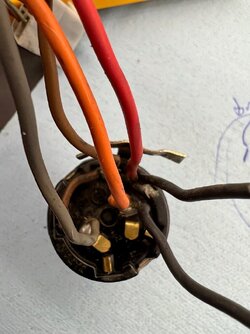
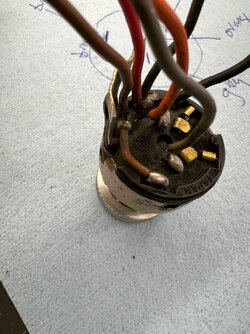
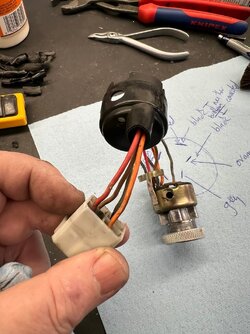
couple of photos. The wiring diagram does not show either of the two black wires, one soldered to the red wire, one soldered to the orange, and both black wires broken off....... Anyone have any thoughts on the two black wires??

following on the wirign diagram, from battery positive one power lead goes directly to starter solenoid, which it does, and has power.

The other from battery positive is supposed to be brown, and goes to fuse box, is twinned at the two 25 amp fusse, and red power out goes to ignitions with, the other out is supposed to be white and goes to voltage regulator.

I don't have power out of fuse box to ignition, so investigating aftermarket fuse box next........

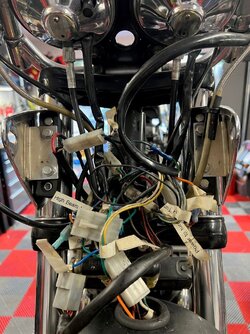
I can say my electrical connection sskills are now far above when I did this the last time, going to have to remove and replace a lot of the crappy retail grade insulated connectors I used, at least I labeled everything the last time I was in there decades ago....
 

Attachments

  • 1200 ignition 1.jpg
    1200 ignition 1.jpg
    157.1 KB · Views: 22
  • 1200 ignition 2.jpg
    1200 ignition 2.jpg
    111 KB · Views: 21
  • 1200 ignition 3.jpg
    1200 ignition 3.jpg
    188.4 KB · Views: 22
  • 1200 ignition 4.jpg
    1200 ignition 4.jpg
    198.1 KB · Views: 22
  • 1200 ignition 5.jpg
    1200 ignition 5.jpg
    164.5 KB · Views: 22
I always advise people not to rely too much on wire colours. Who knows what's been done to the bike since it left the factory around 40 years ago?

Always check the simple things first, like fuses. You don't have to be an electrickery genius to do that. :)

You say have +12V battery power to the two 25A fuses (one feeding red to the ignition switch, the other white to the regulator). But if you don't have +12V at the other side of the red fuse, so my immediate assumption would be that the fuse is blown. That could be all that's wrong with the bike.

I assume that you would have checked the fuses before you started pulling the bike's wiring apart, so I'm also assuming it isn't blown. Sometimes fuses can look OK but still be cactus. I always check them for electrical continuity. If the fuse has electrical continuity, then something else is not making contact in the fuse box area. Maybe dirty fuse connections, or dodgy spade connector on either side of the fuse box?

You refer to the "aftermarket fuse box". The usual aftermarket type is one that uses the coloured blade type fuses, with 6mm male spade terminals for wiring connections on each side of the fuse box, so I'm guessing that's what you've got. They're generally more reliable than the ceramic "bullet" type fuse holders that the Laverda factory used, but the spade connectors either side of the fuse box can occasionally fail to make contact. I've had that happen myself. I think the female spade connectors are affected by vibration and heat and tend to get loose after a while. If the bike has been sitting unused, there could also be some surface corrosion (verdigris) that's interrupting the contact. Just pull each female connector off and give it a squeeze with a pair of pliers to make it a tighter fit on the male spade terminal, then replace it. Even if there's some mild corrosion, the tighter fitting terminal will gouge through it.

Once you've fixed the discontinuity in the fuse box. That should then provide +12V at the ignition switch and hopefully all will be well. But since you've already removed the ignition switch and have found broken wires, you may as well check it out "while you're at it".

It's still possible that the key switch isn't working properly, so I'd suggest that you start by confirming the functions of the switch. At least then you know what it does when you turn the key, and whether it's doing what it should.

It's a pretty simple switch. Having told you to not pay attention to wire colours, let's take a leap of faith and assume they're factory original, and refer to the terminals by their wire colours. You know how to test for continuity between switch terminals.

When it's in the OFF position, none of the switch terminals is connected to any other.
In position 1, orange and red are connected. And separately, brown and grey are connected (these two switch functions are not connected to each other).
In position 2, red and brown are connected.

Laverda convention is that red is the power supply from the battery (via the fuse box that isn't working); orange is the switched 12V power supply to ignition (via the kill switch), brown is the parking light circuit; grey enables the headlights because the headlight is separated from the parking light circuit. There should be an orange and black wire somewhere to provide switched 12V feed from the ignition switch back to the fuse box to power other electrical systems like lights, horn, etc. I don't see an orange and black wire, but that connection happens at the other side of that multi-pin connector for the ignition switch (you don't show the other side of that connector block in your photos).

As for the two black wires soldered to the Ignition switch, I'd guess that neither are original. They've most likely been added by an owner at some point in the bike's history. Perhaps that accounts for the poor solder joints that have broken off.

The black wire that's connected to the same terminal as the orange is a switched +12V feed for something. I'd guess an accessory of some sort, like heated handgrips or a voltmeter.

The other black wire (connected to the same terminal as the red wire) is a permanently powered +12V feed to something. Perhaps it powers another accessory that you want to be powered up when the ignition is off. Maybe a 12V outlet for phone charging, or a plug to connect a battery charger to the bike.

If you have accessories that aren't working, those broken black wires may be the answer.
 
  • Like
Reactions: Rob
I always advise people not to rely too much on wire colours. Who knows what's been done to the bike since it left the factory around 40 years ago?

Always check the simple things first, like fuses. You don't have to be an electrickery genius to do that. :)

You say have +12V battery power to the two 25A fuses (one feeding red to the ignition switch, the other white to the regulator). But if you don't have +12V at the other side of the red fuse, so my immediate assumption would be that the fuse is blown. That could be all that's wrong with the bike.

I assume that you would have checked the fuses before you started pulling the bike's wiring apart, so I'm also assuming it isn't blown. Sometimes fuses can look OK but still be cactus. I always check them for electrical continuity. If the fuse has electrical continuity, then something else is not making contact in the fuse box area. Maybe dirty fuse connections, or dodgy spade connector on either side of the fuse box?

You refer to the "aftermarket fuse box". The usual aftermarket type is one that uses the coloured blade type fuses, with 6mm male spade terminals for wiring connections on each side of the fuse box, so I'm guessing that's what you've got. They're generally more reliable than the ceramic "bullet" type fuse holders that the Laverda factory used, but the spade connectors either side of the fuse box can occasionally fail to make contact. I've had that happen myself. I think the female spade connectors are affected by vibration and heat and tend to get loose after a while. If the bike has been sitting unused, there could also be some surface corrosion (verdigris) that's interrupting the contact. Just pull each female connector off and give it a squeeze with a pair of pliers to make it a tighter fit on the male spade terminal, then replace it. Even if there's some mild corrosion, the tighter fitting terminal will gouge through it.

Once you've fixed the discontinuity in the fuse box. That should then provide +12V at the ignition switch and hopefully all will be well. But since you've already removed the ignition switch and have found broken wires, you may as well check it out "while you're at it".

It's still possible that the key switch isn't working properly, so I'd suggest that you start by confirming the functions of the switch. At least then you know what it does when you turn the key, and whether it's doing what it should.

It's a pretty simple switch. Having told you to not pay attention to wire colours, let's take a leap of faith and assume they're factory original, and refer to the terminals by their wire colours. You know how to test for continuity between switch terminals.

When it's in the OFF position, none of the switch terminals is connected to any other.
In position 1, orange and red are connected. And separately, brown and grey are connected (these two switch functions are not connected to each other).
In position 2, red and brown are connected.

Laverda convention is that red is the power supply from the battery (via the fuse box that isn't working); orange is the switched 12V power supply to ignition (via the kill switch), brown is the parking light circuit; grey enables the headlights because the headlight is separated from the parking light circuit. There should be an orange and black wire somewhere to provide switched 12V feed from the ignition switch back to the fuse box to power other electrical systems like lights, horn, etc. I don't see an orange and black wire, but that connection happens at the other side of that multi-pin connector for the ignition switch (you don't show the other side of that connector block in your photos).

As for the two black wires soldered to the Ignition switch, I'd guess that neither are original. They've most likely been added by an owner at some point in the bike's history. Perhaps that accounts for the poor solder joints that have broken off.

The black wire that's connected to the same terminal as the orange is a switched +12V feed for something. I'd guess an accessory of some sort, like heated handgrips or a voltmeter.

The other black wire (connected to the same terminal as the red wire) is a permanently powered +12V feed to something. Perhaps it powers another accessory that you want to be powered up when the ignition is off. Maybe a 12V outlet for phone charging, or a plug to connect a battery charger to the bike.

If you have accessories that aren't working, those broken black wires may be the answer.
Thanks for the detailed info, Cam. I am about to head out to the garage to have another go. Doubt it is just a fuse, last weekend 10-year-old granddaughter Olive pulled all the fuses and replaced them all with brand new. I checked the fuses she took out, and all looked fine. also showed here how to check circuit continuity and resistance, she had an ohmmeter on each fuse she removed, I had her replace them anyway. It could be a fault in the aftermarket fuse box itself, that is where I am going to start today.......

I am positive it was not me who soldered on the two black wires to the ignition switch so they must be pre 1999 when I first acquired the bike....
 
After 40 years, I'm still searching the tool stores for a left-handed hammer... I was told they are next to the tins of stripey paint, but I can't find those either.
18695.jpg
 
Back
Top