- Location
- Calgary, Alberta, Canada
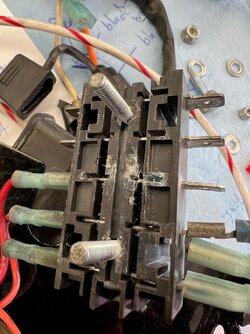
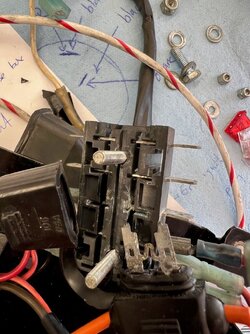
removed all the old Bosch stuff and related wiring. Aftermarket fuse box corroded, and no battery power to the fuse terminal.I always advise people not to rely too much on wire colours. Who knows what's been done to the bike since it left the factory around 40 years ago?
Always check the simple things first, like fuses. You don't have to be an electrickery genius to do that.
You say have +12V battery power to the two 25A fuses (one feeding red to the ignition switch, the other white to the regulator). But if you don't have +12V at the other side of the red fuse, so my immediate assumption would be that the fuse is blown. That could be all that's wrong with the bike.
I assume that you would have checked the fuses before you started pulling the bike's wiring apart, so I'm also assuming it isn't blown. Sometimes fuses can look OK but still be cactus. I always check them for electrical continuity. If the fuse has electrical continuity, then something else is not making contact in the fuse box area. Maybe dirty fuse connections, or dodgy spade connector on either side of the fuse box?
You refer to the "aftermarket fuse box". The usual aftermarket type is one that uses the coloured blade type fuses, with 6mm male spade terminals for wiring connections on each side of the fuse box, so I'm guessing that's what you've got. They're generally more reliable than the ceramic "bullet" type fuse holders that the Laverda factory used, but the spade connectors either side of the fuse box can occasionally fail to make contact. I've had that happen myself. I think the female spade connectors are affected by vibration and heat and tend to get loose after a while. If the bike has been sitting unused, there could also be some surface corrosion (verdigris) that's interrupting the contact. Just pull each female connector off and give it a squeeze with a pair of pliers to make it a tighter fit on the male spade terminal, then replace it. Even if there's some mild corrosion, the tighter fitting terminal will gouge through it.
Once you've fixed the discontinuity in the fuse box. That should then provide +12V at the ignition switch and hopefully all will be well. But since you've already removed the ignition switch and have found broken wires, you may as well check it out "while you're at it".
It's still possible that the key switch isn't working properly, so I'd suggest that you start by confirming the functions of the switch. At least then you know what it does when you turn the key, and whether it's doing what it should.
It's a pretty simple switch. Having told you to not pay attention to wire colours, let's take a leap of faith and assume they're factory original, and refer to the terminals by their wire colours. You know how to test for continuity between switch terminals.
When it's in the OFF position, none of the switch terminals is connected to any other.
In position 1, orange and red are connected. And separately, brown and grey are connected (these two switch functions are not connected to each other).
In position 2, red and brown are connected.
Laverda convention is that red is the power supply from the battery (via the fuse box that isn't working); orange is the switched 12V power supply to ignition (via the kill switch), brown is the parking light circuit; grey enables the headlights because the headlight is separated from the parking light circuit. There should be an orange and black wire somewhere to provide switched 12V feed from the ignition switch back to the fuse box to power other electrical systems like lights, horn, etc. I don't see an orange and black wire, but that connection happens at the other side of that multi-pin connector for the ignition switch (you don't show the other side of that connector block in your photos).
As for the two black wires soldered to the Ignition switch, I'd guess that neither are original. They've most likely been added by an owner at some point in the bike's history. Perhaps that accounts for the poor solder joints that have broken off.
The black wire that's connected to the same terminal as the orange is a switched +12V feed for something. I'd guess an accessory of some sort, like heated handgrips or a voltmeter.
The other black wire (connected to the same terminal as the red wire) is a permanently powered +12V feed to something. Perhaps it powers another accessory that you want to be powered up when the ignition is off. Maybe a 12V outlet for phone charging, or a plug to connect a battery charger to the bike.
If you have accessories that aren't working, those broken black wires may be the answer.

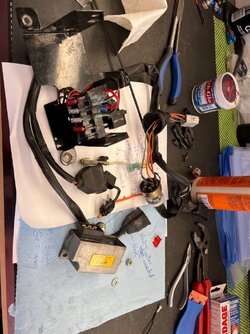
removed everything made all new proper connections, fresh direct power wire from battery positive to fuse box terminal. Now have lights, engine cranks over on the starter button.
I pulled a plug, grounded it, turned engine over on starter button, I do not appear to have spark. Is a John Wilson IIS box, my memory is that it has some sort of test switch setting. The switch on the box is set to "3". Rotated the switch selector with a small screwdriver, nothing.....
In my garage fire I lost most of my motorcycle documentation, manuals, instructions, etc.. So no documentation to refer to to trouble shoot the IIS. There is a tiny little power wire from the IIS box to the positive terminal on the battery. I have not started checking the ignition box wiring, will have to pull it all out and take it apart.
I am hoping John comes along to describe how/where I check to be sure the IIS box is properly getting ignition power and how to troubleshoot. I am sure the box is fine, it must be in the wiring. Is there a test setting on the box?