Chain Wear

I remember a pot of grease on the gas burner, when liquid chain goes in, leave for a few minutes, fish it out with wire, hang on the clothesline and when cool, wipe with rag and reinstall.

That was a while back, when I had a HONDA 750/4.
She died a nasty death, when head butting the front of a Honda Civic. R.I.P.
 
chrisk said:
I remember a pot of grease on the gas burner, when liquid chain goes in, leave for a few minutes, fish it out with wire, hang on the clothesline and when cool, wipe with rag and reinstall.

That was a while back, when I had a HONDA 750/4.
She died a nasty death, when head butting the front of a Honda Civic. R.I.P.

Duckhams, Chris, Duckhams. Never forget to put the pin in the handle before picking up the tin of molten grease!! Don't ask me how I ....
 
Don't trust the pin, don't ask me how I know.
I don't immerse my mc chain in kero, just brush it with a stiff paintbrush over the dish of kero so that most of the stuff falls into the dish. If after cleaning off the accumulated gunk, it still has stiff spots, it is new chain time. Anything to do with chains is dirty poxy work. They always seemed to come in in waves to workshop, suddenly there would be a two week period with tons of chain and sprocket jobs. Maybe it was related to the weather.
 
nick7 said:
Chains dont actually stretch, i recall?

No, they don't. The tolerances between pins, plates and rollers increase ... but 'stretch' seems to describe the overall increase in pitch (which is what wears the sprocket teeth) quite satisfactorily.
 
Surely they develop slack through wear, and become elongated? God  , I must have too much time on hands to bovver with this?😂😂
 
that is exactly what Pirana posted #42, just worded differently, or if you like when the pin and bushing/hole drillings are all perfectly round the chain is XYZ length, after loads of miles those holes/drillings become worn and (possibly) oval, the pins become worn and smaller in (irregular) diameter and  so the worn length of chain length is xyz+ xyz%, this also means that the distance (centre to centre) of every link is bigger, and then does not match the sprockets, eventually leading to wear on the drive faces of the slopes of the teeth,
and, anyone remember hooked sprockets? there did at one time exist a lot of crap sprockets, the ones on my kids mopeds were shit before the chains??? maybe they were not hardened,  don't understand that actually.
blimey I feel like a beer and its only ten o/c
CLEM
 
CLEMTOG said:
that is exactly what Pirana posted #42, just worded differently, \
CLEM

Grazie, Clem. In fact in the bicycle industry we use a gauge that simply gives a very accurate measurement of the length between a set number of pitches. If that figure reaches beyond a certain point fitting a new chain (only) will almost invariably cause the chain to skip under load on any sprocket (anywhere from 3T-12T in a cluster or cassette these days!). With most riders it's that 'preferred' gear or two that's used the most, particularly on regular commute routes. On my bikes I intentionally mix ratios to try and share the work between as many rear sprockets as possible (by using the high-low ratio of the front chainrings and choosing to ride at a different RPM ... cadence).

No such luxury on a moto - the 'cassette' is in the gearbox!. Motos are more forgiving because everything is bigger and stronger, but fitting a new chain on a worn sprocket is not a good idea - or vice-versa. I'm guessing a new chain on a fukt moto sprocket would jump, just as a bicycle does. The Honda chain adjusters that came with my alloy swingarm actually have a 'green-good' and 'red-replace' section to show when it's time to replace. Not a bad idea, unless you alter sprocket sizes at all. Probably worth marking your axle pos when everything is new and another mark to indicate replacement point ... but as many have said, stiff links are usually the 'replace' indicator on good o-ring chains anyway.
 
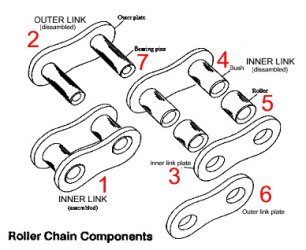
With a worn chain, the centre to centre distance only increases on every second link. When you think about the construction of a chain, the 'inside' links with the bushes and rollers in them are a fixed length, regardless of how worn the chain gets. But the 'outside' links with pins will vary in length, because their pitch length is dependent on the close fit of the pins in the bushes. That means the links will be unevenly spaced, which (from a smooth running point of view) is perhaps worse than them all being elongated the same amount. Maybe it's that uneven pitch length that makes worn chains sound horrible as they go around.

Has anyone else noticed that even a quite new chain will sound different when the rear wheel is rotated backwards? It's usually noisier than when rotated forwards. I presume that's because the sprocket teeth get "run-in" to the chain one way, but not the other. Looking at the sprockets, I've never been able to spot any asymmetry on the teeth (unless it's completely knackered), so it must be a very small difference.
 
CLEMTOG said:
that is exactly what Pirana posted #42, just worded differently, or if you like when the pin and bushing/hole drillings are all perfectly round the chain is XYZ length, after loads of miles those holes/drillings become worn and (possibly) oval, the pins become worn and smaller in (irregular) diameter and  so the worn length of chain length is xyz+ xyz% ...

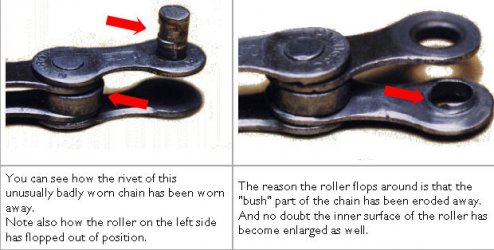
Following the dictum that 'A Picture is Worth a Thousand Words'  ...  :D.  (NOT my own work, btw)
 

Attachments

  • Chain wear.jpg
    Chain wear.jpg
    52.7 KB · Views: 118
Does that pic debunk your theory, Cam? Pins wear and the peened 'bush' on the inside plate wears. But I think moto chain construction is different in that regard. However, the inside bores of the inner plate link assembly on the moto chain must wear, along with the pin (as per the pic). I'd hazard a guess that wear is distributed evenly across inner plate and outer plate segments of the chain.

You can actually turn a sprocket around and get away with a new chain as the profile of the 'back side' of each tooth should still be as it was when new ... sort of. But once THAT side wears, the chain goes for a 'spin'  of its very own - around the sprocket ... know wot I mean, Vince?  :D
 
Why yes I do, the first time I was completely missing 6 teeth on the rear alloy sprocket, unseen or felt and a few years later I was slipping the chain over the rear, it went from driving fine to shit really quick both times I was in the middle of trips but luckily managed to get the 600ks home. It's hard to see any damage or wear to the rear sprocket with the chain guard covering so much. Hope I have better luck and distance with the now steel rear sproket.
 
Hi Guys
              I can't believe some of the things I've read on this thread. The easiest way to check chain wear is to try to pull the chain off the rear sprocket at the nine o'clock position looking straight at it. If you can the chain is worn out and needs replacement along with both sprockets. They are consumable items which give very good service if maintained correctly. I've fitted hundreds of sets over the years and have found Afam to be the best by far. If you find tight spots it's because the chain has been run too tight at some point in it's life. I fitted a set of tyres to an R1 owned by a local wheelie hooligan and advised him his chain was very badly worn and at the end of its life. Obviously he ignored me, the chain broke and destroyed the crankcases throwing him over the front and into A&E. He came back to tell me that he wished he'd listened as the bike was a write off. A good kit costs pence per mile and a sight cheaper than crankcases.
 
Back
Top