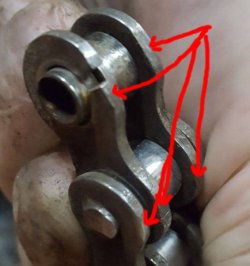
"I noticed that it's next to the connecting link. Just wondering whether there's any significance in that.
Good thing you spotted it before it could do something nasty."
of course it is significant Cam, think about it, the spring link is supplied with one plate riveted to the pins, (nice a ridged) the other (at one time) plate was a loose push fit over the pins, (not so now) so movement under load was possible causing differing stresses on the fixed plate and the loose plate, and even some "bending" of the pins, the spring merely keeps the loose plate in situ, I do like riveted links because of this, and let no one say that those links are useless because if they are soft enough to rivet, then they are no good, ALL THE LINKS ARE RIVETTED. They don't get hardened after assembly.
Nowadays the loose plates in spring links are a very tight fit, and have to be "pressed" onto the pins with some sort of mechanical screw device, a G clamp and a small socket perhaps, the self rivet links were always like this.
CLEM