
You are using an out of date browser. It may not display this or other websites correctly.
You should upgrade or use an alternative browser.
You should upgrade or use an alternative browser.
Dellorto Main Jet - too rich problem
- Thread starter Chuck3CL
- Start date

More good questions John, thanks, here goes:
"Air cleaner filter in best condition? Yes, clean filter."
"condition of ALL three plugs, ie if a lot of cold crank starts and short road rides. Cold enrichment disengaged once on the ride."
Plugs newish and cleaned, I shut the choke off(cold enrichment) immediately after cold start.
"Pilot fueling adjustment screw position ( 1 3/4 out usual ) "
- I set for best running at idle.
"Oring intact on the adjuster screw, proper metal washer also contacting Oring." -
New carb rebuild parts about 10k km earlier.
"Has this motor been running poorly previous and loaded up the exhaust system with oil/carbon build up? Being ejected on upper rpm use." -
No, runs great all the time with Ignitech advance curve now optimised.
"Wondering what MPG/kms/l are you getting from a tank, "-
With 95 octane I get approx. 11 km/ litre.
"On the road, if brave, open the cold enrichment lever to see if the engine gets fluffy," - runs poorly if choke temperarily pulled on while running.
" check the 5K ohm resistor spark plug covers for open circuit." Checked ok. Even cleaned the contacts within the plug cap.
"Air cleaner filter in best condition? Yes, clean filter."
"condition of ALL three plugs, ie if a lot of cold crank starts and short road rides. Cold enrichment disengaged once on the ride."
Plugs newish and cleaned, I shut the choke off(cold enrichment) immediately after cold start.
"Pilot fueling adjustment screw position ( 1 3/4 out usual ) "
- I set for best running at idle.
"Oring intact on the adjuster screw, proper metal washer also contacting Oring." -
New carb rebuild parts about 10k km earlier.
"Has this motor been running poorly previous and loaded up the exhaust system with oil/carbon build up? Being ejected on upper rpm use." -
No, runs great all the time with Ignitech advance curve now optimised.
"Wondering what MPG/kms/l are you getting from a tank, "-
With 95 octane I get approx. 11 km/ litre.
"On the road, if brave, open the cold enrichment lever to see if the engine gets fluffy," - runs poorly if choke temperarily pulled on while running.
" check the 5K ohm resistor spark plug covers for open circuit." Checked ok. Even cleaned the contacts within the plug cap.

This has my attention, very low, with decent ignition and optimum carby setup, 15k/l is well within reach. Have a think here, not obvious the root issue or issues, have misgivings about 0,02 m/m change in mains, will make a big difference... j
"Wondering what MPG/kms/l are you getting from a tank, "-
With 95 octane I get approx. 11 km/ litre.
"Wondering what MPG/kms/l are you getting from a tank, "-
With 95 octane I get approx. 11 km/ litre.

mauricejota7604
Hero member
- Location
- Victoria Australia
Main jets aren't your problem Charlie
have you got the correct thickness washer under the brass seat for the float needle and are the needle jets all tight??
have you got the correct thickness washer under the brass seat for the float needle and are the needle jets all tight??

hooksey
Hero member
- Location
- Vic , Australia
In short No........if its running rich set in middle groove with your other settings, and you haven't replaced needle and emulsion tubes??Short of replacing needles and tubes, do you think there would be any advantage in changing the needle position one step?
They will be flogged out.
One other unlikely, source of mains, had the unfortunate supply of mains from a dealer now not dealing, had drilled out mains and put them back in the sale stock, stamped as 1.xx though wide as the English Channel for size.... have a bunch of 145 here i solder up and drill with number drills to get a ball park mains size, then order the nearest in new stock. As useful or useless as this is too you Charlie ( assumed name ).
Much of the riding done at 3300rpm is mostly transition "idle pilot" and lower needle to emulsifier tube, the mains are not the primary fueling port, obtaining best k/l we decided on a mains that did not flood the pilot jet, then slowly reduced the pilot jet to around 55, can go lower though the off idle stumble was dangerous in traffic, flame out when cracking the throttle. mains for big riding, pilot/needle for cruising, just off throttle stop. Background of some use or no... j.
Much of the riding done at 3300rpm is mostly transition "idle pilot" and lower needle to emulsifier tube, the mains are not the primary fueling port, obtaining best k/l we decided on a mains that did not flood the pilot jet, then slowly reduced the pilot jet to around 55, can go lower though the off idle stumble was dangerous in traffic, flame out when cracking the throttle. mains for big riding, pilot/needle for cruising, just off throttle stop. Background of some use or no... j.
Last edited:
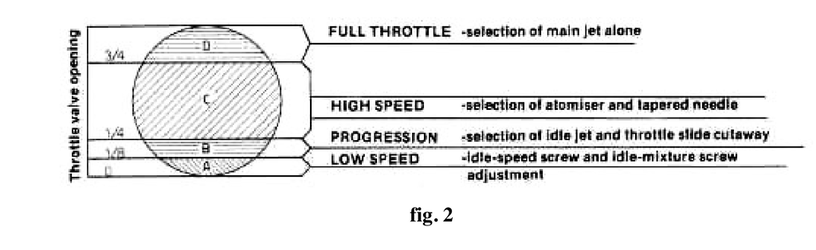
Time to pull it apart and have a closer look at the needle config.Main jets aren't your problem Charlie
have you got the correct thickness washer under the brass seat for the float needle and are the needle jets all tight??

Dellortoman
Hero member
- Location
- Tasmania, Australia
Laverdas seem to be reasonably un-fussy about Dellorto jetting. Just chuck a bit of fuel down the inlets and they'll run. As long as it's not way too lean it'll be OK. You only need to get fussy when you want to maximise performance and fuel economy. My jota had 140 mains in it when I bought it and it ran OK at WOT. It was a bit down on power and guzzled fuel like there was no tomorrow, but there were no noticeable flat spots and the plugs didn't foul up.Seems low on factory spec Cam? Check my factory manual.... right you are Cam, 118 for 1000 and 115 for the 1200.
As you say Cam, broadly, some latitude in mains sizing.
Just recalled one mystery 3c ride that came my way to make a solution to mystery, poor running at WOT, on the center stand engine running nothing too obvious, no real load so throttle blipping was was all we could do... on the road, over rich fluffing of sorts. Back to workshop, remove tank take a close look, the throttle cams were hard against one of the separate "choke" ( really fuel enrichment, i digress..) outer bowden cable, each time you gave it some constant stick on the twist grip the cam arms would pull the plunger up on one of the carbs... Mmmmm that was not in the diagnosis instruction manual.... forgot about that novel issue... very simple rectification. I use liberal free play on the plungers. at least 3mm, even 5m/m or more free play, only have to lift the plungers slightly overall. j ** doubt it is same this case, as all three are exhibiting same condition as described.
Just recalled one mystery 3c ride that came my way to make a solution to mystery, poor running at WOT, on the center stand engine running nothing too obvious, no real load so throttle blipping was was all we could do... on the road, over rich fluffing of sorts. Back to workshop, remove tank take a close look, the throttle cams were hard against one of the separate "choke" ( really fuel enrichment, i digress..) outer bowden cable, each time you gave it some constant stick on the twist grip the cam arms would pull the plunger up on one of the carbs... Mmmmm that was not in the diagnosis instruction manual.... forgot about that novel issue... very simple rectification. I use liberal free play on the plungers. at least 3mm, even 5m/m or more free play, only have to lift the plungers slightly overall. j ** doubt it is same this case, as all three are exhibiting same condition as described.
Today I modified the choke cable mount with the lathe to add an additional 1.5 mm slack to make sure the plungers seat and seal. Didn't help my too-rich problem but I can eliminate that as a cause .
I reset all the idle jets at 1 1/4 turns for best idle.
I think my next move is to replace the needles and emulsion tubes with new ones.

I reset all the idle jets at 1 1/4 turns for best idle.
I think my next move is to replace the needles and emulsion tubes with new ones.
Attachments

Laverdalothar
Hero member
- Location
- Germany
Hi Chuck,
first of all, I would exchange all needles and jets, ultrasonic-clean the carbs and re-assemble them with new seals and parts. Else you are chasing the problem from an unknown state of wear of the parts.
Second, I would check if the float valves REALY seal. could easily be they don't, then you are also chasing the problem with no result
Last but not least: is it really fuel that is burned or might it be oil, please...? Not uncommon that the valve-seals on the intake side harden over time and don't seal anymore. As it is black smoke though, I suppose it's gasoline and not oil (would be more blue smoke then)
One more thing: if it happens only while accelerating hard, it could also mean that your accelerator pumps are set wrong.
first of all, I would exchange all needles and jets, ultrasonic-clean the carbs and re-assemble them with new seals and parts. Else you are chasing the problem from an unknown state of wear of the parts.
Second, I would check if the float valves REALY seal. could easily be they don't, then you are also chasing the problem with no result
Last but not least: is it really fuel that is burned or might it be oil, please...? Not uncommon that the valve-seals on the intake side harden over time and don't seal anymore. As it is black smoke though, I suppose it's gasoline and not oil (would be more blue smoke then)
One more thing: if it happens only while accelerating hard, it could also mean that your accelerator pumps are set wrong.
Hi Chuck,
first of all, I would exchange all needles and jets, ultrasonic-clean the carbs and re-assemble them with new seals and parts. Else you are chasing the problem from an unknown state of wear of the parts.
Second, I would check if the float valves REALY seal. could easily be they don't, then you are also chasing the problem with no result
Last but not least: is it really fuel that is burned or might it be oil, please...? Not uncommon that the valve-seals on the intake side harden over time and don't seal anymore. As it is black smoke though, I suppose it's gasoline and not oil (would be more blue smoke then)
One more thing: if it happens only while accelerating hard, it could also mean that your accelerator pumps are set wrong.
Thanks Lothar, yes, there are a few parts I have not yet replaced like the emulsion tubes and needles which I will get. The others have been replaced not too long ago. I have an ultrasound bath too. I'm going to closely inspect the float valve too.
I removed the accel pump actuators but I'll check for any leaks there from the remaining parts.
It's definitely fuel, not oil. Doesn't burn any oil, but 11km/litre is the problem.
If I hit the throttle with a hard rev after an idle the black smoke can be seen coming out the exhaust. So I'm considering a worn needle, not the main jet.

Worn slides will give you an erratic tickover before they affect anything else. Once they start to lift the amount of air that leaks round a worn slide is negligible to what is flowing underneath it.
Check your float height. the higher the fuel level the richer it will run but remember if its E10 its going to run rich and sooty so you may need to come down a bit on mains
Always remember the spec given by Laverda and Dellorto was set with 4/5 star leaded fuels and times change .
.
Check your float height. the higher the fuel level the richer it will run but remember if its E10 its going to run rich and sooty so you may need to come down a bit on mains
Always remember the spec given by Laverda and Dellorto was set with 4/5 star leaded fuels and times change
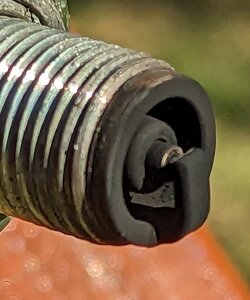
.Here goes...more free advise, a smile here. Plug condition has a few notables, the actual threaded metal body internal wall has flaked build up of contamination, that is the coolest part of a plug as such takes a long time to build up. Ceramic nose is well contaminated, beyond a clean would proffer. New plugs, BP8ES and a 10km plug chop ( easy on the throttle, you already know large throttle effect ) would be next, ie are all three carbies, indicated by the plug chop, the same. If so that is the good news, whatever is the reason or reasons for this condition, fix one fix three.
The k/l your having is close to what factory engines consumed with gross over fueling to compensate for the one step BTZ. That was in the main ( pun intended ) idle pilot jet domain. Going out on a limb, factoring in the various suggestions from the well experienced folk, this issue you have has a lot in common with well known cold crank fuel enrichment fault(s). Mains issue am far from convinced even though it has some commonality of puffing black exhaust and high fuel consumption.
Post new plunger seals, are there witness marks on the rubber pads to indicate some degree of effective sealing. j
The k/l your having is close to what factory engines consumed with gross over fueling to compensate for the one step BTZ. That was in the main ( pun intended ) idle pilot jet domain. Going out on a limb, factoring in the various suggestions from the well experienced folk, this issue you have has a lot in common with well known cold crank fuel enrichment fault(s). Mains issue am far from convinced even though it has some commonality of puffing black exhaust and high fuel consumption.
Post new plunger seals, are there witness marks on the rubber pads to indicate some degree of effective sealing. j
Thanks John, new plugs and a plug chop are on the to-do list. Hopefully I can identify which throttle opening range and so which jet circuit is the culprit. (Btw, all 3 plugs look like the previous picture.)Here goes...more free advise, a smile here. Plug condition has a few notables, the actual threaded metal body internal wall has flaked build up of contamination, that is the coolest part of a plug as such takes a long time to build up. Ceramic nose is well contaminated, beyond a clean would proffer. New plugs, BP8ES and a 10km plug chop ( easy on the throttle, you already know large throttle effect ) would be next, ie are all three carbies, indicated by the plug chop, the same. If so that is the good news, whatever is the reason or reasons for this condition, fix one fix three.
The k/l your having is close to what factory engines consumed with gross over fueling to compensate for the one step BTZ. That was in the main ( pun intended ) idle pilot jet domain. Going out on a limb, factoring in the various suggestions from the well experienced folk, this issue you have has a lot in common with well known cold crank fuel enrichment fault(s). Mains issue am far from convinced even though it has some commonality of puffing black exhaust and high fuel consumption.
Post new plunger seals, are there witness marks on the rubber pads to indicate some degree of effective sealing. j
I don't think it is a fuel enrichment cause. The new seals have the telltale witness mark dimple on them and I even added additional slack to ensure a good seating.
Next investigation is the floats/float valve as Paddy, Maurice, etc have mentioned.
Ok Charlie, all noted, one of the more unusual ( to diagnose ) issues on this forum. Your methodical approach and skills will endure over the issue. Have a think here though am all out of ideas at this time.
Of course in the end, the reason will be obvious once found, just not obvious at this time, nature of faults, many the time witnessed. j
Of course in the end, the reason will be obvious once found, just not obvious at this time, nature of faults, many the time witnessed. j

Rob
Hero member
- Location
- Midlands, UK
In my experience, replacing these can make a big difference. I would make this my next move.there are a few parts I have not yet replaced like the emulsion tubes and needles which I will get
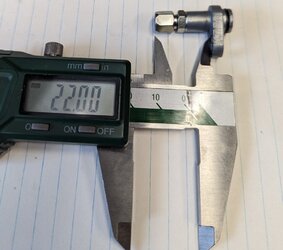
Hi Maurice, each brass seat for the float needle has a fibre washer as in this photo.Main jets aren't your problem Charlie
have you got the correct thickness washer under the brass seat for the float needle and are the needle jets all tight??
All needle jets are tight.


Last edited:
Setting the float height, here, fabricate a small right angle bracket with 18m/m inside edge, food grade plastic tube coupled to the fuel inlet, blow air into the needle and seat and test for cut off at 18m/m. Can do it on the engine as a fiddle ( save removing the carbies ). Not sure this helps, j.