
You are using an out of date browser. It may not display this or other websites correctly.
You should upgrade or use an alternative browser.
You should upgrade or use an alternative browser.
Dellorto Main Jet - too rich problem
- Thread starter Chuck3CL
- Start date

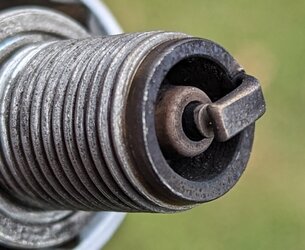
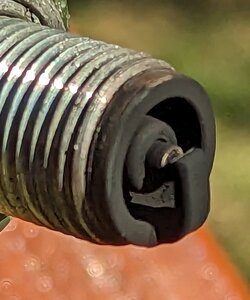

As you indicate Charlie, significant improvement, well outside the usual issues we see, a smallish change on the needle and a change in plug colour....well done. jDid a test using the top (leaner) ring on the needle instead of the middle: seems to provide better torque in 4th&5th.
Plugs don't exhibit carbon like before.
AFTER:
View attachment 81568
BEFORE:
View attachment 81569

hooksey
Hero member
- Location
- Vic , Australia
Nice……. A leaner engine will always give more power……..well until it goes pop! For a road ridden bike all will be wellDid a test using the top (leaner) ring on the needle instead of the middle: seems to provide better torque in 4th&5th.
Plugs don't exhibit carbon like before.
AFTER:
View attachment 81568
BEFORE:
View attachment 81569


Agree Paul, so next step will be to optimise the idle jet settings which now need to be readjusted after the needle change.I have a from the tip of my nose feeling that modern fuels need leaning off a bit.
Going down a tad on the pilots could be the ultimate solution.
Paul
Previously I ordered 120 Main jets, down from 125. I might as well give them a try too when they arrive just to see if there is any additional difference.

CLEMTOG
Hero member
6 things, 4 mentioned before, but there is a twist
1) be sure the choke plungers are fully home and there is slack in all three cables (why the need to turn off a few mill from the flange face, when there is a cable adjuster?????)
2) be sure that the float valves are shutting off 100%
3) be sure that the float height, checked on the bench, each carb indidvidually on a flat surface (as diagram above) is 100% correct
4) be sure that the ignition timing is correct and advancing correctly and on all 3 cylinders, not just the outers and that the slides are balanced using prorietory vacuum gauges , you do have acces to those dont you?
5) temporarilly junk the three into oen exhaust and fit a conventional Jota system (borrowed from a friend?)
listen carefully now...................6) visit a local dyno and pay the cost for a few runs, listen to what the techo says and act upon it, unlike a UK dealer who took a troublesome SFC1000 to a local race shop dyno with its owner and then argued with the operator that he was wrong!
CLEM
1) be sure the choke plungers are fully home and there is slack in all three cables (why the need to turn off a few mill from the flange face, when there is a cable adjuster?????)
2) be sure that the float valves are shutting off 100%
3) be sure that the float height, checked on the bench, each carb indidvidually on a flat surface (as diagram above) is 100% correct
4) be sure that the ignition timing is correct and advancing correctly and on all 3 cylinders, not just the outers and that the slides are balanced using prorietory vacuum gauges , you do have acces to those dont you?
5) temporarilly junk the three into oen exhaust and fit a conventional Jota system (borrowed from a friend?)
listen carefully now...................6) visit a local dyno and pay the cost for a few runs, listen to what the techo says and act upon it, unlike a UK dealer who took a troublesome SFC1000 to a local race shop dyno with its owner and then argued with the operator that he was wrong!
CLEM
I went down 8 points on the idle jets on my 750 S. But there are other problems even though the carbs must have been half a dozen times in the ultrasonic bath. I've been given another pair of carbs so will try those once they've been cleaned up.Agree Paul, so next step will be to optimise the idle jet settings which now need to be readjusted after the needle change.
Previously I ordered 120 Main jets, down from 125. I might as well give them a try too when they arrive just to see if there is any additional difference.
Another thing I learnt on my 3C. It was running rich on one cylinder. I'd needed to drill out the needle jets which had been put in with some strong thread lock product. It turned out that the rich cylinder was down to it's needle jet not being fully screwed down. There was 1/2 turn in it due to a slightly damaged thread. It was then sorted.
Paul
1) cable adjusters had no more range, I added a bit more slack this way. No prob.6 things, 4 mentioned before, but there is a twist
1) be sure the choke plungers are fully home and there is slack in all three cables (why the need to turn off a few mill from the flange face, when there is a cable adjuster?????)
2) be sure that the float valves are shutting off 100%
3) be sure that the float height, checked on the bench, each carb indidvidually on a flat surface (as diagram above) is 100% correct
4) be sure that the ignition timing is correct and advancing correctly and on all 3 cylinders, not just the outers and that the slides are balanced using prorietory vacuum gauges , you do have acces to those dont you?
5) temporarilly junk the three into oen exhaust and fit a conventional Jota system (borrowed from a friend?)
listen carefully now...................6) visit a local dyno and pay the cost for a few runs, listen to what the techo says and act upon it, unlike a UK dealer who took a troublesome SFC1000 to a local race shop dyno with its owner and then argued with the operator that he was wrong!
CLEM
2) already discussed above
3) already discussed above
4) I always use carb sync vacuum tubes similar to "SyncPro".
Ignition:Ignitech setup like this (pic from Jugs_S)
The 6deg flat to 1500rpm is critical for good idle with Ignitech. Prevents erratic advance calculation in Ignitech firmware at low rpm.

5) Prefer 3:1.

Dellortoman
Hero member
- Location
- Tasmania, Australia
I don't think there's such a thing as a common curve with Ignitech ignitions. Everyone has their own version because the unit is fully programmable, and you can create whatever curve you like. I sometimes wonder if you'd find any 2 curves the same.
Chuck's photo is a bit small and resolution not so good, but I can make it out OK on my monitor.
Starts off at base advance of 6° which it holds until 1500rpm, where it jumps to 12°. From there it ramps up with increasing revs.
12° at 1500
17° at 2000
24° at 3000
28° at 4000
31° at 5000
32° at 6000 where it maxes out.
Seems a reasonable enough curve for a 3CL.
My Jota's map looks quite different because it starts with a base advance of 3° at starter cranking speed (below 300rpm). Once the engine starts and goes above 300rpm, it jumps to 8° and stays there for idling up to 1000rpm, where the advance ramp starts. It's not a very steep ramp and maxes out at 30° at 6500rpm. We settled on this curve after one Saturday morning on the dyno. It starts easily, idles nicely when warm and runs OK through the rev range.

Chuck's photo is a bit small and resolution not so good, but I can make it out OK on my monitor.
Starts off at base advance of 6° which it holds until 1500rpm, where it jumps to 12°. From there it ramps up with increasing revs.
12° at 1500
17° at 2000
24° at 3000
28° at 4000
31° at 5000
32° at 6000 where it maxes out.
Seems a reasonable enough curve for a 3CL.
My Jota's map looks quite different because it starts with a base advance of 3° at starter cranking speed (below 300rpm). Once the engine starts and goes above 300rpm, it jumps to 8° and stays there for idling up to 1000rpm, where the advance ramp starts. It's not a very steep ramp and maxes out at 30° at 6500rpm. We settled on this curve after one Saturday morning on the dyno. It starts easily, idles nicely when warm and runs OK through the rev range.
Apologies guys, here's a better picture. Thanks to some advice from Jugs_S I set this map up 2 yrs ago and it's gives me a instant start-up and steady idle because of the Base Advance up to 1500rpmThat ignition map, is it a common curve used??? Hard to read as an attachment. j
Here is the pic. ( I tried to upload the .ign file but I don't think the forum takes that file format. )
During the 'Base Advance' period, the Ignitech triggers directly off the rear edge Hall Effect sensor, no calculation needed, giving a steady firing rate.
But beyond Base Advance, Ignitech then caculates the advance based on the leading edge of the Hall Effect pickup sensor. At low engine speeds this caculation can vary because of variable timing estimates, giving erratic firing at times.
So, using the fixed firing rate of the Base Advance up to 1500 rpm I can get a steady idle.

Last edited:
The curve on my highly modified 3c took some road testing that annoyed a few club members on a day ride we did to The Bylong Valley Way. At stops, the chief Igatech Guro would ask how was that and I would consult my trained arse dino and give a response. Obviously this mostly affected rideability below the main jet. It's surprising how just a small tweak to the curve would affect that and be detected by the seat of my pants. You must be careful to avoid any pinging or expensive problems will occur. I think the NSW club's technical brains trust compare notes on this. BTW this depends on your engine specs, my map might not like your engine and vice versa.
Good man Cam, and Charlie, laterly. Basic cold crank starting can be at TDC, though pragmatic design dictates other parameters, dependent on hardware and program design philosophy. Had the option on IIS to cold crank start at TDC, not timed derived prediction of theoretical TDC, actual physical TDC, many the reason, in the main, non linear instantaneous crank velocity under cold cranking.
In the day, some 28 years ago, curves were best and only derived by on the road, loaded engine with associated atmospherics, ie air velocity around the intake system. Took about 18 months to have a selection of curves, 120 motors Including CR 120's, 180 motors, Monty, Twins also, the Monty came much later. Dyno was not an option.
The curves ( maps ) shown here have me well surprised, know my 180 and 120 motors, many long hours with trial and error. Maybe it is all new now, hard to imagine why that would be so, then many of us live and learn. j
In the day, some 28 years ago, curves were best and only derived by on the road, loaded engine with associated atmospherics, ie air velocity around the intake system. Took about 18 months to have a selection of curves, 120 motors Including CR 120's, 180 motors, Monty, Twins also, the Monty came much later. Dyno was not an option.
The curves ( maps ) shown here have me well surprised, know my 180 and 120 motors, many long hours with trial and error. Maybe it is all new now, hard to imagine why that would be so, then many of us live and learn. j
As you say Vince, had a "Valet" curve on the iis, had the rev limiter set much lower ( to get a feel for the limiter in action ) plus knocked about 30hp out of the engine, some maximum 25DBTDC, one of the reasons the curves look alien to me here. jThe curve on my highly modified 3c took some road testing that annoyed a few club members on a day ride we did to The Bylong Valley Way. At stops, the chief Igatech Guro would ask how was that and I would consult my trained arse dino and give a response. Obviously this mostly affected rideability below the main jet. It's surprising how just a small tweak to the curve would affect that and be detected by the seat of my pants. You must be careful to avoid any pinging or expensive problems will occur. I think the NSW club's technical brains trust compare notes on this. BTW this depends on your engine specs, my map might not like your engine and vice versa.
John I was asked to show a few people your curve diagrams when this first started being tested. I guess that had an impact on where they started their curves. I thought you gave everybody that info when they bought your ignitions. What I like as a feature in the Ingatech was its ability to spin the engine without spark a couple of times to allow maximum starter clutch engagement to reduce slippage or kickback, mainly in the 120s as I hear kickback can brake expensive engine bits.
Apologies again John, I added this text to my previous post a bit later on an edit as a bit of my reasoning for the curve I'm using.Good man Cam, and Charlie, laterly. Basic cold crank starting can be at TDC, though pragmatic design dictates other parameters, dependent on hardware and program design philosophy. Had the option on IIS to cold crank start at TDC, not timed derived prediction of theoretical TDC, actual physical TDC, many the reason, in the main, non linear instantaneous crank velocity under cold cranking.
In the day, some 28 years ago, curves were best and only derived by on the road, loaded engine with associated atmospherics, ie air velocity around the intake system. Took about 18 months to have a selection of curves, 120 motors Including CR 120's, 180 motors, Monty, Twins also, the Monty came much later. Dyno was not an option.
The curves ( maps ) shown here have me well surprised, know my 180 and 120 motors, many long hours with trial and error. Maybe it is all new now, hard to imagine why that would be so, then many of us live and learn. j
"During the 'Base Advance' period, the Ignitech triggers directly off the rear edge Hall Effect sensor, no calculation needed, giving a steady firing rate.
But beyond Base Advance, Ignitech then caculates the advance based on the leading edge of the Hall Effect pickup sensor. At low engine speeds this caculation can vary because of variable timing estimates, giving erratic firing at times.
So, using the fixed firing rate of the Base Advance up to 1500 rpm I can get a steady idle."
Yes Vince i was contacted by many the iis users for the curves, about the time ignitech surfaced, i could not supply hardware at that time, some folk had the curves some did not. There was no mystery all the same, as a dial back timing light and 15 minutes on a running motor revealed the curve mid points. DMC curves as published were works of art, not always representing the actual way points. As you starter clutch vulnerability was a major concern, refer to iis having an actual TDC encoder signal available. Need not disable a spark there is no chance of a damaged starter or clutch with firing at actual TDC. Actual TDC as a reference brings many advantages, including actual crank position encoding data, even post TDC position, upper RPM retarding from 40DBTDC a notable on CR engines. Few would know that or the reasons for it, had full use of the quickest Corsa in Australia, my gratitude to Neil. j
Pretty much what i did, though without an actual TDC encode you can only fire off the trailing edge ie base advance on the moving stator plate, which plus or minus changes the forward reference signal for varying retard of the forward reference signal. IIS had a fixed interval of 40Degrees, all you needed to do was set TDC proper PM for the Italians, there was TDC plus or no advance for cold crank and idle. Its clever the ignitech, though is only working with its crank encoding or pickups, velocity and time derived calculations are part of that tradeoff. jApologies again John, I added this text to my previous post a bit later on an edit as a bit of my reasoning for the curve I'm using.
"During the 'Base Advance' period, the Ignitech triggers directly off the rear edge Hall Effect sensor, no calculation needed, giving a steady firing rate.
But beyond Base Advance, Ignitech then caculates the advance based on the leading edge of the Hall Effect pickup sensor. At low engine speeds this caculation can vary because of variable timing estimates, giving erratic firing at times.
So, using the fixed firing rate of the Base Advance up to 1500 rpm I can get a steady idle."

Laverdalothar
Hero member
- Location
- Germany
Hi Vince, both my engines had issues with the starter clutch when using the DMC1/2 with original pickups. I spoke to Uwe about this and he was convinced it had to do with 2 things: worn starter clutches and uneven adjustment of the pickups, which cause slight changes in the recognized engine speed, which the DMC - as a feature - tries to compensate. He said to me that it is mandatory to a) service the starter clutch regularly and b) set the distance of the pickups to the rotor 100% correctly.What I like as a feature in the Ingatech was its ability to spin the engine without spark a couple of times to allow maximum starter clutch engagement to reduce slippage or kickback, mainly in the 120s as I hear kickback can brake expensive engine bits.
I never had that problem with the 1000 SFC with the optic sensor used in the DMC2 for 120° Models. On the Jota (180° MK2 engine), this solution wasn't available so I did chose to replace the DMC 1.1 by a DMC 3 during the last engine rebuilt by OCT. Problem fixed. Hopefully... ;-)