SF3 Australia restoration costs?

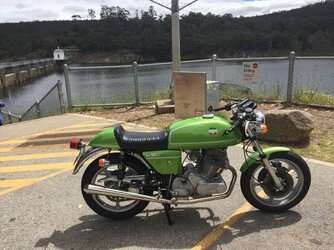
I must agree Boetje, it is very pretty, although blue wouldn't be my first choice. I thought all Laverda's were meant to be orange, or maybe red.

I hope to do all the mechanical work myself if I buy it both to save some money and for the enjoyment, I'm experienced with parallel twins but only Triumphs and Nortons. In this case I hope to bring it up to a fairly high standard so expect to fork out a fair bit. Usage wise it won't do a lot of hard work, I have other bikes with specific uses
 
I agree, engine may need no attention at all if the climate where you live is not too humid. He in inland Southern California when it does not rain much and no humidity, I have seen many motorcycles sitting for years with no corrosion inside the engine at all. My first Laverda 750 sat outside for 27 years. The inside of the engine looked perfect.

Had the bike lived in Florida it would have been a rusty mess.
You only find out about the problem when you hear a big graunch and find a hole in the crankcase.
I wouldn't trust a bottom end that has been sitting for years, if you intend using the bike.

Paul
 
Paul,

I understand your concerns but if I knew a particular motorcycle spent its entire life living in the area that I do, even if for 50 years, I would bet it has no issues with the engine bearings from sitting.

I have found on 750's if corrosion is anywhere it will be in the cylinder head as moisture seems to condense there. So if you remove a valve cover and take a look and see none, change the oil and ride the bike! Every Laverda I own was sitting a long time when I got them and they had no engine corrosion.

My 1968 750 spent 27 years sitting outside.

My 1969 750 spent 22 years sitting outside.

My 1976 3CL was not ridden for 10 years.

My 1982 1200TS was not ridden for 18 years.

My 1983 RGS was not ridden for 10 years.

My 1988 SFC1000 was not ridden for 13 years.

All have there original engine bearings and no problems.

I recently got a 1958 Ariel 500 running that had been sitting since 1964 and it had no problems in the engine.

As I type this at 11:00 AM the humidity is currently 12% and in a few hours it is supposed to be 8%. Things don't corrode here!

If I lived in Florida and a bike sat for 20 years, I would not want to touch it!
There are very corrosive sulphuric by products of combustion in old oil that will corrode your bearings with time. And water from condensation. One of the reasons we change oil.
Or so I'm lead to believe.

I wouldn't trust an unknown bottom end for any length of time.

Paul
 
Just like any 2nd hand vehicle, there is no guarantee. Use your eyes for general condition, look at receipts, test ride it, buy it from a long term trusted friend and after all that change the oil service it and cross your bloody fingers and toes, YOU NEVER KNOW EVER. Or you could spend mega thousands and at least a year completely going through everything, your choice.
 
That's a particularly specific Bonnie Maurice. Not a 72 with a conic hub front brake or a 76 with a disc rear. Halfway between. Never seen a white one either. As to that SF2, time moves on obviously and you cannot compare a 73 model bike with more modern bikes just as Machines only, you have to allow for when they appeared in their own time. Just me being a preachy dick, I like lots of different bikes, I rode a WLA around a car park once and loved that experience, but it wouldn't be my first choice on a sunny Sunday.
1975 Vince not a recognised year model but the same build as 1974 with the conical rear hub.
Sold new from Mussetts in Melbourne.
 
Must have been close to the last made before the factory officially closed and it became a Co-Op. I had a 76 Co-Op bike and loved it a lot, blue euro spec 5 speed with disc both ends, one of dozens stolen and never seen again, the scum loved the discs and 5-speed boxes, replaced by a 64 first-year unit constructed 650 bonnie basket case, fitted with a 72 conic utter crap front brake, spent a fortune on it and never reliable. Sold after multiple engine rebuilds and replaced by my 3c 34 years ago.
 
I think the strikes were going on in 1975 and from what I have read the Co Op was almost in place then, build quality was extremely variable and Mussetts nearly went broke dealing with a huge amount of warranty claims (particularly T160 triples)
 
The 750 Bonnie I rode for the WA importers in the 1978 Castrol 4-Hour in Perth was the 'new' model - discs front and rear and more modern looking exhausts - which looked a little scratched and secondhand after 3 hours of dragging them on every corner!
 
Scrumhead,
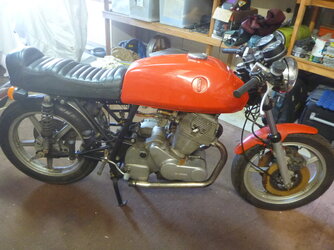
I carried out a Full restoration on my 1976 750SF3 recently, it was purchased in Boxes, not much change out of $10,000Aussie.
Red of Redax and Greg at DAMM Racing Excellent mentors for information and parts, highly recommend.

Skeeta
Bike looks a treat Skeeta, re shaped ducktail suits it. :cool:
 
Thanks !
Only thing is : I don't like riding it ...
At all !
So it just sits there being pretty....

That sounds a bit like a girlfriend I once had... Did not hang her to the wall though...

If you do not like the performance or suspension, there is A LOT that can be done about it... I can understand (and followed the same route) to keep it as close as possible to standard/original. However, unfortunately original is not allways what suits you... Upgraded front-end, different rear shocks and you have fixed the suspension mostly. Power is a bit more complex, but shorter gearing on secondary drive chain kit can fix this instandly with low cost. The sound and the look of it is just gorgeous
 
Hi Skeeta, you seem to have already experienced what I'm looking at. The result looks outstanding, similar to what I'd be looking for. How was the experience, any significant issues. Are you willing to share overall costs? Cheers Paul
 
I've followed this with interest. How much does restoration cost is the proverbial 'how long is a bit of string' question. It depends where you choose to start and where you choose to stop, what you start with and who you plan to do the work and your project time frame. Best approach is to look at the job, step it and budget each phase on real cost data. Plenty of online price schedules and most shops will advise indicative job costs. I. have a friend who spent $25k restoring an r90s that to my eye and ear was already pretty nice before he started. He wanted the stunner the factory never made. Many, like me, prefer the bike to wear its history in full view.
As to SFs being disappointing, I remember that in the day the road testers described them as being heavy, expensive and no faster or not much faster than comparable twins. Myself, I find that to be mostly true, however that depends where you ride and how often you get into the > than 5000rpm range. there's no slouch about an SF hammering along at its natural gait. In fact, there, midst noise and vibration there's a world of fun to enjoy. But each to his own. I know a guy with a 750 Zephyr and he wouldn't get that. The Zephyr is smooth, quiet and quick but ultimately no faster than the SF, just boring as. Like comparing an precision use-once instrument to a robust machine designed for work.
 
Gday Scrumhead, the one thing I regret not doing is having the crank balanced, just for self assurance, I would recommend this if your overhauling the engine. The rest is very straight forward just depends on how you want the final product to look, all up it was $10000 the most expensive being the paint job and seat manufacture other than that parts were readily available and prices can very but reasonable as long as you have the basic bike- engine, frame, forks, wheels ect, the forum is a great wealth of information...just ask

Skeeta
 
'Hey Skeeta, did this bike come from Tassie ? If it did it may well be my old one prior going to Tas.'

Gday Chris,
Yes indeed the Bike came from Tassie ,I bought it from Tino Livan, he sadly died and his wife was selling off his bikes.
I have been trying to trace some of its history, perhaps you could send me some info, thanks

SkeetaP1060009.JPG
 
Back
Top