Techy Stuff and Why

And the old truism that the shorter the wheelbase, the less lean angle required for a given turn.

OK, time for a bit of analysis. Feel free to skip this post if your eyes start to glaze over.

BTW, this all comes out of my head using basic high school level physics and maths. It's probably covered more thoroughly in some obscure motorcycle design textbook, but I don't have access to anyone else's musings on the subject.

There will of course be some lateral forces on the oil in the sump as a bike leans into a corner, but I don't think they'd be particularly significant to the design of the oil pickup. That's why I made the statement in Julian's race bike thread that a swinging oil pickup wasn't necessary. A narrow or V-shaped sump with the pump suction tube at the bottom should be more than adequate to ensure reliable oil scavenging. Actually, thinking about it a bit more, a swinging oil pickup could be a disadvantage if it get's stuck on the wrong side. I reckon it's a complication best avoided.

For a bike not to fall over, the G-force acting on the centre of gravity of the bike/rider combination must be aligned through the contact patches of the tyres on the road. This is true whether going in a straight line or leaning into a corner. Those three points (CG + two tyre contact patches define a plane though which all of the forces (including acceleration and braking) act. Let's call this the force plane. If you get a force outside that plane that's not countered by some other input (like putting a foot down), then things become unstable.

The source of the lateral forces is interesting. It comes from the fact that a bike doesn't pivot on its centreline as it leans. It rolls around the curved profile of the tyre, so the contact patch moves off-centre toward the inside of the turn. That means you have to lean a bit further to keep the CG "above" the contact patch. The wider the tyre, the greater the off-centre effect. A wide tyre has the advantage that it effectively increases cornering clearance as you lean, but it also means you have to lean further than a bike with narrow tyres at the same speed.

Another "off-centre" component is the rider. He can hang off the side of the bike to move the CG towards the inside of the turn, reducing the amount the bike has to lean.

As far as the lateral oil slosh is concerned, whether you're pulling 1.3G or 1.6G doesn't really matter. All you need to know is how far the force plane deviates from the centre plane of the bike. That depends on the tyre width and the height of the CG above the ground. That calculation involves a bit of trigonometry (I'm happy to provide the calculation details if anyone is interested).

The lower the CG, the greater the effect of the contact patch offset, so erring on the side of worst case I'll assume a pretty low CG of 600mm above the ground, and a 160mm wide tyre. At a 45° lean, I figured out that the force plane deviates from the bike centre plane by a bit over 8°. At 60° lean like the MotoGP guys can achieve, the deviation is around 13°. That's the angle that the oil surface will deviate from its normal orientation relative to the bike. It'll actually push the oil towards the inside of the turn.

The above calculation doesn't allow for rider gymnastics. In the real world, the rider will lean into the corner, with the effect of standing the bike up a little. That will move the oil back towards the outside of the corner, offsetting the oil shift calculation above. So it may go back to zero, or somewhere near. How much the two opposing actions counteract each other probably depends on the agility of the rider. But even if the rider stays bolt upright, 13° isn't likely to bother the oil pickup even in a full width sump.
Trust me D'man this is not glazing my eyes over, super interesting, your perspective and this whole thread.
 
Always wondered about various geometries and lean angles but never looked into it. When I fitted 17s to my SF (120 Fr 160 Rr) it did feel like the bike leaned more for a given corner speed, but as i hadn't adequately compensated for changed COG (ie the bike was lower) I figured this was the main reason for that feeling.

Very interesting stuff.
 
I am with Cam on this. Hanging way over on the inside of the bike to have it as upright as possible to keep it on the fat part of the tyre will have far more effect on how the oil lies in the sump than anything else discussed here but come nowhere remotely close to the sideways g forces "flat" vehicles have, nor braking forces. Modern classic racing tyres in 130 have incredible grip but not compared with modern slicks.
 
Thanks all for the input, getting lots of interesting thoughts here.

Cam, Yes I do agree the swinging pickup would be of little use and also agree about the un-needed added complexity. KISS

Been thinking of the oil staying down and have a question as my brain is a little addled at the moment, 1G gravity, + let us assume we can reach 1G lateral,
If the bike were to be vertical that would cause the oil to be at about 45 degrees in the sump?
As we lean the sump moves around the oil so in essence if we see a lean of 45 degrees the oil would be smack bang back to normal static position?
At 1.5G and about 67 degrees of lean the same deal?
Therefore in my case and for all intensive purposes the oil movement from side to side through cornering forces, although present is immaterial as long as you have a reasonable level in the sump?
Would you agree here?

Thanks,
Jules

IAG,
Yes, this was my thought but after some testing decided probably against it, the thing is that for my idea to work (and it is very simple, i did test it and it would work) it would obviously advance or retard both inlet and exhaust together in the same operation (single cam) and the result was minimal in my sim data. If I had two cams things would be very different but the mechanicals would be a lot more complex. Can't have it all :rolleyes:
 
1G gravity, + let us assume we can reach 1G lateral,
If the bike were to be vertical that would cause the oil to be at about 45 degrees in the sump?
Yes, but you'd need a sidecar to hold the bike vertical. Actually, this is something I've noticed with my Kawasaki Z1300 sidecar outfit. Not so much with oil starvation (never seen the oil pressure light come on in corners) but with fuel. If the tank is less than about half full, the engine will cut out in a hard left corner, or when flying the (left mounted) sidecar. It's fuel injected - no float bowls so the engine dies immediately as the pump sucks air.

As we lean the sump moves around the oil so in essence if we see a lean of 45 degrees the oil would be smack bang back to normal static position?
At 1.5G and about 67 degrees of lean the same deal?
Yes, that's one way to form a mental image of what's going on. You can look at it either from the world frame of reference as you have done (world fixed, bike leans) or from the bike/rider frame of reference (bike fixed, world and gravity tilts). Both are valid. It just depends which way your brain prefers to visualise it.

Although I'll be mightily impressed if you can achieve 67° of lean and stay on the bike :)

Therefore in my case and for all intensive purposes the oil movement from side to side through cornering forces, although present is immaterial as long as you have a reasonable level in the sump?
Would you agree here?
Yes. As long as you maintain the habit of leaning into turns, all will be good.

Oil scavenging in cars and sidecar outfits could be an issue though. Simplest way to deal with it is to have a deep/narrow sump, or a well in the sump where the oil pickup is. Most car engines I've looked at have a bit of the sump that hangs down lower than the rest. That would be where the pickup is. Never heard of anyone fitting a moveable oil pickup, but I suppose some might exist.

All of this prompted me to wonder about Formula 1 where they generate huge G-forces during cornering. I just googled it - they can achieve more than 4 G 😲. They use a dry sump lubrication system to get around the oil pickup issue. It doesn't matter if the oil pickup for the return pump is starved for a few seconds during cornering with a dry sump system. There may be a build up of oil in the sump while the car is cornering, but It'll get sucked out when the car is on straight sections of track. I guess they'd have to use a high capacity oil return pump so it can deal with intermittent starvation.

 
That last F1 point is a very good one Cam, In fact I have a mate who has a modern Aerobatic plane that pulls massive G both negative and positive, Although it pulls almost nothing in a sideways direction, I wonder where it gets it's oil when inverted, or heavy negative G (horrible feeling by the way)
I will ask.

Drag cars and NASCAR race cars etc use very tall thin and large dry sump tanks that keep the oil retained in the right place quite well. I have seen these with a flexible dip tube but as you mention it would be not so clever on a bike I think.

Regards,
J
 
I was watching a Fighter Pilots Utube channel the other day and he was saying positive Gs were dealable, negative Gs= very bad. And best avoided at all times.
 
Agree with you Vince,
I have been lucky enough to go up many times in all sorts of war-birds and a few stunt planes among others,
The Stunt planes are mega reactive and can pull up to 9G positive and 5 Negative (apparently), But due to their speed of climb and roll, the forces are manageable and brief. But still not pleasant in my opinion. The Warbirds are very fast for a piston powered aircraft and fucking uncomfortable in aerobatics due to them being rather large for this type of manoeuvre, I find even a long 2 G bank for 30 to 40 seconds is very uncomfortable compared to a short 3 second 8 G pull up in a stunt plane for instance.
But Negative even a short 1 G for me anyway is really really unpleasant. To be honest aerobatics in a biplane are the only aerobatics I actually like, the rest are for those who are either super fit or those that want to act tough, (most end up talking to Hughie, as in Huuuughieeeeee )
And believe me, those pilots who can do this continuously in a real powerful war-bird are super fit athletes, unless you have tried it you can not believe how hard it is to even stay conscious let alone fly a bloody big fast complicated machine in an accurate display.
Not for me! although flying over land in something like a P51 is such a cool feeling, very special.

Jules
Pic of a friend in one of the planes he has taken me up in. (the F16 was almost stalling)
 

Attachments

  • Mustang 097.JPG
    Mustang 097.JPG
    52.6 KB · Views: 15
  • Mustang 112.JPG
    Mustang 112.JPG
    48.4 KB · Views: 16
plant very often has flexible oil pickups in the sump, eg diggers, they are very often required at very steep angles, the oil pickup is flexible and has a very heavy weight as its foot valve and strainer.
CLEM
 
Did you know that shenwasn’t the secretary everyone says she was, she was an engineer actually,!
Clever lady and clever invention

The reverse of that caught me out quite badly 30 of years ago with a turbo engine.

J
 
That last F1 point is a very good one Cam, In fact I have a mate who has a modern Aerobatic plane that pulls massive G both negative and positive, Although it pulls almost nothing in a sideways direction, I wonder where it gets it's oil when inverted, or heavy negative G (horrible feeling by the way)
I will ask.
Aerobatic aircraft normally have two oil pickups. One in the sump for normal flight and another in the top of the crankcase for inverted (or negative G) flight. Switching from one to the other is effected by a gravity operated ball valve. Basically just a big heavy ball bearing inside the valve body that blocks flow from one direction or the other, depending which way up the valve is.
 
Last edited:
My bike must have Aerobatic potential, the old tank breather had a similar metal ball for when I was inverted.
 
Aerobatic aircraft normally have two oil pickups. One in the sump for normal flight and another in the top of the crankcase for inverted (or negative G) flight. Switching from one to the other is effected by a gravity operated ball valve. Basically just a big heavy ball bearing inside the valve body that blocks flow from one direction or the other, depending which way up the valve is.
The ball is the same idea as I had for my front to back "slosh valve" blocking or uncovering an opening at the rear of the subsump. Not sure yet if I will use it though.
J
 
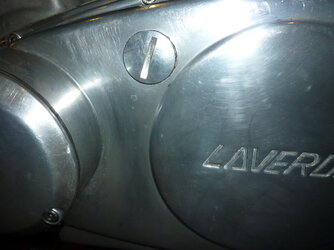
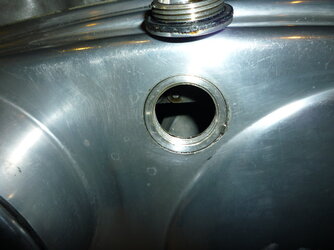
Very interesting views on oil and centrifugal force. But here is my view on another matter, primary tension. my RGS workshop manual says: "Hold 3000 rpm - adjust until whining sound, then back off until sound just gone." I hated doing this and was never really sure the tension became right. So drilled the cover for the pictured threaded insert - inspection plug. Plug is same as on my BSA and is easely found on Ebay and Britbike dealers
 

Attachments

  • P1010046.JPG
    P1010046.JPG
    99.9 KB · Views: 13
  • P1010047.JPG
    P1010047.JPG
    112.3 KB · Views: 13
I'm not certain that primary chain tension is all that important.
Tension it engine stopped anyhow. Back screw off a turn.

Paul
 
I’m no Engee, or physics lecturer, nor do I have experience in flying in stunt planes or have access to F1 teams knowledge.

It’s very hard to see what oil is doing in a sump while cornering. But, every motorbike rider that is mounted on a bike with, a somewhat clear brake fluid resiviour, particularly if low on fluid, will agree that the fluid does indeed slosh from level to left or right while cornering, no matter the G force (created by an old clunker) or angle.

It is my understanding this is why some, most of them use a rubber bellows inside them.

I can’t see why the oil in a sump, 700mm lower than the brake resivior would be any different.
 
Back
Top