
You are using an out of date browser. It may not display this or other websites correctly.
You should upgrade or use an alternative browser.
You should upgrade or use an alternative browser.
The fall and rise of a works SFC engine
- Thread starter sfcpiet
- Start date


Gravelroad said:Thought there isn't any oil pressure at all, as the conrod bearing got its oil supply by the crank slingers as usual? I'd guess the blue traces come from induction hardening of the crank pin bore.
Nice mess you got there, Piet, holy s..tConrod failure as primary damage source would require fatigue damage to initiate. Some traces of initial fatigue crack might still be visible at the fractured surfaces, depending on how badly smashed they are. If you could keep the bits of the conrod, I'd like to take a look at them at my next visit in the west, which I have already on my books anyway.
Regards,
Stefan
No worries Stefan,
The little bits of conrod that remain will be kept as "offerings to the God of Speed".
 The big bit between small and big end is gone, but the fracture surfaces do not indicate any signs of fatigue. Looks more like a forced fracture.
Marnix warned me to swap out the fragile original rods, but, because the crank ran about as true as it absolutely could, and knowing what a bugger SFC cranks can be, I opted to leave it alone. I reckoned if Roberto, Virginio or Marco were able to thrash the bugger 110% back in the day, it'd shrug off the 80% I'd ask of it easily. Reckoned wrong... Yes, the bluing on the crank is a result of the hardening process, evident on quite a few other components as well.
Having previously built 3 championship winning bikes/engines, I am well aware of the life expectancy of racing engines. And no, there are no signs whatsoever of oil starvation anywhere within the engine.
There were no signs of damage or fatigue upon inspection of the crank before assembly, in fact, I simply put it back in as I took it out. Even the main bearings looked and felt perfect. I found serious issues within the gearbox and head, which I attended to.
The bike was a strong runner, its potential was hampered somewhat at Eastern Creek because it was seriously under-geared (due to the fact it was finished only days before packing and shipping, mid winter. A short dyno run was all that I managed to be sure carburation and ignition was in the ballpark). After sorting the gearing and ergonomics, it was run at the SRC event at Paul Ricard, where I raised my self-imposed rev limit to 7000, as opposed to the 6000rpm before. Unfortunately, it went bang near the end of the slow-down lap Saturday evening, which gave me the opportunity to check out some nice cafes on the nearby coast on the Sunday.
Clem, it seems originally only 3 complete bikes were built, probably a few more engines to keep the racing campiagn going throughout the 73 season. Marnix can supply far more insight on this. Unfortunately, the original head is missing from this particular engine. Instead, a Electronica head and pistons are fitted. I have reason to believe that this may be a prototype head, as I found a couple of inconsistancies compared to production items.
piet

v2ventiler
Senior member
Hi,
just as I am curious, what pistons? Aftermarket?
Michael
just as I am curious, what pistons? Aftermarket?
Michael

That's the second crank of it's type to break a rod.
The other one was on the road here in France, but after 2 Bol d'Or.
The engine still exists. It's the one pictured in Marnixs' and Tim Isles' book.
I don't know if it's possible to know the number of engines built. Or the parts for them.
Paul
The other one was on the road here in France, but after 2 Bol d'Or.
The engine still exists. It's the one pictured in Marnixs' and Tim Isles' book.
I don't know if it's possible to know the number of engines built. Or the parts for them.
Paul

hochkoenig
Senior member
- Location
- Salzburg-Austria
nick7 said:Youve blown an RC45?Wouldnt have thought that possible for mere mortals
so commiserations or congratulations depending how you look at it! Horrendously pricey to fix presumably?
they dealer sold me a o-ring from a vfr witch is 0,2mm less, that means not enougt oilpresure, look like the "works-engine"....
I lost a number of money of the value of a small flat home.....
hochkoenig
Senior member
- Location
- Salzburg-Austria
Gravelroad said:Thought there isn't any oil pressure at all, as the conrod bearing got its oil supply by the crank slingers as usual? I'd guess the blue traces come from induction hardening of the crank pin bore.
of course, but if in the oilplates are as usual that sticky oilgrease, no oilpressure...
anyway, that conrods look much to tiny to me.... not even polished from lazy italian work-workers....
Paul Marx said:That's the second crank of it's type to break a rod.
The other one was on the road here in France, but after 2 Bol d'Or.
The engine still exists. It's the one pictured in Marnixs' and Tim Isles' book.
I don't know if it's possible to know the number of engines built. Or the parts for them.
Paul
Paul,
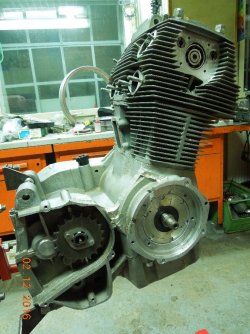
This particular engine is pictured in the SFC Registry book on page 60, the one without the starter motor flange.
Standard SFC-type cast Asso pistons were fitted, the same as all '75-'76 750SFC had when they came from the factory.
Attachments
hochkoenig said:of course, but if in the oilplates are as usual that sticky oilgrease, no oilpressure...
anyway, that conrods look much to tiny to me.... not even polished from lazy italian work-workers....
On the 73 crank I know, the rod was 1mm thick.
2 Bol d'Or with the same engine can't be bad.
Paul

Thomas aus LAU
Hero member
sfcpiet said:Paul,
....the one without the starter motor flange.
To me, the missing starter flange at this picture looks more like it has broken off. Grinding away or milling leaves other traces.
The first 30 years I have repaired Laverda engines, I had never problems with an starter flange.
But suddenly, in the past 10 years I had a total of four cases, where massive cracks have occurred on the starter flange.
One went almost to the cylinder base.
Also there was my SFC motor 18391, in which the almost invisible crack was already five centimeters long.
It always runs forward from the clutch support along the edge of the engine housing, same way as at your foto.
In my opinion, the cause is that bending forces occur, when pulling the clutch and the wall thickness is too thin due to milling too much.
It only occurs with stressed (racing) bikes, with very high mileage or if the longer "Girls"-lever is installed to get an more comfortable clutch for a longer time.
Even our Laverdas are getting older

But you can have it welded professionally for around 60 EUR.
Best Thomas aus LAU
Thomas,
Nobody ever claimed the flange was broken or damaged.
The starter motor flange has been intentionally removed. This engine was used for short-circuit racing, therefore there was no requiry for either charging or starting equipment. All this added up to a total vehicle weight of only 150kg, dripping wet.
The engine was fitted with a simple Dansi flywheel magneto which showed evidence that at sometime it had run with a 180? crank configuration.
piet
Nobody ever claimed the flange was broken or damaged.
The starter motor flange has been intentionally removed. This engine was used for short-circuit racing, therefore there was no requiry for either charging or starting equipment. All this added up to a total vehicle weight of only 150kg, dripping wet.
The engine was fitted with a simple Dansi flywheel magneto which showed evidence that at sometime it had run with a 180? crank configuration.
piet
v2ventiler
Senior member
Have you ever weighed the motor as in your picture above?
Michael
Michael
Thomas aus LAU
Hero member
sfcpiet said:Thomas, Nobody ever claimed the flange was broken or damaged.
piet
May be. In my opinion, the material of the crankcase would look different after sawing, grinding or milling.
Best Thomas
Thomas aus LAU said:May be. In my opinion, the material of the crankcase would look different after sawing, grinding or milling.
Best Thomas
Rest assured, the flange was most probably simply hacked off, the edges have been smoothed manually with a pneumatically driven burr or similar.
piet

Dellortoman
Hero member
- Location
- Tasmania, Australia
sfcpiet said:there was no requiry for either charging or starting equipment.
I reckon you've been living in Europe too long Piet. You're losing the ability communicate in English. I'm pretty sure 'requiry' isn't a real word.

chrisk
Hero member
- Location
- Brisbane, Australia
Dellortoman said:I'm pretty sure 'requiry' isn't a real word.
(study) FAIL......
TOP DEFINITION
Requiry
1)Something that is obligatory
2)A cooler way to say 'requirement'
And Piet even used it in context...... 2) A cooler way to say 'requirement'

helicopterjim
Hero member
- Location
- near Lone Butte, BC, Canada
chrisk said:(study) FAIL......
TOP DEFINITION
Requiry
1)Something that is obligatory
2)A cooler way to say 'requirement'
And Piet even used it in context...... 2) A cooler way to say 'requirement'
You forgot the third deinition.
3) A word that you can use in conversation and have people not sure if it's real or not