Weird

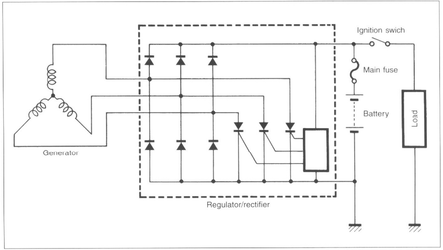
Rob, first the easy bit, the 7 wires you see coming from the RR on the schematic you shared are because the grounding of the RR direct to frame is displayed as a brown line ) in fact in that schematic a brown line is used to display ground in several places it is not a hard wire. There are only 6 wires from the RR.

You may have already tried this and I feel your frustration from all your posts but try this : the green wire from the RR, wire it directly to the ground on the battery not to a bolt or plate on the frame, directly to the (-) on the battery. What is the condition of the battery ground cable and where is it grounded to, clean and solid?
Red/white wire same thing directly to the battery no inline connectors, splices, etc, directly hard-wired.
The sensing wire same thing and connects it directly to the battery it does not need a fuse, eliminate as many connections as possible and thoroughly inspect your battery cables and grounding source.

The schematic diagram you provided shows 2 wires one of which must be the sensor wire going to the instrument cluster, that's not right.

HTH
 
All this input regarding wires going to here or there is irrelevant. The old RR with 6 wires has worked perfectly since 2010 when I upgraded the ignition/alternator. The new RR has only 5 wires, no sensing wire and it worked perfectly after installation for the 800km round trip to Dumbleyung.
The diagram I posted doesn't reflect what's on the bike regarding that sensing wire, instead of going through ignition switch it's connected to the battery via a hot wire between the main fuse block and main relay As for all the connections, they're all in an enclosed box that never sees the weather, every connection is as clean as the day I wired it. I can guarantee there is no problems with the wiring. The alternator checks out with the test I've done with my meter.
I've done what John suggested and ran wires direct to battery. At the end of the day the old RR shows it's charging even if it's low, 13.7,
The new RR doesn't show any output. So next move is to get another RR. The only thing I haven't tested is the RR themselves with a meter but I don't know how to do that. All I'm doing now is going around in circles.
 
So the wiring diagram is different to what you have on the bike and the RR you have installed has 5 wires and not the 7 as per the diagram.

Could it be that the RR is earthed via the mounting bolts and the wire you have running to earth/-ve is actually the sensor wire?
 
Last edited:
The wiring diagram I posted is how I wired my bike. My bike is layed out totally different to how a tripled is wired. As mentiond in previous post there arer 7 wires ignor the 7th as it a charge warning light that doesn't exist on the RR we use. the sensing wire goes to ignition switch, in my case it's connected to battery via main fuse going to main relay. The new RR only has 5 wires eliminating the sensing wire so now that connection now sit empty. The way it's wired is not the problem as it's been working perfectly since 2010 and the new RR worked perfectly to Dumbleyung and back.
 
I’d agree that your RR is poked, that seems obvious from your descriptions. I suppose the next question is why. Perhaps the old one wore out, they don’t last forever, and the new one is just a dud, it’s not uncommon for electronic parts to fail early.
I’m not certain, maybe John could confirm? but I think RRs can be damaged by running them without a load, e.g. a battery, and the effect is worse if the connection is intermittent and turning on and off. So perhaps you still have a gimpy connection somewhere.
My money is on the first reason, but of course it’s your money really 😁
 
From memory, on the Dumby ride you still had the dying SSB battery installed. Did you check what voltage it had when you got home?

Also I am interested in howe the RR figures out what is going on if there is no sensor wire? - a hypothetical question but I will do some research out of interest..

Just found this Youtube vid on testing 3ph RRs. A bit verbose but easy to follow. May be of help. They also have vids on testing the stator.

 
Last edited:
From memory, on the Dumby ride you still had the dying SSB battery installed. Did you check what voltage it had when you got home?

Also I am interested in howe the RR figures out what is going on if there is no sensor wire? - a hypothetical question but I will do some research out of interest..

Just found this Youtube vid on testing 3ph RRs. A bit verbose but easy to follow. May be of help. They also have vids on testing the stator.

Good Man Davo, vid is useful for basic testing of the six diodes in the usual RR we see, one item not drawn on the simple ( effective ) schematic is high power shunt SCR, dependant on design there may 3 of these or 1 with an isolating diode. The SCR is like a diode only with a trigger input extra connection ( three terminal device ). This SCR shorts out the high ripple AC or DC Voltage ( and shorts out ALL the current for part of a cycle ). There is a small control circuit with the external sense wire, when the sense wire sees a potential above ideal battery charge voltage, it fires the SCR(s) to "Shunt" the unwanted Voltage and Current to the return path. This "shunting" means the RR does most work when unloaded and less demand as the load increase. Hard to damage a shunt RR, erratic connections while not ideal are less likely to cause permanent damage. Made this as simple as possible given the operation of overall alt-rr can be complex, not required for most diagnoses. j
 

Attachments

  • Shunt_Reg .png
    Shunt_Reg .png
    86.2 KB · Views: 1
I’d agree that your RR is poked, that seems obvious from your descriptions. I suppose the next question is why. Perhaps the old one wore out, they don’t last forever, and the new one is just a dud, it’s not uncommon for electronic parts to fail early.
I’m not certain, maybe John could confirm? but I think RRs can be damaged by running them without a load, e.g. a battery, and the effect is worse if the connection is intermittent and turning on and off. So perhaps you still have a gimpy connection somewhere.
My money is on the first reason, but of course it’s your money really 😁
Hello Andy, once again the technical details will almost drown the clear simple operations of electronic devices. Bare bones, older silicon type fabrication was made for best quality. There is a life limit on power electrical chip fabrications, am not convinced consumer grade fabrication is made with a 10-20year life in application, these days. Manufactuers of parts, Selling silicon is just that, not sell today and wait 20 years for a repeat order. One of the limits on producing modern electronics like ignition systems. Personal view based on watching the semiconductor industry since 1969, my era. There is the "Bathtub" curve, initial use of a chip may fail early, then the life is good for the bottom of the bathtub curve then rises at the end of life, as a field failure. MTBF is a term we use, look it up if interested. HTH j.
 
Hello Andy, once again the technical details will almost drown the clear simple operations of electronic devices. Bare bones, older silicon type fabrication was made for best quality. There is a life limit on power electrical chip fabrications, am not convinced consumer grade fabrication is made with a 10-20year life in application, these days. Manufactuers of parts, Selling silicon is just that, not sell today and wait 20 years for a repeat order. One of the limits on producing modern electronics like ignition systems. Personal view based on watching the semiconductor industry since 1969, my era. There is the "Bathtub" curve, initial use of a chip may fail early, then the life is good for the bottom of the bathtub curve then rises at the end of life, as a field failure. MTBF is a term we use, look it up if interested. HTH j.
Thanks John, I havent heard it called a bathtub curve but I have certainly seen that effect.
But what I was hoping for was a confirmation that running the alternator without a load could damage the RR? Many years ago on another bike I fried a stator by running a worn out battery, excess power fed back to the stator and overheated it.
In this case I was concerned that similar may be happening, perhaps exaggerated by surges or spikes when the load is added and removed while running?
Or is there protection built into the RR circuitry?
(Or am I completely off track…? 😁)
 
Thanks John, I havent heard it called a bathtub curve but I have certainly seen that effect.
But what I was hoping for was a confirmation that running the alternator without a load could damage the RR? Many years ago on another bike I fried a stator by running a worn out battery, excess power fed back to the stator and overheated it.
In this case I was concerned that similar may be happening, perhaps exaggerated by surges or spikes when the load is added and removed while runninOr is there protection built into the RR circuitry?
(Or am I completely off track…? 😁)
Hello Andy, a details man, you will have many demands on your time....well maybe. Ok unloaded RR, very low probability of damage to RR, though the stator can be in peril not so much a power demand issue as voltage excursions beyond the insulation integrity. That is the possible insulation breakdown and the outward symptom of an "overheated" coil assembly, which is caused by induced current in a shorted adjacent turns. This leads to stressed inter winding insulation from elevated localized temperature and further insulation failure, seems the coil was damaged by too much power dissipation, yet the stator actually cooked itself from within, not external load or shorted load. Point out a PM stator spends much of its time being "shorted" phase to phase ( Y form connection ), and as such is designed to be "shorted" for much of its in service life. The magnet gap to stator collapses when this regulating short happens and this gap is what limits the maximum output current to about 20amps in Laverda ND alternators. Again simplified ( whats that look for...grin ) magnet to stator interaction, do as a broad operational condition, let me know if my ramble missed a point not covered. HTH j

*** an open circuit battery ( broken internal mechanical connection ) will unload the RR and possibly cause over voltage excursions in the stator, time critical of how fast the scr fires. An OC battery will have 12V+ or so terminal and collapse to zero when say a headlight is switched on, common problem in flooded cell low cost batteries, the vibs fatigue damage to internal cell to cell connections, ie the electrolyte conducts enough to make a DMM register though will not support a load, and presents as a fume or explosion danger if say a starter motor is engaged, ponging battery is the clue. j
 
Last edited:
Nothing more to say apart from last night I brought another RR, SH530, so in a couple of weeks I should know if the RR is toast.
Hoping it arrives and solves the problem as I want to meet Marty and co up the road aways and ride back to Walpole with them.
Riding the BM would be a cop out unless they want to do a hundred kays of dirt which they probably don't.
I'll post the results.
Thanks John
 
Thanks John, I havent heard it called a bathtub curve but I have certainly seen that effect.

Look, I apologise for the humour in advance. But this RR Mumbo Jumbo is above my intellect.

The bathtub effect has shot a memory of a guy that had to be carted off to hospital, in his bathtub.

The thrill of the vortex caused by a pulled plug tickling his nuts while in the bath was quickly diminished by the pain of his nuts being pulled through the plug hole grill.

Bathtub hole effect….. ouch!
 
Look, I apologise for the humour in advance. But this RR Mumbo Jumbo is above my intellect.

The bathtub effect has shot a memory of a guy that had to be carted off to hospital, in his bathtub.

The thrill of the vortex caused by a pulled plug tickling his nuts while in the bath was quickly diminished by the pain of his nuts being pulled through the plug hole grill.

Bathtub hole effect….. ouch!
Thanks for bringing it back to my level CK :unsure:
So far all I got was that John bought a Chinese battery charger:unsure:
Im still confused.....
 
Last edited:
Thanks for bringing it back to my level CK :unsure:
So for all I got was that John bought a Chinese battery charger:unsure:
Im still confused.....
Have all the duetch pins and plugs as well as the duetch crimping pliers.
Give me a call Rob you already have the phone number .
Chris Italbrit Classic Motorcycles.
 
Thanks for bringing it back to my level CK :unsure:
So far all I got was that John bought a Chinese battery charger:unsure:
Im still confused.....
Get your drift, guys. I picked up 'earth' or 'neutral' and 'positive' terminals ... a few techo bits in the middle where i got a little lost :ROFLMAO:

I must learn to use the many functions of my funky Fluke multimeter ...
 
Thanks for bringing it back to my level CK :unsure:
So far all I got was that John bought a Chinese battery charger:unsure:
Im still confused.....
Know its tedious, then tedious people have to be endured, or no....grin.
Bought a chinese battery tester, an anti-battery charger, by any other name would be called, or smell as sweet... can become hot... j
 
Bathtub curve is closer to home than you realize, how the purchase price and resale price of Laverda propagates, new price high side of the bath ( and you took a bath in the day, 3 times the price of jappy bikes ) then as they aged at the bottom of the bath, prices down the drain, then discovered as a "classic" we get to the other side of the bathtub, maybe even find a towel to dry ourselves off... j.
 
  • Haha
Reactions: Jo
Back
Top