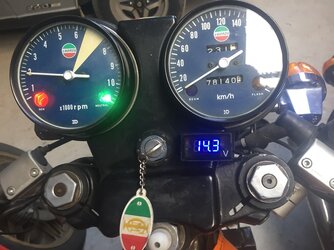
when you are your own dreaded previous owner

Something in you post Paul, FWIW, lean mixture burn, is at a lower temperature than the correct Stoichiometric burn, ditto over rich, its lower burn temnperature. A lean mixture does not provide adequate piston crown cooling hence the old mechanics incorrect assumption it burns "hotter".

Confirmed when i used 3 K type thermo couples on the first bend of the exhaust headers, many a moon ago. Around the 450-480C from memory, peak combustion chamber temperatures are over 600C.

Correct me if i have the blue tinge to headers aspect misunderstood. Non bluing chrome headers can be produced, its much about how the steel is electroplated. Another topic...j
 
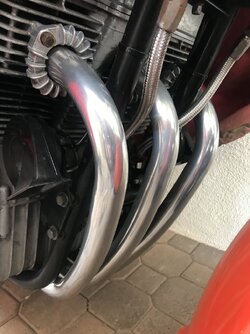
Well, I am yet again demonstrating my lack of understanding. Whatever the reason, while I was getting all three cylinder running and dialing in all three carbs, the single right header pipe blued while the other two header pipes have not blued. That is despite my clever idea to spray an entire can of ceramic heat paint over the course of a week inside the three new header pipes before installation.

So, why would one header pipe blue and not the other two? Brand new complete exhaust system from Malcolm Cox, beautifully made.
Possible inconsistencies in the metal and or electroplating process, this topic could blow out, as the data i have on hand are electroplating text books from 1930's onwards. Very comprehensive ie not in electronic form, good old books as it were. Not sure that helps Paul. j ** post up the CAE data on burn temperatures for cylinder loads, as i can rummage through the archives here.
 
The local chopper blokes would rap copper wire around the pipe close to the head to avoid blueing. I would have expected the finned header clamp to do similar work. I do remember someone saying those finned clamps work best not actually touching the head but being a few millimetres off as that draws more heat away.
 
Well, I am yet again demonstrating my lack of understanding. Whatever the reason, while I was getting all three cylinder running and dialing in all three carbs, the single right header pipe blued while the other two header pipes have not blued. That is despite my clever idea to spray an entire can of ceramic heat paint over the course of a week inside the three new header pipes before installation.

So, why would one header pipe blue and not the other two? Brand new complete exhaust system from Malcolm Cox, beautifully made.
I don't really have the answer for you Paul but thought you might appreciate this photo. These are ceramic-coated header pipes with well over 15,000 miles on them and not even a hint of color change.
 

Attachments

  • IMG_1689.JPG
    IMG_1689.JPG
    130.7 KB · Views: 13
Yes to the ceramic coating. On my RGS the headers are ceramic coated as are the piston tops, combustion chambers and valve faces and the exhaust tract in the head. I do have black ceramic coated header pipes for this 1200 but the new chrome header pipes are gorgeous…..

On my ZX 14 the exhaust is titanium ceramic coated. Ugly gray green color but even higher heat resistance

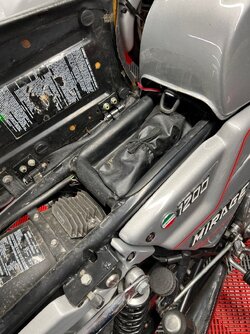
On the electrical front it appears the regulator/rectifier on the 79 1200 is bad. I tested at the battery for voltage at 2,000 rpm, it reads half a volt higher than the voltmeter….:oops: Ordering a new r/r tonight. Surely this has to be the last of the electrical gremlins?
 
The voltage delta from your new guage to the voltmeter connected right to your battery depends where you connected the voltage regulator into your wiring. Voltage drop is normal as you get away from the battery, especially on bikes with older wiring. Or could just be the difference in the guages. If you temporarily hook up the new digital one to your battery you would know for sure.
 
Yes to the ceramic coating. On my RGS the headers are ceramic coated as are the piston tops, combustion chambers and valve faces and the exhaust tract in the head. I do have black ceramic coated header pipes for this 1200 but the new chrome header pipes are gorgeous…..

On my ZX 14 the exhaust is titanium ceramic coated. Ugly gray green color but even higher heat resistance

On the electrical front it appears the regulator/rectifier on the 79 1200 is bad. I tested at the battery for voltage at 2,000 rpm, it reads half a volt higher than the voltmeter….:oops: Ordering a new r/r tonight. Surely this has to be the last of the electrical gremlins?
Ostensibly the only way to have high volts from the RR is when the sense wire on the RR sees voltage drops and jacks up the output by an inverse value, the bigger the voltage drop in the harness ( where the sense wire is connected to ) the bigger the increase in the RR output volts.

Strongly recommend Paul you identify the sense wire on your RR ( most have one like the SH530 ) and connect it to the battery positive terminal direct. Start the engine and read the battery volts at the battery with known good multimeter, you may have a faulty RR though like as not it may well be ok. The above rewire will help to make all clear. HTH j.
 
Well, I am yet again demonstrating my lack of understanding. Whatever the reason, while I was getting all three cylinder running and dialing in all three carbs, the single right header pipe blued while the other two header pipes have not blued. That is despite my clever idea to spray an entire can of ceramic heat paint over the course of a week inside the three new header pipes before installation.

So, why would one header pipe blue and not the other two? Brand new complete exhaust system from Malcolm Cox, beautifully made.
They will all blue equally eventually so just go out and ride it.
I've done a few restorations recently, not a single one has had the pipes blue equally from the start.
Unless something is obviously amiss with the carburation, just go out and ride.

Paul
 
been reading up on rectifier/regulators. Actually seem pretty primitive, even the MOSFET versions just improve the way voltage switching occurs and lessens heat, but still old principles.

One thing of interest I came across is r/r specifically for use with lithium-ion batteries, lessen upper end voltage to better protect the lithium battery. I didn't know that...... I don't have any real interest in fitting a lithium-ion battery anyway. The other thing of interest is how many fake copies of brand name r/r's there are out there, especially Shindegen. Seems to be a blight of fakes.

I ordered a guaranteed authentic Shindegen FA 20 r/r from the same supplier I got my last one from, jasonelectrix on ebay. The problem is it will take a couple of weeks to arrive through customs, so in the short term I am robbing the r/r off the RGS, using the same quick connects so I can swap it back and forth between the two bikes until the Shindegen arrives. The Shindegen FA 20 I already have is properly wired into the 82 1200 and I am going to leave it alone.

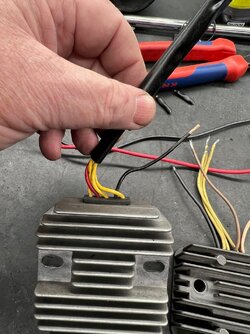
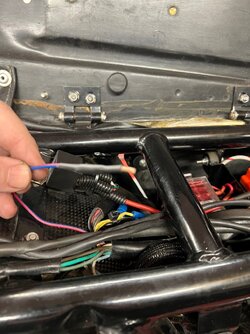
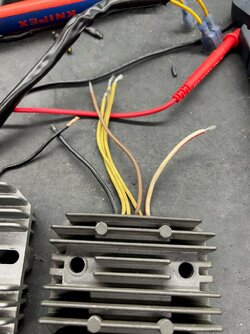
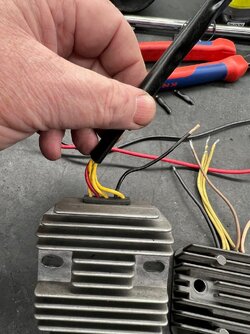
the r/r from the RGS is a 5 wire, then one from the 1200 is a 6 wire. I had to enlarge the 1200 wiring diagram to figure out what the 6th wire is, it is the feed to the charging trouble warning light in the instruments, can do without that, especially as I am going to use the voltmeter anyway.
 

Attachments

  • rr1.jpg
    rr1.jpg
    212.5 KB · Views: 14
  • rr2.jpg
    rr2.jpg
    167 KB · Views: 14
  • rr3.jpg
    rr3.jpg
    153 KB · Views: 14
  • rr4.jpg
    rr4.jpg
    216.6 KB · Views: 14
Last edited:
Common types of RR, mostly 6 wire, 3 ( Yellow colour ) are stator input, mix any three is ok, one wire ( colour can vary ) battery negative, one wire Battery Positive, the third remaining wire is the voltage regulator sense wire, can be green on some regs. This sense wire has to see the actual battery positive voltage when operating. Draws about 1-2mA ( 0,001-2 amps ) and is switched to reduce the drain on the battery. The latter is where the trouble begins, losses in the switched 12V cause high RR charging volts. At 1-2mA low draw i would leave it connected to the battery positive connection, either RR +14.2V or direct on the battery. When the bike is laid up, just disconnect the battery negative connection, good practice in any case. HTH j.

** there is a considerable difference between older shunt RR and newer FET series pass regulator functionality and efficiency/heat control. There are three types of charging criteria for the different composition of Lithium battery technologies, and a whole bunch of mis-information all over the WWW. True AC to DC RR cannot actually indicate a proper "Charge light" function, merely just a voltage indication and not actual nett current flow to the battery, which is what a charging light was originaly doing, indicating direction of charge current.
 
Hi John

I actually understood most of your post, electrickery gets less scary by the decade.........

The r/r from the RGS is now on the 79 1200, 14.2 max volts indicated.

As the r/r's all do the same thing, why are there so many models? Is it just shape and case size or am I missing something?

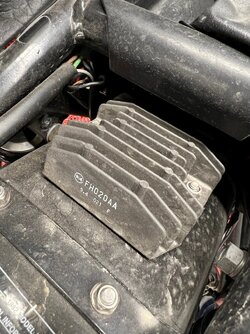
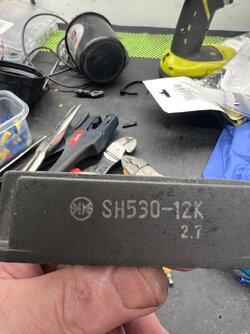
the failed r/r from the 79 1200 is a Shindegen SH530-12K 6 wire. Smaller in physical size than the r/r I just robbed off the RGS.
 

Attachments

  • rr5.jpg
    rr5.jpg
    154.2 KB · Views: 8
  • rr6.jpg
    rr6.jpg
    167 KB · Views: 9
  • rr7.jpg
    rr7.jpg
    128.8 KB · Views: 8
... then one from the 1200 is a 6 wire. I had to enlarge the 1200 wiring diagram to figure out what the 6th wire is, it is the feed to the charging trouble warning light in the instruments,
Really? Does your 1200 have a working "GEN" light in the dash?
I'd have expected the 6th (brown) wire to be a voltage sense wire as John suggested. I'm not aware of any 3-phase RR with a generator light output.
 
Really? Does your 1200 have a working "GEN" light in the dash?
I'd have expected the 6th (brown) wire to be a voltage sense wire as John suggested. I'm not aware of any 3-phase RR with a generator light output.
My recently acquired 78 1200 has a prior owner installed and operating generator light, it is actually very useful. If I am trolling around in traffic anything less than 2400RPM with the headlight on the prior owner-installed Gen light comes on, the same thing at idle if the headlight is on the Gen light is on flip the headlight off the Gen light goes off. I have not traced the wiring circuit yet but I believe it is connected thru the Ignitech module.
 
Hi John

I actually understood most of your post, electrickery gets less scary by the decade.........

The r/r from the RGS is now on the 79 1200, 14.2 max volts indicated.

As the r/r's all do the same thing, why are there so many models? Is it just shape and case size or am I missing something?

the failed r/r from the 79 1200 is a Shindegen SH530-12K 6 wire. Smaller in physical size than the r/r I just robbed off the RGS.
Would have put money on the original SH530 being not the fault, would have done my money cold. Well done you Paul to stay on track and replace to confirm the root cause of overvolts.

May well be, the SH530 are reaching the "feet end of Bath Tub curve" ie age related mean time between failure decreases ( oops had the wrong way first post ) significantly. Comment later on the plethora of RR types and features. j.
 
Last edited:
My 1200 TS had a charging light till I upgraded to a ZZR250 3 phase alt which then requires a 3 phase RR so no charge light.
What is the charge system fitted to your 1200 Dave?? I'd have thought the Red supplied ign upgrade would come with the 3 phase alt as mine did.
 
My recently acquired 78 1200 has a prior owner installed and operating generator light, it is actually very useful. If I am trolling around in traffic anything less than 2400RPM with the headlight on the prior owner-installed Gen light comes on, the same thing at idle if the headlight is on the Gen light is on flip the headlight off the Gen light goes off. I have not traced the wiring circuit yet but I believe it is connected thru the Ignitech module.
Dave , Reads a lot like a Voltage sense detector, Cam has or had one of my versions of a threshold gated window voltage detector pcb. 79 Jota has a Kwaka dash on it and i used the pcb to drive the "gen" light. As you load dump on and off the battery volts/system volts sags or rises, most notable at lower rpm around 2Krpm the alternator starts to work. j.
 
Cam has or had one of my versions of a threshold gated window voltage detector pcb.
It's still on the bike John, but no longer works. Red light stays on all the time. It only worked for a few months, so I installed a voltmeter. I submit the photo below as exhibit 1. Note that at 2000rpm the system voltage is 14.3V, but the "GEN" light remains on.

One of these days I'll remove the charge light gizmo. Do you want it back to diagnose its failure mode?

Voltmeter.jpg
 
It was the SH530 that failed on my charging issues John.;
Yes Rob, though my strong conviction it was nuked by back emf, intermittent connection of stator to the 6 pulse diodes causing significant reverse voltage spikes across the diode pack. One of your diodes was punched through ie short circuit i recall. That was the last RR as i recall, not certain if you had two with fault condition.

Any of the Shindengen RR here are at least 20+ years old now, ditto any i sent with iis alternator kits. Princely $25-45 in quantity from the wreckers. j
 
Back
Top