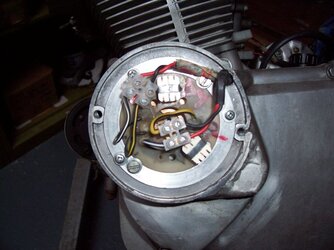
750 sf ignition problem

I'm confused. How does a dual coil work on a 750 Laverda?

OK, I admit to being a bit of a dunce as far as the 750 twins are concerned (I've never owned one) but as far as I'm aware, the original setup has two points and two coils. The points cam is gear driven off the crank and rotates at half engine speed. That means it can't be a wasted spark system, even though the pistons rise and fall together.

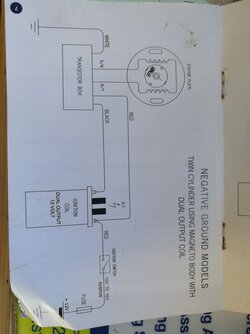
You can't drive a dual output coil from two sets of points. The same goes for a pointless electronic ignition. An electronic system fitted to a 750 twin will normally have two pickups (as stated in the original post) and two coils. Although different configurations are possible with smart electronics.

If it really is a double output coil and wasted spark system, then it either has two lobes on the ignition rotor and one of the pickups is redundant, or the two pickup signals are somehow sorted out in the electronic box and fire the same coil. I know nothing about Boyer ignition systems (and there's bugger-all info on their website) so it could be either of those alternatives, or maybe another that hasn't occurred to me.
IMG_20210505_114748.jpg
 
the Norton is definitely a 'wasted spark' 'cos it has (original) 2 x 6v coils in series, so always firing both.

I guess 2 pickups or 2 points allows for redundancy?

FYI running a MK3 Boyer and dual fire aftermarket coil on mine. Works well.
 
If 2 pick-ups are used, 2 single coils would be sufficient to fire each cylinder individually, without a wasted spark, as with the points. If both pick-ups are hooked to a dual coil, you end up with a wasted spark and all the disadvantages that come with it.

The DMC uses a single optical pick-up, operated by 2 slots, gives a wasted spark on both cylinders. One output channel can be used to power a dual coil for the same effect, frees up a bit of space under the tank. I've used this set up sucessfully for the past 20-odd years. Thanks to a 3rd, smaller slot in the rotor, the current DMC32 system is "single fire", ie, the box recognises which cylinder is to be sparked. From there, the box delivers alternate sparks to the corresponding cylinders, just like the original points system. Less stress for the coils with a steady, reliable tick-over that will seemingly go on all day.

piet
 
360 deg twins are easy. One pickup or trigger at engine speed and a twin lead coil. Yes, a wasted spark - but so what ? Never had a problem with that. Half speed rotor needs two lobes or magnets at 180 deg spacing.
180 twins are a tad more complicated. I've used two pickups and two single lead coils - IE two single cylinder setups - at crank speed.
The awkward one is a half-speed trigger and a twin lead coil. the firing intervals get pretty short which means a low impedance primary coil must be used. I recently did a CB350 like this. A single Pertronix trigger with a two magnet (90deg) rotor at half engine speed. A coil with around 2.2 ohm primary resistance was needed to let it rev out. A 3 ohm coil couldn't handle it.
 
OK, going by the wiring diagram posted above by natm, it seems my second guess was right. The two pickups feed signals to the ignition box which then fires the dual coil when the rotor lobe passes EITHER pickup. Bit of a cheap way to do things because the ignition box only needs one channel.

That Boyer system is quite un-sophisticated because it's a single channel device that still uses the bike's mechanical advance system rather than an electronic advance map. It's basically just an electronic relay with no smarts built in. I suppose it has the advantage of being simple.
 
So's the pertronix - just a magnetic switch. No condenser required. I've used them both fixed timing and with the OE centrifugal advance.

If you really want to get basic, there are several conversion kits available for the venerable Briggs and Stratton, replacing the points.
 
OK, going by the wiring diagram posted above by natm, it seems my second guess was right. The two pickups feed signals to the ignition box which then fires the dual coil when the rotor lobe passes EITHER pickup. Bit of a cheap way to do things because the ignition box only needs one channel.

That Boyer system is quite un-sophisticated because it's a single channel device that still uses the bike's mechanical advance system rather than an electronic advance map. It's basically just an electronic relay with no smarts built in. I suppose it has the advantage of being simple.
not really ... the Boyer has advance, the pickups are however fixed and just rotating magnets passing a coil
 
My knowledge regarding auto electronics is fairly rudimentary, I usually just try to follow whatever instructions I have to hand. Having looked at most of the Boyer ignition circuit diagrams., they show, whether a twin or triple, 2 separate coils or 1 separate and 1 double outlet that the coils are just about all wired together in series with only a single input wire to the coils from the ignition box and a single return, with the wiring polarity being reversed be it positive or negative ground/earth.
Correct me if I am wrong, but surely apart from the a double coil being perhaps slightly less efficient, how does it make any difference with 2 coils wired in series or a single double coil?
Will they all not be sending a High voltage current at the same moment?
I understand that with some engine configuration this would not work. But with a twin or a 180 triple?
I can't see how with those set ups it can be anything other than a wasted spark system.
I'm not including a Ducati in that assumption as they are 270 degree firing and I can't be bothered trying to work out where the pistons are going to be at each spark.
I understand that there is a question as to why fit a electronic ignition to a simple twin cylinder engine (I didn't actually fit it), but the answer is probably for ease of maintenance for most people. How the ignition box itself works is fairly irrelevant, and a bit like computers, I don't want to know how they work.
If it was necessary for motorcyclists to understand exactly how everything functions, then most would still be riding around on push rod singles, although with bikes that are 40 plus years old it does help to have some idea.
 
Last edited:
I'm not including a Ducati in that assumption as they are 270 degree firing and I can't be bothered trying to work out where the pistons are going to be at each spark.

Here's a Boyer set up on my 270°SF - PK's separated and one moved to suit - using one magnet - 2 boxes and the original two single coils. Been on there about 30 years!
 

Attachments

  • 90 deg ign.jpg
    90 deg ign.jpg
    114.8 KB · Views: 37
The original dual Point, 2 Condensers - 2 Bosch Coils will last forever and easily reach 8000 rpm aside for changing plugs, maybe points under extreme conditions (If so buy VW Beetle Echlin with a little Modification Fits perfect) - The original Copper wire spark plug wires and Plug Caps also last forever.

<<IMPORTANT>> Thing about the SF and SFC is that you have to drill a 1/8th hole in the bottom of the distributor cap to drain moisture and use something like a permanent Aerobic Sealant (3M makes it) on the engine casing to drain oil vapor an water moisture to drip or drain from the distributor encasement.

Set up as such you can yearly clean the distributor compartment.

If your so intent to use an electronic ignition system that 1/8 hole drilled in the bottom of the distributor cap is critical.

If you are using an electronic ignition system you will have to replace the copper spark plug wires with carbon fiber spark plug wires.

After 45 experience of riding a Breganzie 750 you can KISS me for this INFO and lucky you caught me half sobber ;o)

Ventilate and keep the Distributor compartment DRY whether it be Points or Electronic.
 
Last edited:
I'm all for building a Mo-bid Racer on your Wife's kitchen table - If you can get away with it: Owning a Breganzie ;o)

Hope I came across with my explanation regarding the Braganzie Twin distributor issues.

Breganzie Enthusiasts are a shit lot of Lost Puppies ;o)
 
Last edited:
Hi knowledgeable ones.
Slightly perplexed! I've a sf2, was fine 2 weeks ago when I parked it up. But now it's only firing on the right cylinder.
It has a Boyer mirco_mkIII ignition system (Not fitted by me), with a duel outlet Wat Yong coil, (which in itself does not fill me with confidence, but what do I know, it might be the Ferrari of coils)
It's firing fine on the right cylinder, have changed plugs and caps, makes no difference.
I'm rather under the impression that the coil is very unlikely to fail on one cylinder only and if it fails then it should be both. Any ideas?
By the time I get replies I guess the bike will probably be in a thousand bits.
It'll be a dodgy spark plug. Disconnect the carb pumper and screw out the mixture a full turn.
 
Breganzie 750 SF2's are a sketchy bike torn between the 70 SF0 and 73 SF3 - I would not have a clue what he has unless I see a PIC of her and Carb specifics.

The Breganzie factory never introduced a new model on the New year but rather and ongoing transition through the summer months and put a label on her which really wasn't much help - More like a 750SF2 was built in the summer of 72 when they were migrating from open mouth VHB 30A's, DMC Exhaust to filtered PHF's, Conti Exhaust, Disk Breaks and Alloy wheels - Really a 72 Breganzie 750 SF2 is a condrium ;o)
 
Last edited:
Ron, apart from the original cam on the SF1, SF1,2 and 3 have the same engine with 36mm carbs.

SF1 appeared after the summer hols in 72 as the 73 model.
Sf2 appeared a year later with disc(s) at the front as the 74 model.

Paul
 
The first thing I would do is get rid of the electronic ignition and use the points! Other than ocasional maintenance, electronic ignition works no better than the points and can be repaired on the side of the road. Both my 750's are still running fine on points after 44 years. Other than having one condensor go bad 20 years ago, no problems.
 
maybe stay with points but my experience with fitting a Boyer to a Norton 20+ years ago was quite an improvement.

I've nothing against points (and have gotten back on the road after dropping the bike ... lost the points cover but banged the points into shape with a roadside rock) but on the Norton it immediately idled far better / lower rpm and was crisp accelerating and fouled the plugs less.

No guarantees that the Boyer is better (but that's 2 bikes so far that were trouble free) (with changed regulators also) but have also converter an Alfa to CDI (better) and an Aston to an optical trigger (6 cyl.) to Petronix with good results.

The key maybe is a good gen. / alt., good R/R, good coils and good leads / plugs.
 
Back
Top