LAVERDA 1000 SFC Superleggera Part one

you mean - without the engine, right?

honestly: I think the difference is between a TT-Racer and a street ready bike, lightened to the max. Also, the claim of 170kg is not totally correct. There was a guy in OZ who raced a TTF1 after lightening it massively again and then it weight in at 180kgs:


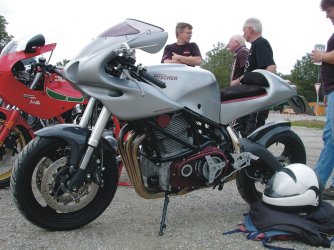
So - I assume the factory TT-F1 was more in the ballpark of just below 200kgs I would say, but might well be proven wrong soon. I know of one bike though that was raced by Michael Stöcker in the 90's, belonged to Uwe Witt for a long time and that now is owned by Michael, wich was taken FAR beyond the race-status of the 80's by replacing the rims with extremely light ones, the rear brake, too, alternator removed etc. etc. etc. and now comes down to 165Kgs if I am not mistaken, with something like 110 - 115 HP. pretty fast beast with a well experienced rider/owner... so - 170 on the factory TT-F1 is something I still doubt.
 
As per the link above, 180 kilos was after a massive reduction further to the factory reduction. I still have my doubts that 170 Kilos (74 kilos below stock...) was possible by then. keep in mind that the factory was always aiming for reliability first. shaving 74 kilos off of a standard RGS would have meant to drill everything hollow to an extend that it would break during a long distance ride most probably. I am not saying it is impossible at all, I just have my doubts they knew hot to do that beginning of the 80's and even if, they would have done it. Can't find any specs though online other than the link above, so - who knows...?

ist it maybe @RGScott on this forum? He wanted to write an article about the TT F1 according to this message:


if so, maybe he can comment, also on the infos I linked above from OZlaverda
 
Last edited:
So - I assume the factory TT-F1 was more in the ballpark of just below 200kgs I would say, but might well be proven wrong soon. I know of one bike though that was raced by Michael Stöcker in the 90's, belonged to Uwe Witt for a long time and that now is owned by Michael, wich was taken FAR beyond the race-status of the 80's by replacing the rims with extremely light ones, the rear brake, too, alternator removed etc. etc. etc. and now comes down to 165Kgs if I am not mistaken, with something like 110 - 115 HP. pretty fast beast with a well experienced rider/owner... so - 170 on the factory TT-F1 is something I still doubt.
The bike Michael raced for Uwe was destroyed (by Michael) at a hill climb at Schauinsland. The frame and running gear was junked after retrieving it from under the Armco, the engine cases live on in a much-modified 3CL. I personally re-phased a 120° crank to make that happen, one of two 180° engines with a true LH gear change that I have built. I also twisted two 120 cranks to 180 for Hans T. for both his white and red/grey bikes. Hans hasn't disclosed how much those bikes actually weigh, but pushing them around lets them feel quite light, I'd say around 180-ish kg with road gear.

Michaels present track bike is one of the original RGS Corsa as built by Uwe Witt (7, 8 or 9? nobody knows exactly), originally owned by Georg K. from Cologne, later Bodo B. in Saarbrücken. It is NOT a TT-F1, afaIk it still runs the stock frame. I rode that bike a fair bit back in the day and remember it as being extremely quick. Georg teamed with mate Günther for a Hockenheim 1000km event, had their riding skills been a bit superior, they would have mopped up much of the field. IIrc, they came in mid-field, no mean feat as many top racers used the Easter event as a pre-season training gig. Günther, a devout Ducati rider, said afterwards he had never ridden a faster bike! The Ducati they had planned on using expired shortly before the event, the RGS was Plan B.

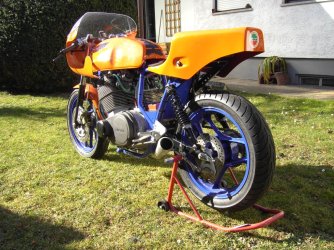
The TT-F1 frame is Cro-Mo and considerably lighter. It must also be considered that the TT-F1 crank is about 1.5kg lighter than the stock crank, so it does have somewhat of a handy head start over a stock RGS.

The track bike I share with Willi W. weighs in at around 190kg, no exotic materials used. The alternator cover is in fact from the Witt TT-F1! With a lashing of titanium and carbon fibre maybe a reduction of around 5-8 kg may be possible.

piet

Tuscher I.jpgTuscher II.JPGEisenschwein.JPG
 
Last edited:
This one of the more interesting threads on the forum. Much information to be had and great to see that people (like Piet) are sharing there experiences gained back in the days when Laverda were more relevant as a race bike.😀👍
Tom
 
Spoke with Michael today and his bike - as Piet rightly mentioned - is a heavily modified RGS Corsa, strictly trimmed down for weight savings. The list of lighter components include (but not exlusively):

-Carbon fibre parts all over the place
-no alternator
-no starter freewheel
-no starter
-lightened and balanced parts afaik all over the engine
-light weight 3-2-1 Exhaust
-striped down electrics with no lights
-massively lightened PVM wheels (something like 3 kilo front and not much more on the rear...!) with light weight brake rotors
-a LiFePo4 accu (0,8 kilos compared to roughly 15 Kilos of the original Battery...)
-etc. etc.

this bike actually comes in at 178 Kilos with oil and battery, no fuel. It is damned quick and Michael knows hot to ride it...:


Michael doesn't recall the weight of the Corsa exactly but was pretty sure it was around or above 200kgs at that time coming from the factory. If you strip some kilos from the lighter frame and add all the heavier components that were on these bikes (heavier wheels than the extremely light weight PVM, no carbon fibre but also a bit lighter fairing and tank etc., heavier battery, alternator, freewheel, starter on the bike etc. etc. etc.), 170 Kilos sounds not achievable with the components on the bike. I think that sounds more like a target than a real weight...

but let's see what the "Super Legera" comes up with... ;)
 
Last edited:
HI

Like that, plus he can probably find more kg, by making axles and engine parts in titanium, yes we have to make a competition, who can build that relief TT1
 
I am out of that... I sold my Carbon fibre parts to the starter of the thread as I was so angree about Boba not returning my tank after 7 years and countles messages, promisses etc., that I just lost interest in the project.
 
Hi Lothar.

Namely, plus we're late by being in the senior age, where you don't ride as much anymore, plus now they've also destroyed the Bikers Classic, so you don't have to either, (I'm sure you save a lot of money), I've sold my Endurance racers, and now I just go and enjoy myself in my workshop, and build for others, it's nice, personally I think that the Laverda era is going downhill, most people I know are 65 years plus, and people don't ride their bikes more
 
Hi Lothar.

Namely, plus we're late by being in the senior age, where you don't ride as much anymore, plus now they've also destroyed the Bikers Classic, so you don't have to either, (I'm sure you save a lot of money), I've sold my Endurance racers, and now I just go and enjoy myself in my workshop, and build for others, it's nice, personally I think that the Laverda era is going downhill, most people I know are 65 years plus, and people don't ride their bikes more
A lot of people rode their bikes to Breganze. But you didn't need a lightweight version to achieve that.
 
sounds very light to me to be honest, but definitly higher than 170kgs, which was my asumption, too. Makes you wonder why a standard RGS is 60 kgs heavier...
 
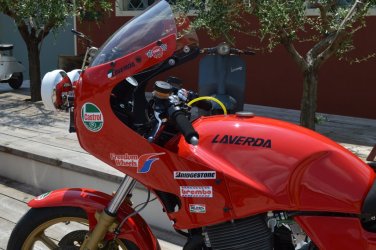
Interesting reading the views on TTF1 weights. My red TTF1 comes in at ~170kg when it was setup for racing. A quick summary of the pictured bike. Everything red is fibreglass, everything gold is magnesium, everything silver is aluminium. The frame is CrMoly and shortened and swingarm is unique to TTF1 but aluminium. In race setup it was positive discharge so no starter motor or stator and flywheel was lightened significantly as is the crank, rods and pistons. It runs a 525 chain & sprockets and the exhaust is a 3:1 + tiny thin walled megaphone. The only things which are heavy are in the motor but having lifted a standard SFC1000 and a TTF1 motor there is a very noticeable difference. In summary anything they could reduce they have down to the tradition rubber grips being foam, the axles have been centre drilled, side cases reduced etc. A lot of small changes which add up.
 

Attachments

  • Matin Hone 3.jpg
    Matin Hone 3.jpg
    154.7 KB · Views: 65
Exactly, really poor form—unfortunately, Niels doesn't speak nicely, plus he got all his ideas from me, but he's the one with the problem.
 
Back
Top