
You are using an out of date browser. It may not display this or other websites correctly.
You should upgrade or use an alternative browser.
You should upgrade or use an alternative browser.
Rear wheel with rotor brake substitute
- Thread starter Chuck3CL
- Start date

piranha-bro2
Hero member
- Location
- Melbourne
Holy shaez, it's getting complicated! I'll just say well done getting it done in lockdown - being in Melbourne I know all about it - order, wait a day, two, three, click and collect. Order online, wait weeks for Oz Post to deliver. Nothing is simple or quick.
I guess using the KLR caliper and bracket meant you were compelled to find a simple solution for that setup. I do like your idea of later customising the brake caliper bracket to lock into the original 3CL bracket and M8 pinch bolt - sounds elegant - and can probably trim down the KLR bracket even more. Even have some alloy billet welded in place.
One thing noone has taken into account (I think) is the clamping force of the axle on the caliper bracket, which must have some effect on controlling the twisting force under brakes and thus torque compression forces on the rod.
I guess using the KLR caliper and bracket meant you were compelled to find a simple solution for that setup. I do like your idea of later customising the brake caliper bracket to lock into the original 3CL bracket and M8 pinch bolt - sounds elegant - and can probably trim down the KLR bracket even more. Even have some alloy billet welded in place.
One thing noone has taken into account (I think) is the clamping force of the axle on the caliper bracket, which must have some effect on controlling the twisting force under brakes and thus torque compression forces on the rod.

Dellortoman
Hero member
- Location
- Tasmania, Australia
That thought did cross my mind. And you're right that it can play a role in holding the caliper in place. But I suspect that role is minimal compared to the torque arm. In fact some are set up with a floating caliper mounting plate. Since I didn't know whether the Kawasaki was a floating system or not, I assumed zero clamping of the mounting plate by the axle nuts.One thing noone has taken into account (I think) is the clamping force of the axle on the caliper bracket, which must have some effect on controlling the twisting force under brakes and thus torque compression forces on the rod.

Whew... Cam, Quentin, you guys have been busy, well done! Now the feedback is like taking a drink from a fire hose! All great thinking. I know the natural reaction when the technically minded are given a design challenge! All good value feedback for the Laverda community. Anyway my 2nd of possibly 3 solutions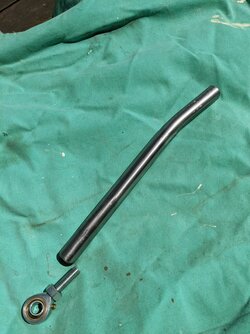 I am making now. I found a quality steel 16mm rod in my scrap. Flattened one end and put a bend in it to go into the old Lav swingarm pinch mount and tapping the other end for the rose joint and caliper for now. Here is a pic.
This is prototype 2, the last will be a shaped one piece plate....after lockdown!
Thanks again guys.
I am making now. I found a quality steel 16mm rod in my scrap. Flattened one end and put a bend in it to go into the old Lav swingarm pinch mount and tapping the other end for the rose joint and caliper for now. Here is a pic.This is prototype 2, the last will be a shaped one piece plate....after lockdown!
Thanks again guys.
Last edited:
piranha-bro2
Hero member
- Location
- Melbourne
That gave me a chuckle, Chuck. The sighted leading the sighted?!As a retired engineering manager with Lockheed Martin, Rockwell, E-Systems, etc I know the natural reaction when the technically minded are given a design challenge!


breganzane
Hero member
- Location
- NSW Australia
He also said that "an engineer would analyse the loads and calculate the 'critical stress' and yada yada yada.... "
Naturally, as an engineer, I took that as a challenge.
Cam,
So am I (sorta) but I figured you would do it for me, so I could get on with reassembling my Dad's Velo forks!
 Nice work.
Cheers
SB
breganzane
Hero member
- Location
- NSW Australia
I think it was Carroll Smith (a bloke) who said "the best way to weaken a tube by a factor of 10, is to put a bend in it".  As an aside, his book "Engineer To Win" is an essential read for anyone fiddling with their bikes. Packed with info and also an enjoyable read.
As an aside, his book "Engineer To Win" is an essential read for anyone fiddling with their bikes. Packed with info and also an enjoyable read.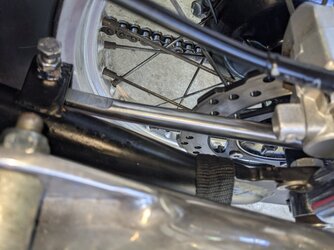
Dellortoman
Hero member
- Location
- Tasmania, Australia
Yes it is. As shown in your previous photo, it's already bent.At 16mm dia. steel, this bar ain't gonna' bend!

I agree that it won't bend under braking forces because there's bugger-all bending moment on it.
It'll slide through the clamping bolt though because it's being pushed lengthways in that direction.
Last edited:
Took a bloody long bar and a strong vise to get that little bend in!
It was a cold bend, I didn't want to heat it.
Agreed Cam, it would slide through, that's the last bit to sort.
In the mean time there is an interference at the caliper preventing caliper rotation though.
It was a cold bend, I didn't want to heat it.
Agreed Cam, it would slide through, that's the last bit to sort.
In the mean time there is an interference at the caliper preventing caliper rotation though.
piranha-bro2
Hero member
- Location
- Melbourne
Keep an eye out for a little Brembo rear caliper (like this - not sure the model number https://www.ebay.com.au/itm/2646866...07MPuXCnblsHTR5f0rH5kP4WWjpge0nEaAmoXEALw_wcB).
They're tidy, twin piston and easy to fit in ... but definitely suited to an underslung mount!
They're tidy, twin piston and easy to fit in ... but definitely suited to an underslung mount!

Yikes. A new one might be cheaper?Keep an eye out for a little Brembo rear caliper (like this - not sure the model number https://www.ebay.com.au/itm/2646866...07MPuXCnblsHTR5f0rH5kP4WWjpge0nEaAmoXEALw_wcB).
They're tidy, twin piston and easy to fit in ... but definitely suited to an underslung mount!
Paul

hooksey
Hero member
- Location
- Vic , Australia

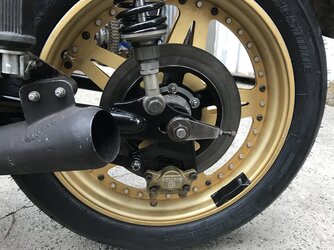
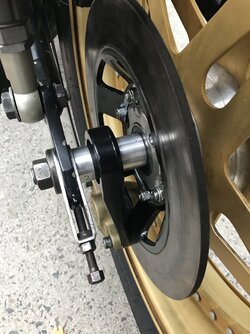

I'm enjoying this - It's like the forum of old - joining in on new ideas / improving / engineering, rather than talking about orange paint
Further thoughts on the concept...
• The caliper provides a heat source to the damper oil - close proximity. If this is a road bike as opposed to a racer, then probably no worries.
• The calpier looks close to the damper in the photos. The caliper looks like a solid-bridge-sliding-pin design. Is there enough space to accommodate pad wear? It looks like there probably is, but worth a mention.
Further thoughts on the concept...
• The caliper provides a heat source to the damper oil - close proximity. If this is a road bike as opposed to a racer, then probably no worries.
• The calpier looks close to the damper in the photos. The caliper looks like a solid-bridge-sliding-pin design. Is there enough space to accommodate pad wear? It looks like there probably is, but worth a mention.
Well, I finally took the Kawaverdasaki out this arvo after the conversion and I couldn't be more pleased with the result. It's like a new bike. Fair enough,it does have a new tyre on but the real improvement was getting rid of that heavy wheel, all 5kg+ of it. Turning control is very responsive, acceleration has picked up, and the rear brake feels great in trail braking.
The old alloy wheel used to feel so sluggish like you had to drag it around corners. I think it had to do with the rotational inertia of the heavy wheel acting like a stabilising gyroscopic force resisting change of turning direction. Anyway I couldn't help thinking while riding that Laverda took a perfectly good wire-wheeled bike in 1975 and degraded it with the heavy alloy wheels. Anyway, I think we've worked over this thread enough to help anyone interested in the KLR650 mod.
Thanks for all your input guys, made the job much more enjoyable (and entertaining!)
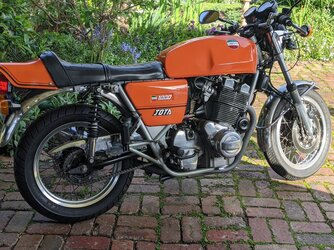
The old alloy wheel used to feel so sluggish like you had to drag it around corners. I think it had to do with the rotational inertia of the heavy wheel acting like a stabilising gyroscopic force resisting change of turning direction. Anyway I couldn't help thinking while riding that Laverda took a perfectly good wire-wheeled bike in 1975 and degraded it with the heavy alloy wheels. Anyway, I think we've worked over this thread enough to help anyone interested in the KLR650 mod.
Thanks for all your input guys, made the job much more enjoyable (and entertaining!)

martymoose
Hero member
- Location
- Sydney, Australia
Hey Vince, reckon you need a 17 inch rear
All the modern triumph Bonnie's have 17 rear, 18 front, older ones had 19 fronts. Maybe you are onto something there Chuck.
All the modern triumph Bonnie's have 17 rear, 18 front, older ones had 19 fronts. Maybe you are onto something there Chuck.
Could be Marty. My Tiger XCX runs wire 17 rear 21 front!
And my friends Triumph Scrambler runs wire 17 rear, 19 front (and chain on the right like the Lav.)
Interesting thing on that factory built model, Triumph used a right hand brake caliper assembly and flipped it over onto the left side upside-down!
And my friends Triumph Scrambler runs wire 17 rear, 19 front (and chain on the right like the Lav.)
Interesting thing on that factory built model, Triumph used a right hand brake caliper assembly and flipped it over onto the left side upside-down!
Thought I'd wade in and add my 2 cents worth...I agree with earlier opinions regarding the tie rod in compression, you need to be careful there.
I wouldn't bother changing the caliper/carrier combination as it works so why make extra problems for yourself. There is an advantage to using the single sided sliding calipers in that they don't extend very far on the inside so don't have clearance issues with the spokes.
However you may have notice that the caliper has two pistons of different sizes. This is done to help equalise pad wear. The smaller piston presses on the leading edge of the pad - which is most prone to wear - with less pressure than the larger piston, which presses on the trailing edge of the pad. However it was designed to work when installed on the right side of the wheel, standard modern practice, but the Laverda has it on the left side. So the small brake piston is now bearing on the trailing edge of the pad and the large piston on the leading edge of the pad. This will work, but you may expect the tendency of the pads to wear faster on the leading edges than the trailing edges will be increased. I don't know the long term implications of this but I'm sure that you'll keep us posted!
cheers,
bazzee
I wouldn't bother changing the caliper/carrier combination as it works so why make extra problems for yourself. There is an advantage to using the single sided sliding calipers in that they don't extend very far on the inside so don't have clearance issues with the spokes.
However you may have notice that the caliper has two pistons of different sizes. This is done to help equalise pad wear. The smaller piston presses on the leading edge of the pad - which is most prone to wear - with less pressure than the larger piston, which presses on the trailing edge of the pad. However it was designed to work when installed on the right side of the wheel, standard modern practice, but the Laverda has it on the left side. So the small brake piston is now bearing on the trailing edge of the pad and the large piston on the leading edge of the pad. This will work, but you may expect the tendency of the pads to wear faster on the leading edges than the trailing edges will be increased. I don't know the long term implications of this but I'm sure that you'll keep us posted!
cheers,
bazzee
piranha-bro2
Hero member
- Location
- Melbourne
You'd have to be using your rear brake a lot to heat the rear damper. And ditto to wear pads rapidly - In the decades i ran a spoke-disc rear i never replaced pads (original setup was the 08 Brembo, later changed to one of the little ones). Some riders love a lot of rear brake power and use it a lot - different riding styles.
And I only posted that Ebay listing to show the type of caliper, Paul. Although I've never seen them go for peanuts anywhere online. If someone had a Zane one they wanted to sell me for peanuts i would have bought it - maybe i should have asked! I think I paid A$150 for my second one, 2nd hand.
And I only posted that Ebay listing to show the type of caliper, Paul. Although I've never seen them go for peanuts anywhere online. If someone had a Zane one they wanted to sell me for peanuts i would have bought it - maybe i should have asked! I think I paid A$150 for my second one, 2nd hand.