Weird

I concur Doctor Rob in far away land.. modern batteries are not just batteries, they have internal active control circuit assemblies embedded. Was not sure of Rob WA battery origin.

Just had a very difficult repair on a golf buggy with active battery, Li. Worst of all, the control module has a solid state gyroscope, repaired the module ( potted item ) only one wheel would drive...??? Moved the control pcb about and both wheels went berserk as i did so.... as if trouble diagnoses was not difficult enough, angle of pcb was crucial.... was fun testing the buggy out on my cul de sac street, chasing the local dogs with the buggy, as it has a remote control function.... neighbours came out wondering why this robotic buggy was causing havoc in the street, me standing on my verandah out of sight.... lifes joys are many if you make them happen.... j
 
Morning all, well from where I am. Brand new battery SSB LH14. Output was showing 13.7 before battery replacement.
Hence replacing RR with new from Red. output 14.5~. 800kays later did the starter clutch so removed the stator.
Reassembled and zero output. Replaced the new RR with another SH530 and got 13.7v. Tested all 3 RRs with DMM, the 2 SH530 showed the exact same numbers and the 3rd new one from Red {unbranded} showed a fault hence the zero output. So confident the new RR is fucked and the 2 SH530 are fine hence the new stator. Output wires connected direct to battery and even did what John suggested and connected the output and senser wire together and the same result. Will check the new stator output to compare numbers with the old one.
It did cross my mind that maybe the DMM is faulty but testing the BM it showed the correct output. Will replace the batteries anyway.
Will do the test John suggested with lights etc.
Lee, not sure how to isolate the electrical system from the charging system and still run the bike. The charging system is only connected to the electrics via the battery so is sort of stand alone anyway. I'm loosing interest in trying to sort this out. Have spent far to many hours dealing with this problem. Electrics aren't my forte.
 
Onwards rode Rob into the electrical storm or no electical storm in this case, hang in there Rob, your doing well. Had to hold the hand of some auto electricians, some are good and dedicated, others get worn down by problems like yours, one gem in QLD charged $100 to solder one wire.... you can imagine my response.... Many do not work on permanent magnet alternator systems, besides they will do what you are doing or all ready done, the one technical advantage for electricians is the many items of test equipment, as intimated to you Rob, there are limits to what one multimeter can accomplish in these kind of situations. Like to see the loaded voltage on that Li battery, motor running and NOT running, also. Take it the starter motor works fine on the Li battery?? Obviously the bike starts on it, keep your meter on it while it cold cranks...yes i know.... "do this and do that" becomes tiresome and tedious. Part of remote diagnosis 'fraid to say, j.
 
Hi John, starter motor recently serviced. Will do as you suggested and report back.
Was just interested in how well the battery was cranking the motor on cold start and fire up...ie means the battery is working as intended.
As an aside after starting the engine how long do you wait ( duration ) in measuring the battery voltage as the charging system is connected to the battery? Reason i ask, as the Lithium battery may well be a very low impedance and draw appreciable current in initial post cold crank start recovery. Not easy to put into words. Loading and unloading the charging system with lights may assist in viewing voltage fluctations in the charging cycle/recovery j.
 
Last edited:
Yep battery working as it should. 440cca spins the motor over no worries and it gets cold in the shed until I light the fire.
That is one measurement that is working, gathering up information on what is working has as much value as in what is not working, perverse as it may sound....

Another loose thought, as demands allow, if the bike is roadworthy ( insult warning, grin ) take it for a 15 minute ride, even a non charging system, the battery should support a ride of that duration. On arrival at home, keep the motor running and measure the battery volts direct ( be hard doing that with just probes ), need help perhaps and raise the engine revs while looking at the battery volts, your looking for only millivolts of change ie slow rise or fall as the electrical load changes ( a good quality dash voltmeter would be a good investment perhaps Rob, if not already installed ). j
 
Last edited:
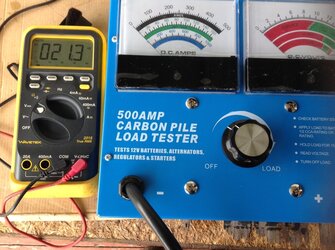
Test equipment makes life less difficult....this non invasive clamp meter has solved many automotive problem measurements...the logging min/max voltmeter has to be quick response to be of greatest use, ie cold crank battery sag is hard to spot without a min/max function. The battery tester has saved me from binning a $300+ battery in the diesel truck.... one of the better $90 spends no mistake. Post this for others to make best of in home fault chasing...j
 

Attachments

  • DC_Current_clamp.JPG
    DC_Current_clamp.JPG
    302.7 KB · Views: 7
  • Logging_min_max_voltmeter_Graphite_pile_Battery_tester.JPG
    Logging_min_max_voltmeter_Graphite_pile_Battery_tester.JPG
    159.2 KB · Views: 7
Last edited:
Ok new batteries in the DMM. first did an ohms test on the new stator and results showed all 3 combos the same and very close to the results of the original stator. Running the motor at idle and DMM set to AC resulted in 15v~ and at 3-4k 60v~ which is in the same ball park as the original stator. Battery putting out 13.3v and turning on ign and lights drop to about 12.9. Hit the starter to see how much it dropped and the engine bursted into life on the touch of the button, in hind sight I should have turned off the kill switch to kill the ign. Went for a fang into town and back, 14kays and the battery now reads 13.4v. Fang into town and back sees the revs in the 4-5k range. Have to say the Motodd is running superbly!!
I've rewired the RR as it has been for the last 14 years, ie: output wire to battery via 25amp fuse and senser wire to the ign.circuit and earth direct to battery. With both output and senser wires connected direct to battery there was no difference in the readings so went back to how it was originally. Question John, is the fuse a good idea or should I just go directly to battery+. The battery is charging it seems as when ever I run the motor it picks up what was lost in the starting procedure. So it still only putting out 13.7v!!!!!
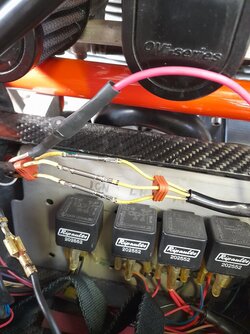
Pic shows the wiring, obviously it will get tidied up and the earth spade will be heat shrinked.
 

Attachments

  • 20220909_150742.jpg
    20220909_150742.jpg
    154.3 KB · Views: 28
Last edited:
Fuse is good practice but Laverda didn't always bother! Maybe worth temporarily bypassing the fuse to make sure that's not causing the problem - Chinese made fuse links can be ropey. Putting the sense wire on a switched feed avoids discharging the battery (~2mA but enough to flatten it over time) but risks overcharging because of volt drop through ign switch and wiring. Can check this by comparing to volts at battery with everything on/running- as long as it's within 0.2v, no worries.

I see you're using a Deutsch plug and socket for the alternator wiring. Whilst it is rated for the job, what did you use to crimp the wires into the pins/sockets? Did you measure the stator resistance and voltage on the connector pins? Just wondering if there's a loose connection/high resistance there.
 
Ok Rob, did well with the tests and basic electrical practise and assumptions. Out and about on the bike helps clear away the problem blues, if not but for a moment in time. Think even the best of us would be challenged by this level of fault difficulty. There is a reason, or reasons, matter of "what could it be" imagination is a part of fault diagnoses. Ponder your last tests and reply, need me tea pot and toast first...very important, j.
 
Ok, new man after me tea.....

If possible, float the Li battery on an external charger, most these days are "intelligent" and introduce new styles of charging regime(s). By float i mean not connected to the bike charging system. Monitor with your DMM, looking for a rising terminals voltage to 14,4V or so, anything under 14,1V would be a point to note. Premise is to rule out what is working and needs no close attention in the process of diagnocsis.

Plastic housings and pin or sockets need to lock together, not just the housing to housing, the individual pins and sockets should not be able to press backwards from the mating tips, ie large gauge wire tends to support a metal contact though the mating force can push a metal contact out of "locked" position, along the lines of what Rob is indicating, ditto unknown source of fuse blades.

Not possessed that pins not locking is an issue outwardly, though easy enough to confirm by looking at the metal mating tips and pushing solidly against the tip to see if it backs out of the housing, been caught a few times with non locked into position pins/sockets. Also if barrel style metal contacts, not deformed in profile causing less than best electrical integrity, again Rob indicates a scenario of this class. Your loaded AC readings tend to dismiss this likely source of issue, all the same. Though easy to check mechanical aspects than non visual electrical parameters.

The photo is illuminating, there is a connector for the stator 3 yellow wires, doing well to reuse a connector there, should that be the case. When desperate i revert to old style double screw tunnel connector "old school connector block" to maintain easy measurement access and visual reliable mechanical form. More tea....j
 
I don't run a fuse in that circuit, connect direct to battery, sensor wire direct to battery as well.
Each owner decides what is acceptable, in many aspects. The fuse is a fault current limit device, there might be 20A or so available from an on bike charging system, there is the possibility of up to 1000A for a moment from the battery however. This latter aspect is what the fuse is there to mitigate. Fire hazard should always have highest priority, a well designed and applied fuse or suitable circuit breaker is able to be a protection without constant monitoring when riding.

At home battery chargers connected most of the time, is a fire hazard also, i will never have unattended battery charging at home or if i must, sitting on a metal plate all combustible material well away from the battery and charger. Connecting a "keep charged" system should have a proper fault limit capacity in the connection battery to charger, after all you have a battery and a tank of fuel adjacent to consider as to hazards and what can be minimised. HTH j
 
So yesterday I ran the output wire direct to battery, no fuse, and the sense wire is still connected to ign circuit. Fired it up and got 13.5 so there was drop from 13.7!!. The pins/sockets on the Deutsch connector are pretty tight, used not the proper deutsch crimper but the crimper I brought when I rewired the bike. It's not the top of the wozzer but does a pretty good job of crimping.
With the deutsch connectors there is a definitive snap into place when installing the pins/sockets into the housings then there is the plugs that lock them in so no chance of the pins/sockets to move once installed correctly.
Rob, when I tested the stator output I just put 3 sockets onto the pins to have better access to the pins for the DMM probs.
When testing the stator, 15v at idle and 60v at revs, does that sound about right? Both stators gave the same results~.
So today I'll I'll run the sensor wire back to the battery again and see if I can recover the 0.2 volts I lost yesterday.
The motodd doesn't get used that often so I kind of like the idea of the sensor wire not draining on the battery.
The wiring involved is, deutch connector to RR, left the 3 f/m spades on the RR after removing the OE terminal block and have male spades fitting tightly going directly to Bat+, Battery- and ign, circuit, all nicely crimped all connections tight.
Just to clarify John when you say float the battery not connected to the charging system, disconnect battery from bike and attach charger to see the output at the battery terminals???
What I like about the SSB lithium is they use a conventional battery charger for charging. I have a 6amp Arlec charger that charges the battery in less than 30mins. Never leave batteries on charge unattended. The current battery is brand new so has never been charged yet. It has 13.3v.
The same voltage it arrived with. With all the constant starting for testing it has maintained that 13.3v. Even with 13.7v it must be putting some charge back into the battery to maintain that 13.3
 
It's hard to tell the charge state of a lithium battery by measuring voltage. They have a very flat voltage curve. As it drains, it'll keep showing a healthy voltage until almost flat, then collapse all at once.

Lithium batteries seem to be fussier and more fragile than lead-acid. I've managed to kill a couple by inadvertently discharging them beyond their happy place. So I reckon I'll stick with lead acid for now. They're a bit more idiot proof.

The other day I didn't fully close the door on my Mitsubishi Delica, and the little footwell lights at the bottom of the doors stayed on. A couple of days later I jumped in the car to go to the shop, turned the key and the dash lights were a bit dim. The starter motor wouldn't even consider cranking the diesel engine. I put it on the charger and went shopping in the old Datto 260Z. After a few hours of charging, the flat battery in the Mitsubishi was healthy again. You wouldn't get away with that sort of abuse with a lithium battery.
 
I'm a fan of lithium batteries. The one in my GSBM1000 I checked the receipt the other day and it was purchased in 2014 and it has never been charged or failed to start the bike in all that time. My mate, also GSBM1000, his battery just died, he charged it but lost volts as soon as he tried to start the bike. He got 9 years out of it that included several trips to the off centre rally that involves trips through the centre of Oz on badly corrugated roads and some of the worst conditions you could put a bike through. He has just clocked over 400,000 kays on that bike since he brought it new in 1995. He plans to replace with the same again, why wouldn't you??
The first lithium I brought for the motodd was probably on the too small side, and at time struggled to start the bike but I had the same problems with the Deka it replaced. It also sat on the shelf for a over a year when I stripped the bike for frame repairs and after that time still had over 13v and started the bike. It eventually died so replaced it with another SSB but with more CCA. Have sent 2 back to SSB, one after a year and the next one after a couple of months due to discharging issues and both replaced under warranty. The current one is brand new [warranty] and was fitted at the same time I did the sprag clutch and the start of my charging issues. There are 2 different models of the SSB lithiums. The LF series been around along time and as fitted to the BMs and the LH series which are the 2 that I've had replaced on warranty and currently have in the Motodd.
I'm a bit suss on the LH series, not only have I had some issues with them a few mates have also had issues with them. Would've brought another LF series for the Motodd but the only one that fits is too small.
 
Right, after yesterdays failed attemp of running the output wire direct to battery eleminating the fuse I got 13.5v down from 13.7
Today all I got was 13.4 even after connecting the sense wire direct to battery. So plugged in the other SH530 RR and now I got 14.2 which is an improvement and a big step forward.
So reconected fitted RR again and back to 13.7 then reconnected the other RR and back to 14.3~ but what was interesting I was getting 14v~ at idle
 
I'd have thought connecting the sense wire direct to the battery would reduce the RR output voltage because it's reading the highest voltage in the system (RR positive output is connected directly to battery positive). You're basically connecting the sense wire and RR positive output together.

If you connect the sense wire somewhere downstream of the ignition switch (a coil positive feed for example) it'll read a slightly reduced voltage and pump up the RR output to compensate, giving you a higher voltage at the battery.
 
I removed the Deutsch plug housings and connected the pins into the sockets and at 3-4k the volts slowly raised at 0.01 intervals until they maxed out at 14.3 then back to idle it dropped down to 14 and stayed there. This happened on both RRs so now thinking it could be the Deutsch plug. With the pins and sockets assembled in the housings there is less pin in socket than connecting directly without housing.
 

Attachments

  • 20220911_125600.jpg
    20220911_125600.jpg
    163.2 KB · Views: 12
Back
Top