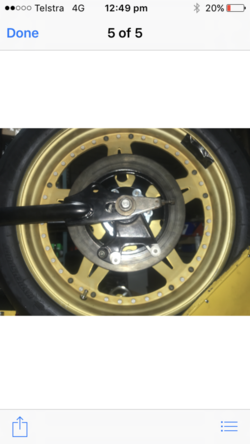
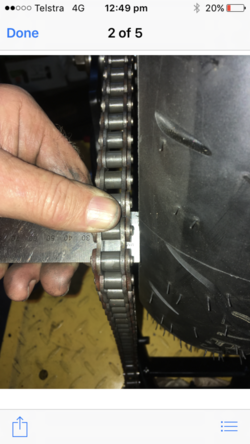
Astralite wheels are interesting. They weren't a bad wheel when they started making them back in the late 70's. They were arguably lighter and stronger than the cast wheels that were available at that time. The following is a bit of "off the cuff" engineering advice if you have Astralites.
They made the wheels that way so they could press the shapes out of plate rather than cast the wheel (solid aluminium plate was stronger than cast aluminium), but relying on rivets to hold the two halves together was something of a compromise.
Those Astralite wheels are now getting pretty old. The manufacturer probably never expected them to still be in use 40+ years later. Rivet failure is starting to become an issue (there's a lot of discussion on the Hesketh forum as they were original fitment to those bikes). The most common failure mode is fatigue cracking. The rivets simply break without warning and ping off into the distance. Or if you're lucky, they'll fall on your garage floor where you can see them before you get on the bike.
The rivets are under a lot of tensile load because of the tyre pressure. So use heaps of soap or rubber lube when fitting tyres because you don't wanna be over-inflating them to high pressures to seat the bead. If you do have trouble getting a bead to pop onto its seat and want to use anything north of about 40psi, use an air hose fitting that will stay on the tyre valve without you needing to hold it there with your hand, lay the wheel flat on the ground and stand well away from it - preferable behind a large tree! There's a massive amount of stored energy in an inflated tyre. People have been killed by exploding rims.
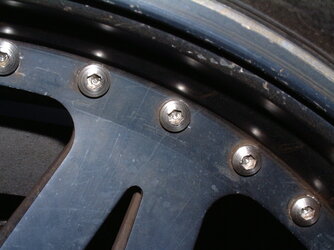
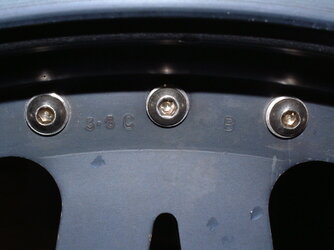
The original rivets were aluminium, 7.5mm dia. If you're going to replace them with bolts, you'll need to drill the holes out to 8mm. A grade 4.6 M8 steel bolt will have roughly the same tensile strength as the original 7.5mm aluminium rivet (because the thread only has a root diameter of about 6.5mm). But you may as well choose Grade 8.8 as the cost difference is bugger all and they're about twice the strength of 4.6. You can also do them up tighter so you'll end up with a stronger wheel.
As for what nuts to choose, you need to consider how to stop them coming loose. Nylocs might be OK, but they're not infallible so you'd wanna keep an eye on them. I'd go for normal hex nuts, cut the bolts off close to the nut then peen the bolt end over to stop the nut unscrewing. It'll look neater than nyloc and will be a more bullet-proof locking method. It's not as if you'll ever have to undo them again. Even if you do need to disassemble the wheel again (say for powder coating) just grind the threads back so you can undo the nuts, and replace with new bolts and nuts when you reassemble.
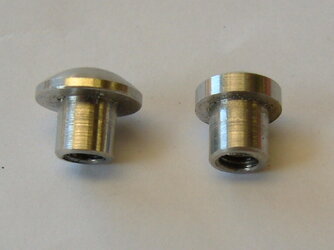
I fixed it by having some female bolts especially made from 316 stainless that I still had to modify on a lathe to reduce the outside dia.
By "female bolt" I assume Rob is referring to barrel nuts. His were custom made, but they're available "off the shelf".
Material: 304 Stainless Steel. One set included 1 piece Nut and 1 piece Bolt.
www.ebay.com.au
The problem with barrel nuts from an engineering standpoint is that they're generally used where a neat appearance rather than strength is the main requirement, so they're normally un-graded 304 stainless steel, so probably similar to a Grade 4.6 - 4.8 bolt, but you can never be sure there are some variables in the manufacturing and hardening processes that can affect the ultimate strength. I guess the choice you need to make is: Do I want a neat looking wheel or a strong one?
If appearance is important to you, I reckon you'd be OK with M8 barrel nuts, but an M8 barrel nut has a body diameter of about 9.5mm, so you'll need a bigger hole. The head diameter is 16mm.
An M6 barrel nut will fit an 8mm hole and has a head diameter of 14mm, so will probably look closer to the original appearance of the wheel, but the smaller M6 thread means a weaker fastening. I'd be reluctant to give an engineering opinion on the suitability of M6 barrel nuts for this purpose. My guess is that they may not be as strong as the original rivets.
Another thing to think about with barrel nuts is that you're pretty much restricted to thread locking compound to prevent them coming loose. You may need to go around with a pair of allen keys occasionally to make sure they're still all tight.
A final thing to think about when replacing Astralite rivets is the potential for corrosion. Unless you actually replace with new aluminium rivets, you'll have dissimilar metals. The aluminium will be sacrificial, so you could get some corrosion of the aluminium around the bolt holes. The best way to protect the wheels is to make sure you have a good paint or powder coat layer on the wheels before you bolt them up, and use a marine anti-corrosive compound on the bolts (eg. Duralac, available from boat chandlery stores).
Casting techniques must have improved since Astralites hit the market. Modern bikes have spindly little cast spokes that look about as substantial as a spider's web, but they evidently do the job.


 These wheels came from UK with bolts installed..........fair chance they have seen some salty roads..............!
Canny do that with Astralites